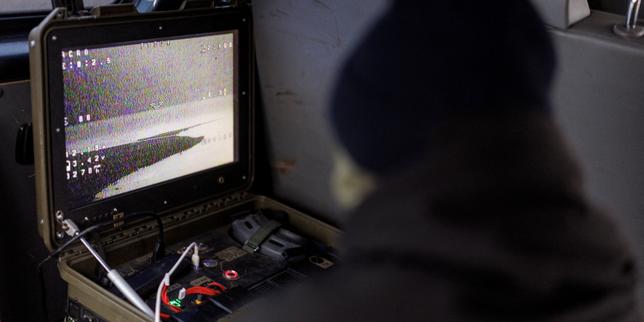
A cold wind whips through a basement in an undisclosed corner of Kyiv. There are no maps pinned to the walls with red yarn. There are no generals barking orders over clouds of cigar smoke. Instead, there is the soft, rhythmic hum of cooling fans and the blue-white glow of high-definition monitors reflecting off the weary eyes of twenty-somethings in hoodies.
One of them, let’s call him Mykola, isn't a soldier in the traditional sense. Two years ago, he was designing user interfaces for a fintech startup. Now, his cursor hovers over a satellite feed that has just refreshed. He isn't looking for a battalion. He is looking for a discrepancy—a patch of grass that looks slightly too uniform, a heat signature that shouldn't exist in a deserted village, or a Telegram post from a bored Russian private who couldn't resist showing off his lunch. Discover more on a connected topic: this related article.
This is the front line of a war being fought in bits and bytes before it is ever fought in blood. While the world watched for the roar of heavy bombers and the grinding gears of massive tank divisions, Ukraine quietly built something more terrifying: a digital nervous system.
The Death of the Fog of War
For centuries, commanders have struggled with the "fog of war." It is that agonizing uncertainty that comes from not knowing what is behind the next hill. In the old world, you sent a scout. If he didn't come back, you assumed the enemy was there. Today, the fog isn't being lifted; it is being digitized, analyzed, and dissolved in real-time. Further journalism by TechCrunch delves into comparable views on the subject.
Ukraine’s mastery of data isn't about having better hardware. It is about an architectural philosophy that favors the many over the few. While their adversary relies on a top-down, rigid Soviet-era command structure where information must travel up a long, vertical ladder to a general’s desk before a decision is made, Kyiv opted for a horizontal web.
Consider the Delta system. It is essentially a situational awareness platform that looks like something out of a high-end strategy game. It integrates data from every conceivable source: Starlink terminals, commercial satellite imagery, radio intercepts, and even chatbot reports from grandmothers in occupied territories who noticed a strange truck parked near a school.
When Mykola spots a target, he doesn't wait for a colonel to sign off. The coordinates are fed into the system and become visible to a drone pilot five miles away and an artillery battery ten miles in the opposite direction. The time it takes from "seeing" to "striking" has shrunk from hours to minutes.
It is a brutal, algorithmic efficiency.
The Civilian Code as a Weapon
The most striking part of this shift is how the boundary between civilian life and military necessity has simply evaporated. In the early days of the invasion, the Ukrainian government did something unprecedented. They updated "Diia," the national app used for digital IDs and paying parking tickets, to include a feature for reporting enemy troop movements.
Suddenly, every citizen with a smartphone became a sensor.
This isn't just about patriotism; it’s about data validation. If one person reports a tank, it might be a mistake. If fifty people in the same three-block radius report a tank, and a commercial satellite confirms a metallic mass at those coordinates, the data reaches a level of "ground truth" that is indisputable.
This is the democratization of intelligence. It turns an entire population into a singular, observant entity. But this shift carries a heavy psychological weight. When your morning commute involves checking an app to see if the road you're on has been flagged for incoming "data points," the trauma of war becomes a constant, digital hum in your pocket.
The Invisible Infrastructure
None of this would function without the umbilical cord provided by low-earth orbit satellites. When the traditional internet infrastructure was decimated by strikes, the war moved to the stars.
The reliance on Starlink and similar constellations changed the physics of the conflict. It meant that a unit huddled in a muddy trench in the Donbas had the same access to high-speed data as a command center in Lviv. They could stream 4K video from a reconnaissance drone directly to their tablets.
Imagine the dissonance. You are sitting in a hole in the earth that smells of wet clay and cordite, feeling like a soldier from 1917, yet you are holding the most sophisticated geographic information system ever devised. You are a 19th-century warrior with 21st-century eyes.
This creates a strange, disconnected reality. The "mastery of data" sounds clinical in a boardroom or an essay, but on the ground, it means a soldier can watch their own death or their own victory on a screen seconds before it happens in physical space.
The Algorithm of Survival
What happens when the enemy catches up? Information superiority is a fleeting ghost. The Russian military has pivoted, beginning to employ its own electronic warfare suites to "blind" these digital eyes. They are jamming signals, spoofing GPS coordinates, and attempting to flood the Ukrainian systems with "noise"—false data designed to trigger wasted strikes.
This has turned the war into a constant cycle of software updates. It is no longer just about who has the longer-range missile; it is about whose engineer can rewrite a line of code faster when a frequency gets jammed.
The stakes are invisible, but they are total. If the data stops flowing for even an hour, the Ukrainian "hive mind" breaks apart into isolated, vulnerable cells. The efficiency that allowed them to punch far above their weight class disappears, leaving only the raw, lopsided math of traditional attrition.
The Human Cost of Data
We often talk about data as something cold, but in a conflict zone, every data point is a human life. When an algorithm "optimizes" a strike path, it is deciding which house is destroyed and which is spared.
There is a danger in this digital mastery. It creates a sense of distance. When you see the world through a thermal camera or a series of icons on a map, the "enemy" becomes a cluster of pixels. The "objective" becomes a successful data handshake.
Mykola, back in his basement, knows this. He sees the icons disappear from the screen when a strike is successful. He knows that beneath that red dot, there were people. He knows that his ability to navigate a spreadsheet and a map interface has more lethality than a thousand rifles.
The mastery of the digital battlefield has saved Ukraine from an early collapse, but it has also ushered in an era where war is a constant stream of information that never sleeps. There is no longer a "rear" where one is safe, because if you are connected, you are visible. And if you are visible, you are a target.
The screen flickers. A new batch of data arrives from a drone over the south. Mykola rubs his eyes, sips his cold coffee, and starts the process again. The digital ghost continues its patrol, silent and all-seeing, waiting for the next discrepancy in the grass.
The blue light doesn't just illuminate the room; it carves out the shape of a future where we are all just nodes in a network we can no longer unplug.