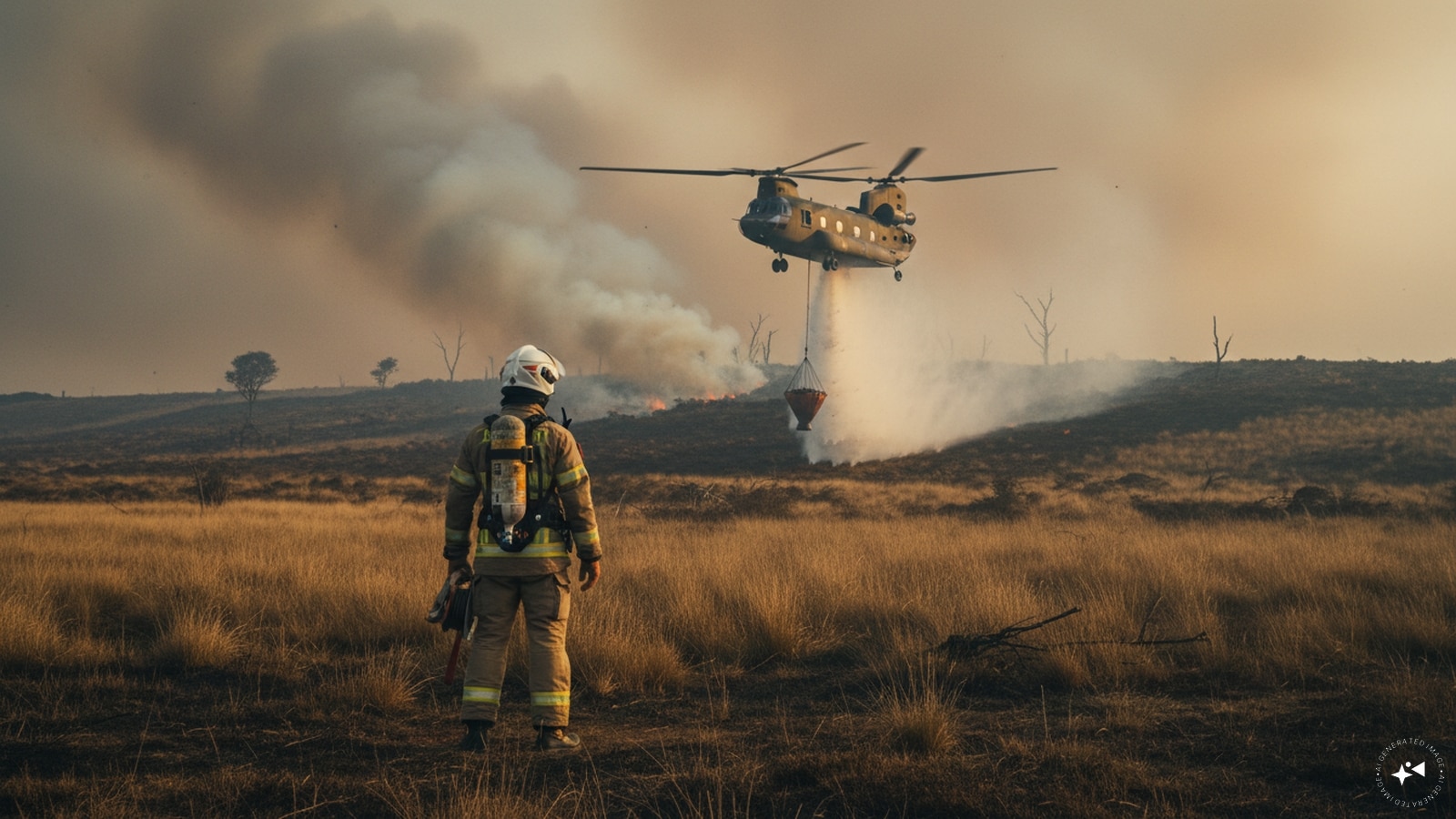
Dropping water from a military plane onto a raging wildfire feels decisive. It looks dramatic on the evening news. It also solves the wrong problem for £45 million.
Whenever a government announces a shiny new pot of money to throw heavy aviation at a wildfire threat, the lazy consensus applauds. Politicians look proactive. Defense contractors smile. Press releases fill up with talk of rapid response, aerial muscle, and modernizing crisis management. Yet anyone who has spent years studying fire behavior, land management, and emergency logistics knows the uncomfortable truth: aerial water drops do not extinguish major wildfires.
Firefighters on the ground do. Fuel management on the ground does.
Calling in military aircraft to fight wildfires in the United States, Southern Europe, Australia, or the United Kingdom is often sold as a breakthrough. In reality, it is frequently a high-cost distraction from unglamorous work that actually stops megafires before they start.
The Illusion of Aerial Firepower
Watch enough footage of a heavy air tanker or modified transport aircraft swooping low over a ridge and dumping thousands of gallons of water or retardant, and it is easy to assume the fire is beaten. That visual is deceptive.
Water has a fundamental physical limitation: it evaporates fast. When temperatures climb, relative humidity drops, and convective updrafts roar off a burning slope, a significant fraction of dropped water vaporizes before it ever touches burning fuel. Even when it hits the ground, water cools surface flames rather than permanently removing the fuel load. Hours later—sometimes minutes later—smoldering roots, duff layers, and wind gusts can bring the front right back to life.
Fire retardant lasts longer than plain water because chemical salts and thickeners help it cling to vegetation and slow combustion. That makes retardant useful for buying time, slowing rate of spread, or anchoring a line while ground crews work. It is a tool, not a silver bullet.
Aviation also hits hard operational walls that press releases conveniently gloss over.
- Visibility and smoke: Thick smoke plumes and inversion layers can ground aircraft or force pilots to fly too high for accurate drops.
- Wind and turbulence: Extreme fire behavior generates violent thermal updrafts and erratic wind shear that turn low-level flying into a high-risk maneuver.
- Turnaround bottlenecks: An aircraft is only effective when it is over the fire. Long transit times, reloading delays, and limited basing infrastructure slash effective drop frequency.
- Terrain and canopy: Dense tree canopies or deep valleys can shield surface fuels from aerial drops, leaving ground crews to do the hard, slow work of cutting containment lines.
I have watched agencies pour staggering sums into high-visibility response assets while starving ground operations of basic readiness, equipment maintenance, and preventative fuel reduction. When budgets are tight, glamour almost always beats maintenance in the court of public opinion. Nobody holds a press conference for clearing brush in February. Everyone watches a flyover in July.
What People Actually Ask When Wildfires Hit
When smoke fills the air or a major blaze makes headlines, the public tends to ask the same predictable questions. Most of them start from a flawed premise.
Do military aircraft actually put out wildfires?
Rarely on their own. Aircraft help slow spread, protect specific structures or ridges, and support ground crews in rugged terrain. Putting out a large, wind-driven wildfire requires containing the perimeter and starving it of fuel and heat—work that depends heavily on ground crews, dozers, hand lines, backburns, and favorable weather shifts. Treating aircraft as a standalone fire-killer mistakes dramatic optics for tactical victory.
Why wouldn't a government spend tens of millions on aerial response?
Because visibility is politically rewarding and prevention is politically thankless. If you spend £45 million on military aviation support and a bad fire season still happens, officials can point to aircraft flying sorties and say everything possible was done. If you spend £45 million on prescribed burning, mechanical fuel thinning, community defensible space, and ground crew capacity, and no catastrophic fire hits that specific valley, nobody throws a parade for the fire that did not happen.
Is using military assets faster than civilian or local options?
Not automatically. Military platforms bring lift capacity, rugged logistics, and personnel depth, yet converting or tasking military aircraft for wildfire missions involves airworthiness checks, specialized drop equipment or systems, crew training, airspace coordination, and command-and-control alignment with civilian fire agencies. Speed on paper is not speed over the flame if integration lags behind.
What should money go toward instead?
Start before ignition. Once a fire is burning under extreme drought and high wind, options shrink fast. Money spent reducing fuel continuity, managing overgrown landscapes, hardening homes and critical infrastructure, and building resilient ground teams pays off across the entire fire cycle—not just during a crisis photo op.
The Physics and Economics Nobody Wants to Hear
Wildfire behavior is governed by three basic variables: fuel, weather, and topography—often summarized as the fire behavior triangle. Aircraft do not change the weather. They do not reshape steep canyons. At best, they briefly alter fuel moisture or flammability along a narrow strip.
If fuel loads have been allowed to accumulate unchecked for decades, dropping water on the flaming edge is like putting a band-aid on a burst pipe. You might slow the leak for a moment, yet the pressure behind it remains untouched.
Consider the economics of aircraft hours versus ground capacity. Heavy aviation carries steep hourly operating costs, maintenance demands, crew requirements, and standby expenses. Even when aircraft are available, they cannot work at night in many conditions, cannot easily penetrate heavy smoke in steep terrain, and cannot hold a line on their own once the drop dries out.
Ground crews, by contrast, dig mineral soil down to bare earth to break fuel continuity, mop up hot spots deep inside the burn scar so embers do not blow across containment lines, and conduct controlled burns during safer windows to reduce future hazard. It is dirty, exhausting, unglamorous work. It is also indispensable.
Imagine a scenario where a regional authority faces a £45 million budget decision ahead of a drier-than-average summer. Option A buys high-profile aerial sorties and rapid-response aviation standby, delivering dramatic capability on paper but leaving surrounding woodlands choked with dry brush and ground crews stretched thin. Option B funds targeted fuel breaks around vulnerable settlements, expands prescribed fire and mechanical thinning teams, upgrades local water supply and access roads, and funds targeted aviation support strictly where terrain demands it. Option A looks tougher in a headline. Option B actually lowers the odds of a catastrophe getting out of control.
Precision Terms That Expose Lazy Thinking
Public debate around wildfires gets muddied by sloppy language. Precision clears the fog.
- Suppression vs. Mitigation: Suppression is fighting an active fire to put it out or contain it. Mitigation is reducing risk and fuel hazard before a fire starts or before it threatens lives and property. Confusing the two leads governments to over-invest in late-stage reaction and under-invest in early-stage prevention.
- Containment vs. Extinguishment: Containment means surrounding a fire with a control line—natural or constructed—that it is not expected to breach. A fire can be 100% contained while still burning intensely inside its perimeter. Aircraft can assist containment; they rarely achieve final extinguishment alone.
- Initial Attack vs. Extended Attack: Initial attack is the rapid response aimed at catching a small fire early while it is still manageable. Extended attack happens when a fire escapes initial containment and grows into a larger, more complex event. Heavy aircraft often shine most when supporting coordinated initial attack or protecting key assets—not when trying to out-muscle a massive, wind-driven fire front by brute force.
Researchers and operational fire analysts such as Stephen Pyne, whose histories and analyses of fire ecology and fire management have shaped modern understanding of how societies live with fire, have long pointed out that treating fire purely as an enemy to be bombed into submission ignores how landscapes and fire regimes actually work. When policy treats fire solely as a military-style emergency rather than an ecological and land-management challenge, the strategy becomes reactive by design.
Where My Contrarian Stance Can Backfire
A sharp contrarian take is only credible if it admits its own blind spots. Going all-in on "skip the aircraft, focus on the ground" has real risks if taken too far.
First, geography matters. In steep, roadless, or heavily fragmented terrain—or around isolated ridges and critical infrastructure—aerial drops can buy precious minutes for ground crews or residents evacuating narrow routes. Abandoning aerial capability completely can leave gaps in fast-moving initial attack.
Second, prescribed burning and fuel reduction carry their own hazards. Smoke impacts air quality and public health. Escaped controlled burns happen. Ecological rules and weather windows limit when work can safely take place. You cannot simply wave a wand and clear every acre overnight.
Third, public expectations are real. Communities under threat want to see visible action overhead. While policy should never be driven purely by optics, ignoring operational realities on the ground during an active emergency is just as foolish as ignoring prevention during peacetime.
The right move is not pretending aircraft have zero value. The right move is stopping the fantasy that £45 million worth of flying hardware fixes decades of fuel accumulation and under-resourced ground operations.
Stop Buying Headlines and Start Managing Fuel
If decision-makers actually want fewer out-of-control wildfires rather than better television footage, the playbook is straightforward—even if it lacks drama.
- Audit spending between flash and function. Compare every pound going toward high-visibility emergency response against what goes into year-round fuel management, ground readiness, and landscape resilience.
- Prioritize fuel breaks where people and infrastructure meet wildland. Protect the wildland-urban interface systematically instead of relying on last-minute heroics when flames are already at the fence line.
- Treat aircraft as a force multiplier, not a cure. Define clear tactical roles for aviation—supporting initial attack, protecting specific chokepoints, aiding ground crews—rather than selling it as a magic shield.
- Measure success by prevented disasters, not dramatic sorties. A quiet season with well-managed fuels and strong ground teams is a win, even if nobody gets a thrilling clip for the news.
Spend the money on the ground before the match is struck.