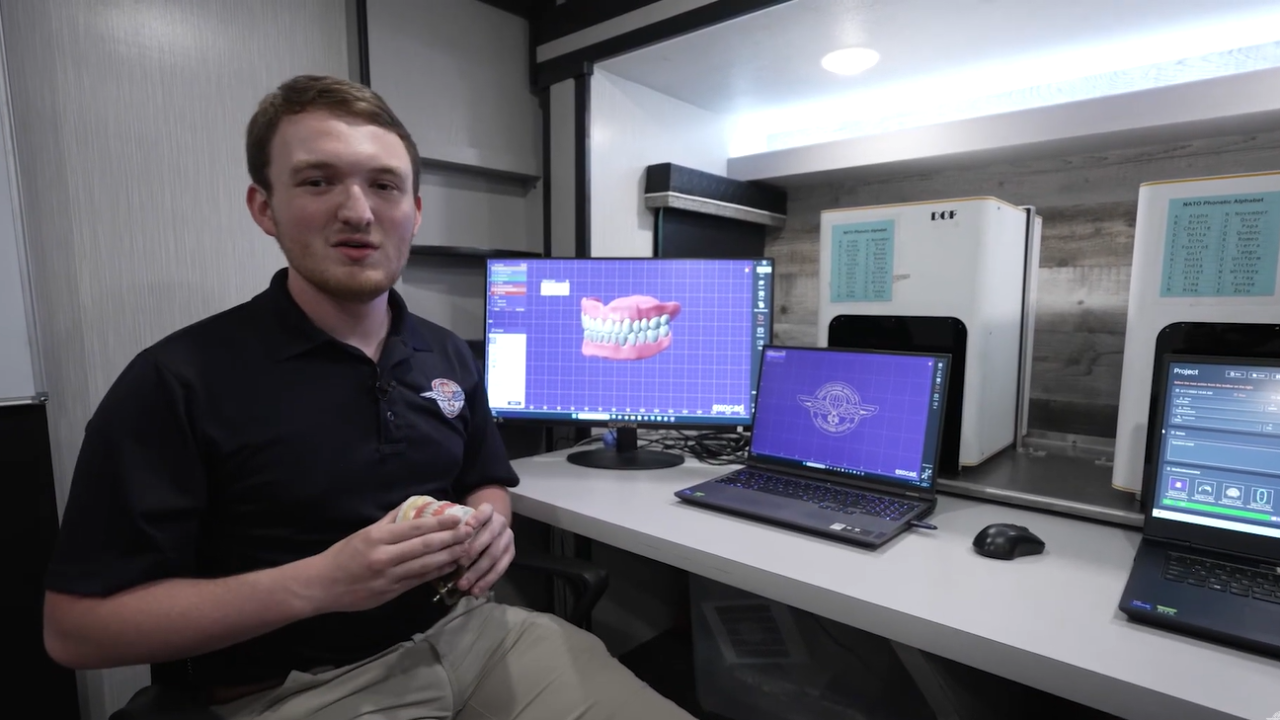
Millions of Americans walk through life hiding their mouths behind their hands, victims of an invisible healthcare emergency where basic dental care remains a luxury reserved for the affluent. More than seventy million adults across the United States live without dental insurance. Medicare flatly refuses to cover routine dental work, leaving a vast demographic stranded in chronic pain and social isolation. Into this institutional void stepped Connor Gibson, a young Tennessee engineer who looked at an archaic, month-long medical manufacturing process and completely dismantled it. Working alongside the nonprofit Remote Area Medical, Gibson built the country's first mobile digital denture laboratory, turning high-end 3D printing into an instrument of basic human dignity that turns out custom prosthetics in a matter of hours.
The traditional path to getting replacement teeth is an exercise in administrative and financial attrition. Traditional dental laboratories rely on physical impressions, plaster molds, and multi-stage bite registrations that require weeks of transit and multiple clinical appointments. For an uninsured worker earning minimum wage, paying thousands of dollars out of pocket is impossible.
Gibson changed the baseline mechanics of the operation. He had no formal training in dental anatomy when he started volunteering with the organization. Armed with a background in computer-aided design from Walters State Community College, he approached the software and hardware like an engineering puzzle.
He spent months studying complex dental terminology, jaw mechanics, and digital polymer layering. Commercial vendors at early industry conventions initially dismissed him, viewing a young volunteer as an outlier with no commercial standing. He ignored the professional skepticism, secured initial grants for industrial printers, and optimized a workflow that converts digital patient scans directly into printable resin files.
Inside a retrofitted mobile lab parked outside weekend pop-up clinics, the manufacturing cycle operates around the clock. Two printers hum continuously while patients wait outside on folding chairs, enduring hours of anticipation for a service they thought was permanently out of reach. Gibson frequently sleeps on a cot inside the cramped trailer while the print beds move back and forth, layering biocompatible resins into functional arches. His personal output reached thirty-five sets of custom dentures during a single chaotic weekend.
The technical achievement, however, masks a deeper institutional failure. Relying on volunteer engineering feats and donated hardware to plug holes in the domestic social safety net is a band-aid on a systemic hemorrhage. The demand routinely overwhelms supply lines. Hundreds of patients line up before dawn at every clinic site, and the mobile lab must turn away dozens of individuals when capacity maxes out.
Yet for those who make the cut, the physical transformation is immediate. Gibson refers to the delivery phase as mirror moments, watching hardened workers and elderly individuals break down in tears when they finally see a complete smile reflected back at them. These reactions capture the brutal psychological toll of tooth loss, which impacts everything from nutritional intake to job prospects.
Expansion efforts are underway to scale the operation from a single mobile lab to a dedicated fleet of three units, which could push production past one hundred sets per weekend. Major printer manufacturers have started donating advanced equipment following national media exposure, shifting public awareness toward the chronic underfunding of dental access. Even so, technology alone cannot outpace a population-wide crisis driven by systemic poverty and medical exclusion.
The machines keep running through the night in the Tennessee hills, bridging a gap that the healthcare establishment refuses to fix.


