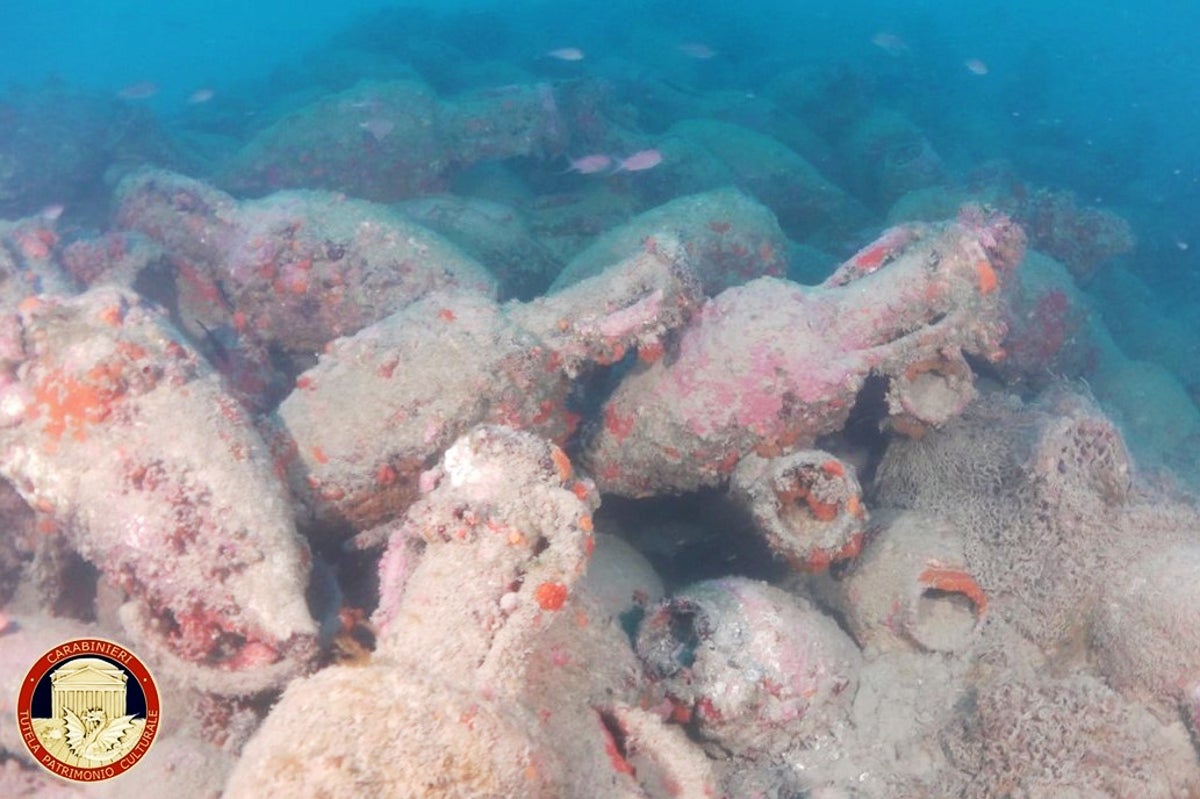
Archaeological marine operations off the coast of Sicily have yielded a remarkably preserved ancient Roman shipwreck dating back more than two thousand years, resting in the depths near the town of Terrasini.
Divers and marine researchers operating under the supervision of the Superintendency of the Sea for the Region of Sicily confirmed the find, which sits at a depth of roughly fifty meters. The cargo consists primarily of amphorae, the standard ceramic transport jars used throughout the Mediterranean basin to haul commodities such as olive oil, wine, and fish paste. This discovery provides concrete physical evidence of the vast maritime trade networks that powered the Roman Republic and Empire during an era of intense commercial expansion.
Beneath the calm blue surface of the Mediterranean lies a vast, unmapped archive of antiquity. Wood rots, metals oxidize, and organic matter vanishes within decades. Ceramics survive. Thousands of clay containers resting on a silent seabed tell a story of economic ambition, maritime risk, and the sheer logistical weight required to sustain an empire centered around a single inland sea.
The Logistics of Mediterranean Commerce
Roman maritime trade was an exercise in calculated risk. Shipowners pushed vessels out onto open water carrying hundreds of tons of cargo without the aid of modern navigational instruments. They relied on dead reckoning, celestial navigation, and an intimate, generational knowledge of seasonal wind patterns.
When a vessel went down, it represented a catastrophic financial loss for the merchants involved. Yet, it also created a time capsule for modern researchers.
The shipwreck discovered off Terrasini is significant not merely because it is old, but because of the integrity of its cargo field. Many ancient wrecks were salvaged in antiquity or looted by modern treasure hunters before authorities could secure the site. This specific hull appears largely undisturbed. The amphorae remain stacked in the precise configuration dictated by ancient dockworkers in a bustling port two millennia ago.
Marine archaeologists employ photogrammetry and high-resolution side-scan sonar to map these sites before moving a single artifact. Every jar holds chemical signatures of its original contents. Residue analysis of the porous terracotta walls reveals molecular traces of ancient wines spiced with resin, or high-grade olive oil produced in distant provinces. These details transform a pile of broken pottery into a precise ledger of ancient supply chains.
Why Deep Water Preserves History
Shallow waters destroy history. Wave action, shifting sands, and the relentless pounding of winter storms break ancient wooden hulls into unrecognizable splinters. Relics scatter across the ocean floor, stripped of their archaeological context.
Depth is a preservationist's best ally.
At fifty meters, the water column filters out violent surface turbulence. Sunlight diminishes, slowing biological growth that might otherwise compromise delicate organic materials. Low oxygen levels in certain underwater pockets further inhibit the bacteria responsible for wood decay.
The Terrasini wreck benefits from this protective marine layer. While the exposed timber of the upper deck structures likely succumbed to marine borers centuries ago, the lower hull timbers buried beneath layers of sediment hold immense promise. Dendrochronological analysis of these wood samples can pinpoint the exact decade the trees were harvested to build the ship, often narrowing down the origin of the shipyard itself.
Ancient shipbuilders did not work from standardized blueprints. Every hull was an individual creation, shaped by local timber availability and regional engineering traditions. Examining the construction techniques used in this Sicilian vessel offers insight into shipwright guilds that left behind no written manuals.
The Threat of Modern Maritime Looting
Discovery brings peril. The moment coordinates of a significant archaeological site leak into the public domain, the threat of illicit salvage multiplies.
Black-market antiquities dealers place high monetary values on intact Roman amphorae. Unscrupulous divers equipped with breathing apparatuses and underwater metal detectors routinely target unprotected wrecks, smashing through fragile stratigraphy to grab prize artifacts while destroying the scientific context forever.
The Sicilian regional government faces a perpetual challenge in patrolling thousands of kilometers of rugged coastline. Protection requires a combination of electronic surveillance, rapid response maritime police units, and community engagement with local fishermen and diving clubs.
When an amphora is ripped from a site without professional documentation, humanity loses the spatial data associated with it. Archaeologists must know the exact angle of the jar, its relationship to adjacent structural timbers, and the sediment layer in which it rested. Without this context, an ancient artifact is reduced to an expensive decorative paperweight stripped of its historical narrative.
Shifting Paradigms in Marine Archaeology
For decades, underwater exploration was an elite endeavor dominated by heavily funded state institutions and famous names with deep-pocketed sponsors. That dynamic has fractured.
Advances in autonomous underwater vehicles and consumer-grade sonar have democratized marine discovery. Independent diving teams and local history enthusiasts now locate significant finds using commercial equipment that costs a fraction of traditional oceanographic gear.
This technological shift creates regulatory friction. State agencies struggle to keep pace with independent discoveries, leading to friction between amateur explorers eager for recognition and bureaucratic authorities tasked with legal protection of cultural heritage.
The Terrasini find demonstrates the value of cooperation. Local divers reported anomalies on their sonar screens to the proper authorities rather than attempting unauthorized recovery. That single ethical choice preserved a critical piece of Mediterranean history for academic study and public exhibition.
What the Cargo Reveals About Empire
Roman expansion was fundamentally logistical. Armies required grain, olive oil, and wine wherever they marched. Fleets required timber, pitch, and hemp. The sheer volume of material moving through the Mediterranean dwarfed anything seen since the Bronze Age.
Every amphora type corresponds to a specific production center. Certain shapes indicate origin points in the Iberian Peninsula, while others point toward North Africa or the Greek islands. By mapping the distribution of these ceramic vessels across various shipwreck sites, historians trace the economic shifts of the Roman economy over centuries.
When a ship sank off the coast of Sicily carrying a specific vintage of wine or brand of oil, it mapped the trade routes of an interconnected globalized world that operated long before the advent of steamships or digital communication.
The sea guards its secrets well, but modern science continues to pry open the chests of antiquity one shipwreck at a time. The discovery near Terrasini is not an isolated event, but another data point in an ongoing effort to map the human footprint across the ancient world.
The silent hull rests in the cold darkness, waiting for the next phase of excavation to bring its forgotten voyage back into the light.


