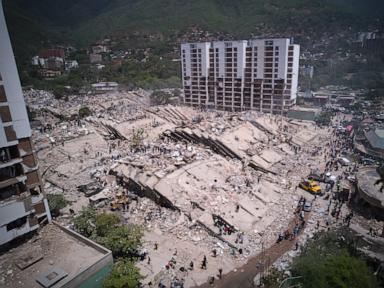
Disaster coverage follows a script written by bureaucrats and read by people who have never moved a metric ton of concrete.
Right now, the international media is fixated on Caracas and the surrounding region following the twin earthquakes. The headlines all repeat the same panic-inducing phrase like a mantra: The 72-hour window is closing. They tell us that after three days, the timeline for rescuing survivors narrows to near-zero. For another look, check out: this related article.
This is a fundamental misunderstanding of structural collapse logistics. It creates a false urgency that kills people, misallocates millions in international aid, and forces rescue teams to make reckless decisions based on arbitrary numbers rather than physical reality.
The 72-hour rule is not a scientific absolute. It is a statistical average derived from completely different urban environments, lazily applied to a complex local crisis. By treating this window as a hard deadline, the global community ensures the next phase of the recovery will be a logistical failure. Related insight on this trend has been published by USA Today.
The Myth of the Flatline
The obsession with the first three days assumes that survival probability drops off a cliff at exactly 72 hours. It does not.
In structural engineering and search-and-rescue mechanics, survival is determined by three variables: void space creation, ambient temperature, and access to air. It is not determined by the rotation of the earth.
- Void Spaces: When concrete frames collapse, they do not pulverize into sand. They shear. They create triangles of life. If a victim is inside a well-formed void, their survival timeline is dictated by dehydration, not the clock.
- The Dehydration Reality: Human physiology under stress can endure five, seven, or even ten days without water under specific conditions—such as the high humidity and cool subterranean temperatures often found beneath collapsed masonry.
- Historical Precedent: We saw survivors pulled from the rubble eleven days after the 2010 Haiti earthquake. We saw rescues two weeks after the 2023 Turkey-Syria disasters.
When international agencies scream that the window is closing, they signal to local authorities that it is time to bring in the heavy machinery. That is where the real tragedy begins.
Bringing excavators and bulldozers onto a pile too early shifts the rubble, collapses the remaining void spaces, and suffocates the people who were surviving perfectly fine in the dark. The rush to beat an arbitrary clock is often what seals the fate of those trapped beneath.
Why the Wrong Aid Arrives Too Late
I have watched international aid operations stumble over their own feet across multiple continents. The same playbook is being deployed right now, and it is failing the people on the ground.
The standard response to a major earthquake is to fly in urban search and rescue teams from thousands of miles away. These teams are highly trained, incredibly well-equipped, and almost entirely useless if they arrive on day three.
Consider the math of international deployment. By the time a team in Europe or North America mobilizes, secures airspace clearances, flies into a disrupted airport, and transports tons of gear to the impact zone, the clock has already run out on their supposed 72-hour utility. They spend millions of dollars to arrive exactly when the media says hope is lost.
The real work of saving lives during the initial phase is always done by neighbors, local civil defense, and immediate bystanders using shovels, crowbars, and bare hands. Data from global seismic events consistently shows that over 90% of extracted survivors are rescued by locals within the first 24 hours.
The millions spent flying elite foreign teams across hemispheres would be infinitely more effective if invested in regional training and decentralized equipment caches before the ground ever shakes. But prevention does not make for compelling television.
The Brutal Math of Resource Allocation
Here is the uncomfortable truth that nobody in a press briefing wants to admit: treating every site as equally salvageable because of a ticking clock is a waste of scarce resources.
Effective disaster management requires cold, algorithmic triage.
[Total Available Rescue Assets]
       /               \
[High-Yield Sites]    [Low-Yield Sites]
(Modern Concrete)     (Informal Adobe/Mud)
       |                       |
PRIORITIZE ASSETS       MINIMAL ASSETS
Imagine a scenario where a rescue coordinator has two teams left. Site A is a collapsed modern apartment complex with reinforced concrete slabs. Site B is an informal settlement characterized by unreinforced masonry and mud-brick structures.
The conventional narrative demands equal effort for both because "every second counts." The insider reality dictates that Site B is a graveyard; unreinforced masonry disintegrates, filling voids and suffocating occupants instantly. Site A, however, contains structural voids that can maintain life for a week.
If you chase the 72-hour myth, you split your forces equally, burning through your personnel's stamina on unviable sites while neglecting the locations where people are actually alive, waiting for methodical, slow extraction.
The downside to this contrarian approach is obvious: it requires writing off certain areas immediately. It looks heartless on social media. It causes political outrage. But it saves the maximum number of salvageable lives.
Dismantling the Debris Narrative
When people look at disaster coverage, they ask the wrong questions. The standard query is always: How can we get more search dogs and sonar equipment into the zone?
The better question is: Why is the local electrical grid still live in three sectors, and why hasn't heavy shoring timber been prioritized over medical tents?
High-tech tools like thermal imaging and acoustic sensors look impressive in b-roll footage. In reality, they are notoriously unreliable in dense, urban noise environments filled with running generators, heavy equipment, and shifting debris. They give false positives that waste hours of meticulous digging.
What rescues people between day three and day seven is not technology. It is labor-intensive, exhausting, manual shoring—tunneling through concrete using wood beams to stabilize the path behind you. It is slow. It is ugly. It ignores the cameras.
Stop Planning for the Last Disaster
The coverage of the Venezuelan quakes treats the event as an isolated meteorological surprise. This framing allows governments to blame nature for what is ultimately a failure of governance and engineering.
Earthquakes do not kill people. Bad buildings kill people.
The lazy consensus focuses entirely on the response phase because it absolves the structural engineering community and local regulatory bodies of their long-term failures. We are told to mourn the tragedy and donate to emergency funds, rather than asking why buildings constructed in known seismic zones lacked the basic ductile detailing required to prevent total pancake collapse.
If we continue to view disaster management through the lens of a frantic 72-hour sprint, we will remain trapped in this cycle. We will keep sending planes filled with sniffer dogs to land on broken runways three days too late, while the real solutions—zoning enforcement, local response capacity, and realistic long-term extraction strategies—remain completely unfunded.
Stop looking at the clock. Start looking at the structures.