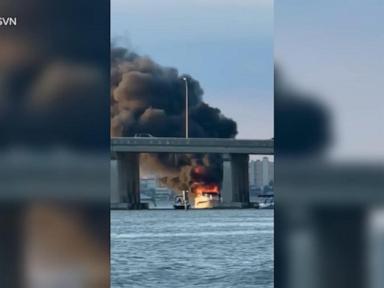
The Atlantic Ocean off Miami Beach has a specific hue in the mid-afternoon. It is a blinding, postcard blue that tricks you into believing nothing bad could ever happen inside it. The water looks solid, almost like concrete painted turquoise, moving only to lap gently against the fiberglass hulls of weekend cruisers. When you are out there, the city skyline becomes a distant fence of glass and steel. The noise of traffic fades. The air smells exclusively of salt and expensive sunscreen. It feels like the safest place on earth.
It is a lie, of course. The sea never truly loses its capacity for violence; it just changes the method of delivery.
On a standard Saturday, two boaters found out how quickly that postcard can melt. They were doing what thousands of people do every weekend in South Florida—skimming across the water, the engine humming a comforting, mechanical rhythm beneath their feet. Then, the rhythm stopped. The air changed.
Within minutes, their vessel was not a vehicle, but a furnace.
We often treat boat safety as a bureaucratic chore. We buy the life jackets because the law requires it. We check the fire extinguishers because a coast guard inspection might result in a fine. We look at statistics about marine accidents and assume they belong to someone else—the inexperienced, the reckless, the unlucky. But the line between a perfect day on the water and a desperate swim for survival is thinner than a sheet of marine-grade plywood.
The Chemistry of a Sudden Crisis
To understand what happened off the coast of Miami, you have to understand the claustrophobia of a boat fire. On land, when something catches fire, your instinct is to run outside. Space expands. You step away from the building, onto the grass, across the street.
On a boat, the math reverses.
A vessel is a self-contained ecosystem floating on an element that will drown you, packed with the very ingredients required to create a bomb. You are sitting on dozens, sometimes hundreds, of gallons of highly flammable fuel. The structure itself is often made of fiberglass resin, which doesn't just burn—it liquefies, releasing a thick, choking black smoke that blinds you before the heat even reaches your skin. When fire breaks out on the water, outside is not safety. Outside is the ocean. You are trapped between two different kinds of infinity.
Consider the mechanics of the engine compartment. It is a dark, cramped space beneath the deck where fuel lines, electrical wiring, and intense heat coexist in perpetuity. All it takes is a single hairline crack in a fuel hose. A microscopic spray of gasoline vapor hits a hot exhaust manifold. A rogue spark from an aging alternator jumps across the gap.
Panic doesn't happen in stages. It arrives all at once. One second you are steering toward the horizon; the next, the deck beneath your deckshoes is uncomfortably warm, and the unmistakable scent of burning plastic is filling your lungs.
By the time the smoke billowed high enough to be seen from the luxury high-rises lining Miami Beach, the two boaters had already made the only decision that mattered. They abandoned ship.
The Phantom Safety Net
There is a common misconception among casual boaters that help is always a phone call away. We live in an era of hyper-connectivity. We assume our smartphones, wrapped in waterproof cases, give us a permanent tether to civilization.
But the ocean degrades signals. Wet fingers fumble on touchscreens. If the boat’s electrical system dies—which it does, almost immediately, when a fire originates in the engine bay—your mounted VHF radio becomes a useless piece of gray plastic. You cannot easily type a text message when the air around you is four hundred degrees and turning black.
When the distress call finally went out, it triggered a massive, coordinated response. Miami-Dade Fire Rescue, the U.S. Coast Guard, and local marine patrol units scrambled. Watching the footage captured by onlookers from the shore, the scene looks cinematic. Red fireboats slicing through the wake, shooting massive plumes of water onto a blackened, crumbling hull.
But those rescue boats take time to arrive. Minutes feel like hours when you are treading water, watching the vessel you owned turn into ash and sink into the Atlantic shelf.
The real heroes of these scenarios are rarely the ones with the flashing lights. They are the strangers.
In busy waters like the channels off Miami, survival often relies on the unwritten code of the sea: the law of merchant marine and recreational fellowship. Another boater, seeing the column of smoke rising like a black marker pen against the blue sky, alters course. They don't wait for the Coast Guard. They don't calculate the fuel cost. They push the throttle forward because they know, with absolute certainty, that next weekend it could be them waiting in the water.
The two individuals in Miami were pulled from the sea by Good Samaritans before the fire crews even arrived to douse the flames. They were uninjured, physically at least. But the psychological transition from a leisurely cruise to a survival situation leaves a permanent mark. You never look at the water the same way again.
The Anatomy of the Aftermath
Once the smoke clears, the reality of the loss sets in. A boat fire is rarely a partial disaster. Unlike a house, where a kitchen fire can be contained behind a closed door, a marine fire almost always ends in total destruction. The hull burns down to the waterline, cracks open, and the ocean claims the rest.
What remains is a series of questions that investigators must piece together from scorched fragments. Was the blower system running to vent fuel vapors before the engine started? When was the last time the fuel filters were changed?
The uncomfortable truth of recreational boating is that maintenance is often reactive rather than proactive. We fix things when they break, not when they are tired. In a car, an engine failure means pulling over to the shoulder and waiting for a tow truck. On the water, an engine failure is a prelude to a crisis.
Every year, the Coast Guard releases pages of data detailing marine casualties. The numbers are sterile. They tell us how many accidents occurred, how many injuries were sustained, and the estimated dollar value of the property damage. What they omit is the human terror of the moment the floorboards flash with light. They omit the sound of fiberglass cracking under intense heat, a sound that resembles small fireworks exploding underwater.
We read these news snippets over breakfast—two boaters safe, vessel lost—and we turn the page. We treat it as a traffic report from the sea. But for the two people who stood on the deck of that burning craft, the world shrunk down to a single, primal choice: stay and burn, or jump and swim.
The boat is gone. The water off Miami Beach has already swallowed the debris, washed over the oil slick, and returned to that deceptive, perfect shade of turquoise. The skyline still glitters in the afternoon sun. But beneath the surface of that beautiful afternoon lies a stark reminder of our own fragility when we choose to leave the shore behind.


_Biopsy.png?branch=uat_release_3)
