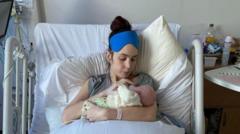
Stop Calling It a Miracle: The Dangerous Myth of "Quad Quadruplets"
The headlines love a good fairytale. An Australian mother gives birth to naturally conceived identical quadruplets—a one-in-64-million occurrence. Cue the heartwarming baby photos, the viral social media posts, and the gushing morning show interviews celebrating a medical "miracle."
It is a comforting narrative. It is also a deeply irresponsible one.
When mainstream media romanticizes hyper-rare, high-order multiple pregnancies, it sells a fantasy that ignores the brutal biological reality. Splitting a single fertilized egg into four identical embryos is not a blessing from the universe; it is a chaotic cellular anomaly that places both the mother and every single fetus at extreme risk.
By framing high-order multiples as uplifting human-interest stories, we trivialize a severe medical crisis. We hide the harrowing realities of extreme prematurity, lifelong neurological complications, and agonizing clinical decisions under a blanket of pastel-colored sentimentality.
It is time to strip away the feel-good fluff and look at the brutal physiology.
The Biological Nightmare of Monochorionic Pregnancies
Let us get the terminology straight. Broadcasters use terms like "identical quads" as if it were a fun genetic party trick. Maternal-fetal medicine specialists call it what it actually is: a clinical disaster zone.
When a single zygote divides into four identical fetuses, they frequently share a placenta. In medical terms, this is a monochorionic pregnancy. Shared vascular networks mean these developing fetuses are literally competing against each other for survival every second of every day.
The Vascular War Zone
In a shared placenta, blood vessels form abnormal bridges between the fetuses. This leads directly to Twin-to-Twin Transfusion Syndrome (TTTS) or, in the case of quadruplets, Multiple Transfusion Syndrome. One fetus acts as a donor, pumping its own blood to its siblings, becoming severely anemic and growth-restricted. The recipient fetus receives too much blood, straining its heart to the point of acute heart failure.
I have spoken with high-risk obstetricians who have spent endless nights in the ICU managing these cases. The physical strain on the maternal body is overwhelming. We are talking about:
- Extreme Preeclampsia: Spiking maternal blood pressure that risks stroke, organ failure, and seizures.
- Uterine Rupture: The human uterus is simply not designed to stretch to accommodate four growing bodies simultaneously.
- Gestational Diabetes and Severe Anemia: The maternal metabolic system is pushed past its absolute physiological breaking point.
To present this survival gauntlet as a magical win is an insult to the mothers who endure it and the clinicians who battle to keep everyone alive.
The Unspoken Mandate: Selective Reduction
Here is the inconvenient truth that happy news segments intentionally leave on the cutting room floor: In almost every high-order multiple pregnancy, doctors explicitly advise selective reduction.
When an ultrasound reveals three, four, or more embryos, the standard clinical recommendation is not to celebrate. It is to reduce the number of fetuses—typically down to twins—to give the remaining children a reasonable chance at reaching full term without severe, life-altering disabilities.
+------------------------+------------------------------------+-------------------------------------+
| Outcome Metric         | High-Order Multiples (Quadruplets) | Reduced Pregnancy (Twin Target)     |
+------------------------+------------------------------------+-------------------------------------+
| Average Gestation      | ~28 to 31 Weeks                    | ~35 to 36 Weeks                     |
| NICU Stay Duration     | Months (High risk of complications)| Weeks (Low to moderate risk)        |
| Risk of Cerebral Palsy | Exponentially Higher               | Significantly Lower                 |
+------------------------+------------------------------------+-------------------------------------+
Parents face a soul-crushing dilemma. Do they reduce two fetuses to save the remaining two? Or do they gamble on keeping all four, knowing that doing so radically increases the risk that all four could die, or suffer permanent neurological damage due to extreme premature birth?
When a family declines selective reduction and somehow manages to deliver four living infants, the media crowns them as heroes who beat the odds. But they did not change the biology; they simply won a high-stakes genetic roulette game where the chips were their children's long-term health.
Promoting these rare success stories creates a false sense of security for other parents faced with these devastating choices.
The Lifetime Price of Extreme Prematurity
Let us talk about what happens after the cameras leave.
Quadruplets are almost never born anywhere near full term. Most arrive around 28 to 31 weeks, often via emergency C-section. A baby born at 29 weeks does not just go to a nursery; they spend months in a Neonatal Intensive Care Unit (NICU), hooked to ventilators, feeding tubes, and monitors.
The long-term consequences of this forced early entry into the world are not subtle:
- Cerebral Palsy and Intraventricular Hemorrhage: Premature infants have delicate blood vessels in the brain that are prone to rupturing. Brain bleeds lead directly to long-term motor and cognitive deficits.
- Chronic Lung Disease: Immature lungs require mechanical ventilation, which can cause permanent scarring and lifelong respiratory issues.
- Retinopathy of Prematurity: The abnormal growth of blood vessels in the eyes can cause permanent blindness.
While the media shows a photo of four tiny babies wrapped in blankets, they leave out the lifelong physical therapy, the specialized education plans, the tens of thousands of dollars in medical bills, and the overwhelming emotional toll on the family structure.
The Media’s Exploitation of "Miracles"
Why do media outlets continuously push this narrative? Because "Miracle Quadruplets Born Healthy" gets millions of clicks. "High-Risk Pregnancy Ends in Complex NICU Battle" does not sell ad space.
This sensationalism distorts public perception of reproductive health. It leads people to believe that modern medicine can easily handle any pregnancy volume, ignoring the physical limitations of human anatomy.
It also creates toxic pressure on expectant parents. Parents facing a high-order multiple diagnosis are bombarded with these "miracle" headlines, making them feel like failures or villains if they choose the clinically safer path of selective reduction.
We need to stop feeding into this sensationalist cycle.
A quadruplet birth is not an uplifting fairytale. It is a severe clinical emergency that requires miraculous skill from pediatric teams, unimaginable luck, and a massive physical sacrifice from the mother. Celebrating the outcome without acknowledging the terrifying risk is pure negligence.
Next time you see a viral story about "miracle quads," do not share it. Do not gush over it. Recognize it for what it truly is: a biological crisis that a family was lucky enough to survive.