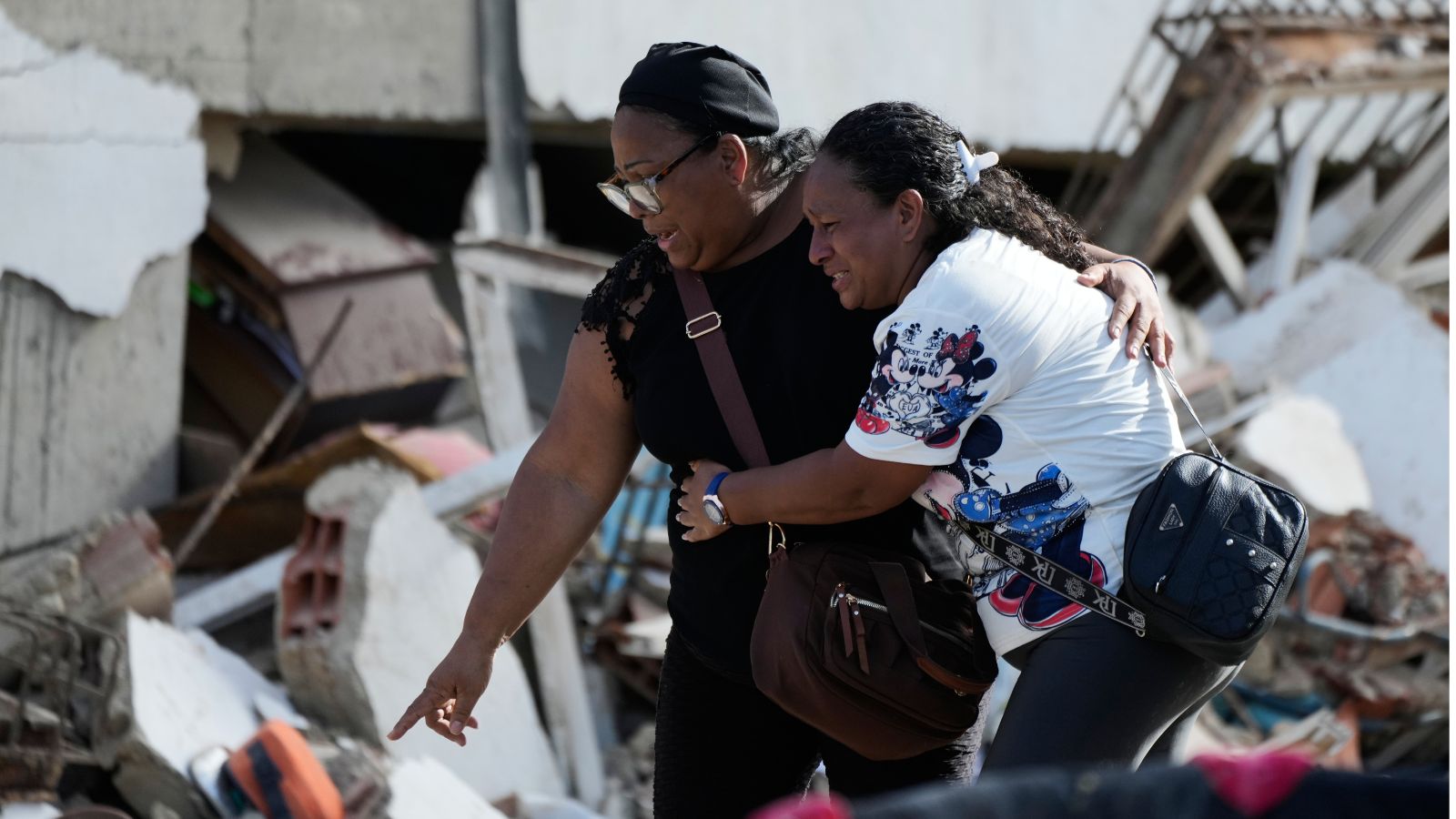
The headlines follow an identical, exhausted script every single time the earth shakes. Death tolls climb. Missing persons counts skyrocket into the tens of thousands. Media cameras zoom in on international rescue teams wearing pristine jumpsuits, accompanied by highly trained K9 units sniffing through concrete dust.
It is a comforting narrative. It suggests that modern technology, global goodwill, and sheer human determination can reverse the fortunes of a flattened city. You might also find this related coverage insightful: Inside the Sudan Supply Chain Crisis Nobody is Talking About.
It is also a lie.
The immediate, hyper-focused obsession with urban search and rescue operations after major seismic events is a performative exercise. It satisfies Western media consumption and lets international governments check a geopolitical box. Meanwhile, it systematically ignores the actual mechanics of survival, resource allocation, and structural engineering. As discussed in latest coverage by Associated Press, the effects are notable.
I have spent two decades managing crisis logistics and structural risk assessments in high-density urban environments. I have watched billions of dollars poured into the frantic, televised scramble of post-disaster response, only for those resources to yield virtually zero statistical impact on saving lives.
If we genuinely care about human survival when a fault line slips, we must dismantle the entire consensus surrounding disaster response.
The Mathematical Absurdity of the Fifty Thousand Missing
The moment a major metropolitan area suffers a severe collapse, media outlets begin weaponizing the term "missing." When an article claims that over 50,000 people are missing, it implies a massive, subterranean population waiting to be pulled from the wreckage.
This metric is structurally flawed.
In the chaos of a collapsed communications grid, "missing" simply means unaccounted for. It means cell towers are down, families are separated across different evacuation zones, and local registries are non-functional. Calling 50,000 people missing creates a false expectation that a massive, coordinated digging operation will miraculously recover a mid-sized city's worth of survivors from beneath the rubble.
Let’s look at the brutal physics of structural collapse. In unreinforced masonry or poorly constructed non-ductile concrete buildings—the exact types of structures prevalent in rapidly expanding urban centers across Latin America and the developing world—the failure mechanism is almost always a pancake collapse.
Floor slabs drop directly onto the floors below them, eliminating the void spaces required for human survival. The survival window in these environments drops off a cliff after the first 24 to 48 hours. Dehydration, crush syndrome, and asphyxiation claim victims long before an international heavy rescue team can clear customs at the nearest functional airport.
When an international team arrives on day four or five with ground-penetrating radar and acoustic listening devices, they are not executing a rescue mission. They are conducting an expensive, high-stakes recovery operation disguised as a rescue. The data consistently demonstrates that over 90 percent of actual live extractions are performed within the first three hours by untrained civilians—neighbors, family members, and local survivors using their bare hands, shovels, and car jacks.
By the time the specialized foreign teams set up their base camps, the statistical probability of finding a living person approaches zero. Yet, the media coverage centers on these late arrivals, creating an illusion that safety is an external commodity shipped in from the outside.
The International Aid Bottleneck
Imagine a scenario where a single-runway regional airport suddenly experiences a 400 percent increase in air traffic overnight. The air traffic control tower is operating on a backup generator. The tarmac has structural cracks from the tremor.
This is the immediate logistical reality of a major disaster zone. Instead of prioritizing high-bulk, high-necessity survival goods like industrial water purification systems, heavy earth-moving equipment fuel, and orthopedic medical supplies, the global community floods the zone with specialized search personnel and uncoordinated pallet loads of arbitrary donations.
This influx creates what logistics professionals call the second disaster.
Planes carrying critical medical staff are forced to circle for hours or divert to neighboring countries because the tarmac is choked with cargo planes delivering unrequested clothes, expired pharmaceuticals, and redundant rescue squads. Every foreign rescue team requires its own security detail, its own clean water supply, its own translation assets, and its own transport vehicles.
Instead of injecting capability into a broken city, these teams frequently become a net drain on the hyper-scarce local resources. They compete with local authorities for diesel fuel. They occupy functional hotel rooms or secure compounds that should be utilized as field hospitals. They demand coordination meetings with local officials who should be focused on restoring municipal water mains and electrical grids.
The insistence on sending bodies instead of capital is driven by optics. A nation sending a 100-person rescue squad gets a primetime photo opportunity. A nation quietly wire-transferring $10 million to local contractors to buy fuel and rent local excavators does not move the needle on public relations.
Earthquakes Do Not Kill People
We must correct the fundamental premise of how we discuss seismic disasters. The phrase "natural disaster" is an evasion of human accountability. An earthquake is a natural phenomenon. A disaster is a policy failure.
The structural engineering community has maintained a clear maxim for a century: earthquakes do not kill people; buildings kill people.
The disparity in casualties between identical magnitude earthquakes occurring in different jurisdictions is staggering. When a magnitude 7.0 earthquake strikes a region with strict building code enforcement, advanced seismic engineering, and continuous infrastructure maintenance, the death toll is frequently negligible. When that same magnitude hits an area characterized by unregulated vertical expansion, corrupt concrete manufacturing, and compromised municipal oversight, the casualties are catastrophic.
The issue is not a lack of engineering knowledge. We know exactly how to build structures that survive severe ground acceleration. We understand ductile detailing, shear walls, and base isolation. The failure point is entirely financial and political.
In rapidly urbanizing regions, concrete is often stretched thin by mixing it with excessive sand or unwashed seawater, destroying its compressive strength and causing internal rebar corrosion over time. Structural columns are designed too narrow to save on materials, and heavy concrete roofs are placed on top of weak columns, creating a lethal top-heavy pendulum when the ground moves.
Focusing our global attention and funding on the drama of the rescue effort allows local governments and corrupt construction syndicates off the hook. It treats the collapse as an unavoidable act of god rather than a predictable consequence of structural negligence. If a building collapses under a moderate or major tremor, it should be investigated as a structural crime scene, not just a humanitarian tragedy.
The Hard Reallocation of Capital
If the goal is to minimize human mortality, the entire playbook must be flipped. The current distribution of international focus is profoundly reactionary. We spend millions reacting to the collapse of structures we knew were dangerous decades ago.
True efficacy in disaster mitigation requires a cold, unromantic shift in strategy.
First, international aid frameworks must disincentivize the deployment of distant, heavy search and rescue teams unless they can be on-site within twelve hours of the initial shockwave. If that timeline is impossible due to geography or infrastructure damage, the resources earmarked for those teams should instantly convert into direct financial grants for regional heavy machinery operators. A local construction company with three functional backhoes and five local operators will pull more people out of rubble in twenty-four hours than an elite foreign squad can in a week.
Second, the global humanitarian apparatus must prioritize structural retrofitting over emergency response. This is a tough sell for donors. It is impossible to photograph a disaster that never happened. You cannot film a heart-wrenching human interest story about a concrete school building that shook violently for sixty seconds but remained standing.
However, the economics are undeniable. Every single dollar invested in seismic retrofitting, reinforcing soft-story foundations, and training local masons in basic rebar tying saves multiple lives and slashes future emergency response costs exponentially.
Third, we must democratize search and rescue training by shifting the focus from elite teams to local neighborhoods. Since the immediate community will always be the true first responders during the critical golden hours of survival, basic leverage tools, cribbing techniques, and first-aid kits should be decentralized and staged throughout high-risk urban communities long before the ground ever moves.
The End of the Spectacle
Continuing to celebrate the current model of international disaster response is an act of complicity. It validates a broken system that prioritizes the theater of rescue over the boring, difficult reality of preventative engineering and localized logistical empowerment.
When we read about massive numbers of missing citizens and watch foreign rescue teams fly into a disaster zone, we are not witnessing a solution. We are witnessing the final, visible stage of a long-term systemic failure.
Stop looking at the rescue workers. Look at the concrete. Look at the building codes. Look at the political systems that allowed those structures to be built in the first place. That is where the deaths occurred, months and years before the fault line ever ruptured.