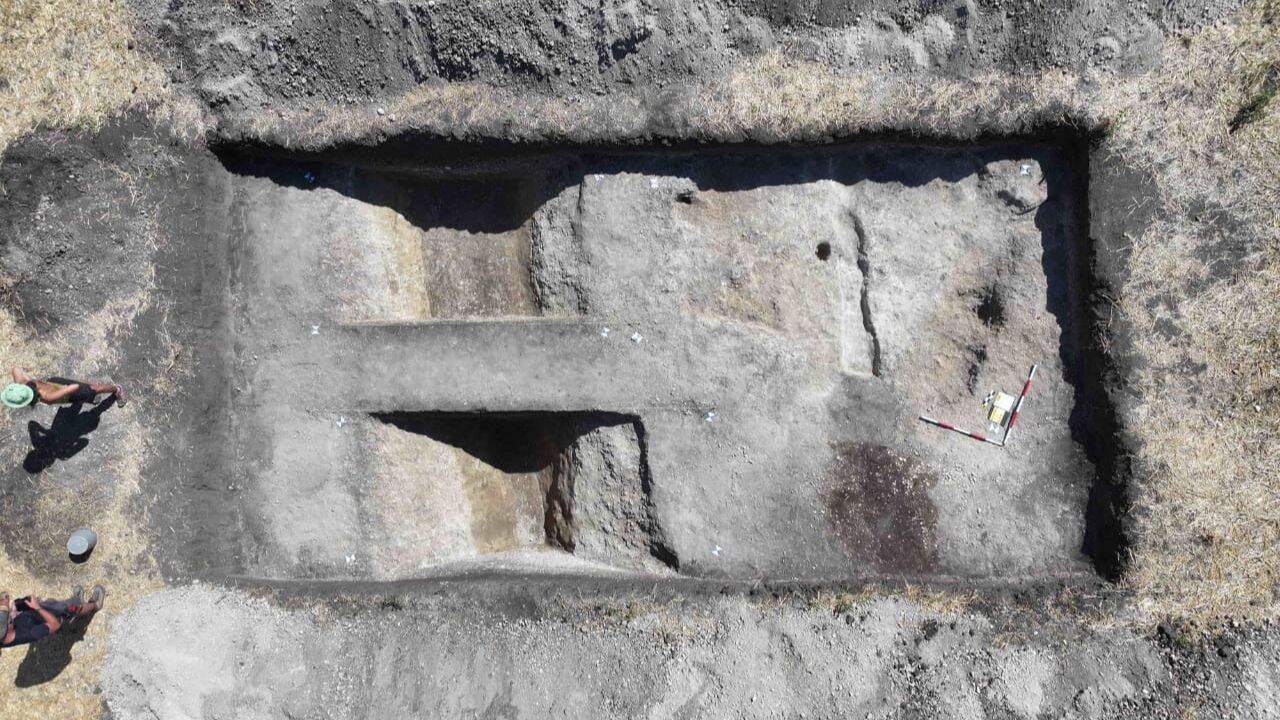
Stonehenge gets all the press. Millions of tourists flock to Salisbury Plain every year just to squint at heavy rocks from behind a velvet rope. Yet, archaeologists digging in Central Europe have quietly mapped an ancient site that leaves Stonehenge looking remarkably modern. Near the village of Chleby in the Czech Republic, researchers have uncovered a massive prehistoric sanctuary stretching back roughly 6,500 years.
That is more than a millennium older than the famous British stone circle.
If you are tired of hearing about the same old megalithic monuments, look closer at Central Bohemia. What experts are finding there challenges everything we thought we knew about early European astronomy, social coordination, and prehistoric architecture.
Inside the Chleby Enclosure
The site near Chleby isn't built from towering blocks of sarsen stone. Instead, it is an enormous circular earthwork—known to archaeologists as a roundel. It spans an impressive 230 meters across. A deep ditch, plunging more than 2.5 meters into the ground, borders the entire perimeter.
Back when stone tools were the absolute pinnacle of human technology, carving out a ditch of that magnitude required serious collective effort.
What makes this specific monument stand out isn't just its sheer size. It features twelve distinct entrances carved into its perimeter at irregular intervals. For a long time, researchers scratched their heads over why anyone would space doorways so unevenly. Then, they started tracking the horizon.
Mapping the Prehistoric Sky
Led by teams from the University of West Bohemia and Charles University, researchers realized the layout was no accident. The orientation of those twelve gaps serves as a massive, land-based calendar.
Specific observation points inside the ring align with major celestial events. One axis tracks the extreme positions of the Moon during its complex 18-year cycle. Another locks onto the sunrise of the summer solstice and the sunset of the winter solstice.
Sound familiar? It is the exact same astronomical principle that made Stonehenge famous. Except the farming communities in Bohemia were building and using these alignments over a thousand years before British builders ever hoisted their first lintel.
For these early agriculturalists, tracking the sun and moon wasn't a neat hobby. It meant survival. Knowing when seasons shifted dictated planting schedules, harvests, and communal gatherings.
Rituals Carved Into the Earth
Monuments of this scale rarely served a purely practical purpose. Prehistoric people didn't shift thousands of cubic meters of dirt just to check the calendar. They used these spaces to commune with forces much larger than themselves.
Excavations inside the deep perimeter ditch yielded striking artifacts. Archaeologists discovered multiple bull skulls and horns clustered tightly around the entrances.
Specialists believe these cattle remains once decorated massive wooden gateways. In early farming societies across Europe, cattle held immense religious and symbolic weight. Walking into the Chleby enclosure meant passing beneath the gaze of ritual animal offerings, moving from the outside world into a sacred ceremonial sphere.
Human remains tell another part of the story. While the site originated in the Neolithic period, subsequent generations kept coming back. Later Bronze Age populations—specifically the Únětice culture—used parts of the landscape for burials, dropping bodies into the ancient earth over long spans of time.
A Different Fate Than Stonehenge
Stonehenge survived through centuries of reuse, shifting meanings, and modern preservation. Chleby took a different path.
By the time the Iron Age rolled around, the sanctuary had lost its original ritual gravity. The deep ditches gradually silted up and filled in. Instead of maintaining a sacred perimeter, local populations built ordinary settlements right over the old holy ground. The ancient calendar faded into farmland and forgotten dirt.
Modern archaeologists are using advanced soil chemistry and ground-survey tech to pull those lost layers back into view. Every sample extracted from the ditches reveals chemical fingerprints left behind by ancient human activity, proving that history isn't just written in stone blocks. Sometimes, it is hidden right beneath a quiet Czech field.
Plan a trip to Central Bohemia if you want to see where Europe's early architects mastered the stars. Just don't expect a gift shop or a velvet rope. You are looking at the raw, unpolished dawn of human engineering.