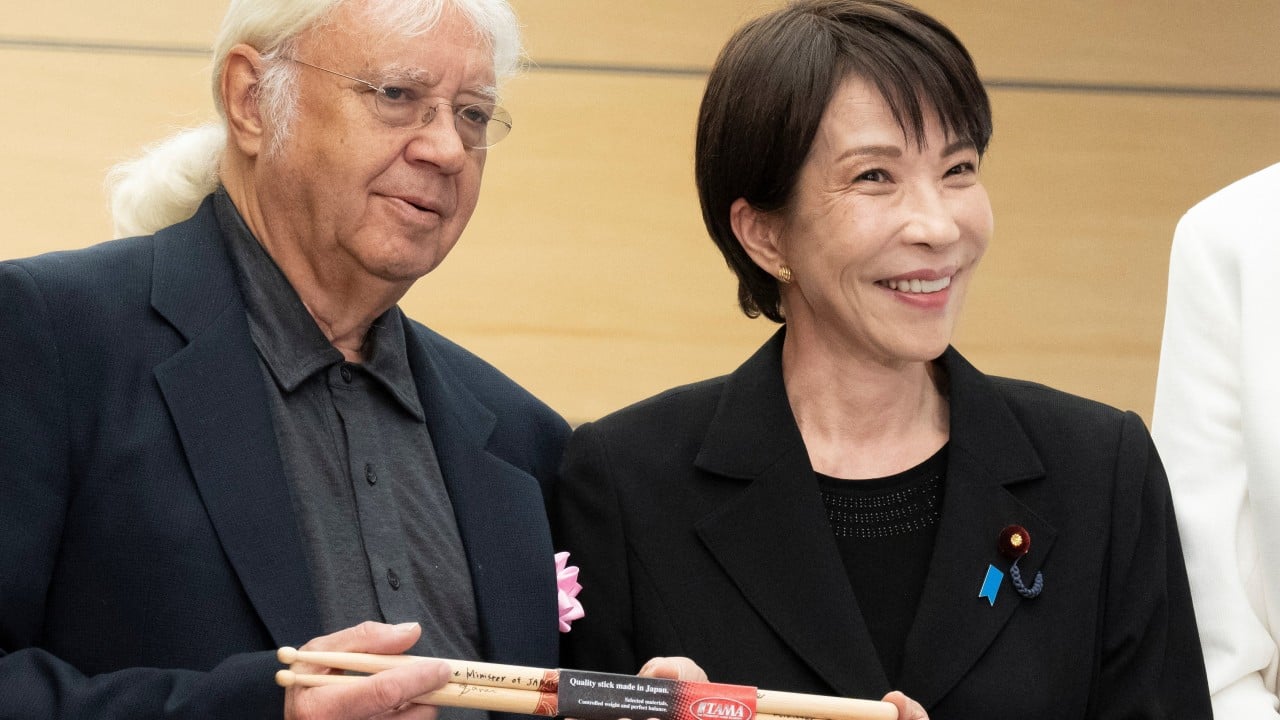
The meeting between Japanese Prime Minister Sanae Takaichi and the British rock band Deep Purple functions as a high-level exercise in cultural capital optimization rather than a mere celebrity visit. In the context of Japan’s "Cool Japan" initiative—a state-led strategy to leverage cultural exports for economic gain—the interaction signals a shift toward a more targeted, demographic-specific form of diplomacy. This engagement operates on three distinct analytical planes: the reinforcement of bilateral UK-Japan relations, the cultivation of domestic political branding, and the strategic deployment of "Soft Power" as defined by Joseph Nye’s framework of attraction and co-option.
The Tripartite Framework of Political Endorsement
The efficacy of a state leader meeting with a foreign cultural entity can be measured through three primary variables. These variables dictate whether the interaction yields a net positive in diplomatic influence or evaporates as a superficial public relations event.
- The Affinity Variable: The degree of genuine personal interest exhibited by the leader. Takaichi’s documented history as a heavy metal drummer provides a layer of authenticity that mitigates the "staged" perception common in political optics.
- The Audience Reach: The demographic overlap between the artist’s fan base and the prime minister’s target electorate. Deep Purple’s longevity appeals to the "Silver Democracy" demographic in Japan—older voters who hold significant political sway and remember the band’s historic 1972 Made in Japan recordings.
- The Institutional Signal: The message sent to foreign ministries regarding Japan’s openness to Western cultural heritage, reinforcing the Western-aligned security and trade posture.
Economic Multipliers of Cultural Legacy
The visit serves as a catalyst for the "Legacy Content Economy." Japan remains the world’s second-largest music market, characterized by a unique resilience in physical media sales (CDs and vinyl) compared to the digital-dominant West. By hosting Deep Purple, the Prime Minister's Office provides an implicit state endorsement of the music industry’s value chain.
The economic mechanism at work here is the Brand Association Loop. When a head of state validates a legacy act, it triggers:
- Catalog Resurgence: Increased streaming and physical sales of historical albums within the domestic market.
- Tourism Pull: Reinforcement of Japan’s status as a premier global destination for international touring acts, which supports the broader hospitality and transport infrastructure.
- IP Protection Signaling: A subtle reminder of Japan’s commitment to intellectual property rights, a critical pillar of its trade negotiations with G7 partners.
The Logic of Professionalized Fandom
Takaichi’s approach deviates from traditional Japanese political communication, which typically favors "Omotenashi" (traditional hospitality) or rigid formality. By integrating her personal background as a musician into the high-office environment, she utilizes Humanization Logic. This logic suggests that a leader perceived as having multidimensional interests is more relatable to a modern, fragmented electorate.
However, this strategy contains a built-in risk: the Dignity-Relatability Trade-off. High-level governance requires an aura of gravitas. Over-indexing on pop-culture engagement can result in "Prestige Decay," where the office’s perceived authority is diluted. Takaichi manages this by maintaining a strict separation between the aesthetic of the meeting and the functional output of her administration. The music is the bridge; the policy remains the destination.
Structural Bilateralism and the UK-Japan Accord
Beyond the individual personalities, the Deep Purple visit must be viewed through the lens of the Comprehensive and Progressive Agreement for Trans-Pacific Partnership (CPTPP) and the UK-Japan Comprehensive Economic Partnership Agreement (CEPA). As the UK seeks deeper integration into Indo-Pacific trade blocks, cultural touchstones serve as the "lubricant" for harder economic discussions.
Music is a primary export of the United Kingdom. When the Japanese Prime Minister prioritizes a British band, she is signaling a preference for British cultural goods. This creates a reciprocal expectation of favorable treatment for Japanese exports—such as automotive technology or robotics—within the British market. It is a non-verbal negotiation tactic that utilizes the "Halo Effect" of a globally recognized brand to soften the edges of nationalist trade policies.
The Operational Mechanics of the "Made in Japan" Brand
The choice of Deep Purple is statistically significant. Their 1972 live album, Made in Japan, is arguably the most famous live recording in rock history. This specific cultural artifact did more for the "Made in Japan" brand in the 1970s than many industrial marketing campaigns. It associated Japanese craftsmanship (in acoustics and venue management) with high-energy, high-quality Western art.
Takaichi is not merely meeting a band; she is referencing a period of Japanese history defined by rapid growth and global cultural integration. This is an exercise in Nostalgia Engineering. By aligning her administration with the symbols of Japan’s era of peak industrial confidence, she attempts to project that same confidence onto contemporary challenges, such as demographic decline and regional security tensions.
Identifying the Constraints of Soft Power
While the visit generates positive sentiment, soft power has distinct limitations. It cannot replace hard-power assets or solve structural fiscal deficits. The "Attraction" phase of diplomacy must eventually transition into the "Transactional" phase.
- Metric 1: Sentiment vs. Policy: Positive social media engagement regarding the visit does not correlate with legislative success in the Diet.
- Metric 2: Temporary Duration: The half-life of a cultural news cycle is notoriously short, often measured in hours or days, whereas policy implementation takes years.
- Metric 3: Demographic Silos: While the visit resonates with Boomer and Gen X cohorts, it may fail to bridge the gap with younger voters who prioritize different cultural markers, such as gaming or anime.
Technical Analysis of the PMO Communication Strategy
The Prime Minister’s Office (Kantei) utilized a specific distribution model for this event. By bypassing traditional media gatekeepers and leaning into direct-to-consumer social channels, the administration exercised Platform Sovereignty. This allows the Prime Minister to control the narrative density—ensuring that the focus remains on the "Joy of Music" rather than potentially controversial policy questions that might be raised in a standard press conference.
This move mirrors the strategy used by modern corporate CEOs. The leader becomes the "Chief Storyteller," using high-contrast, high-affinity events to drown out the "noise" of day-to-day administrative friction.
Strategic Recommendation for the Takaichi Administration
To maximize the ROI of this cultural engagement, the administration should transition from Passive Reception to Active Integration.
- Institutionalize the Exchange: Establish a formal UK-Japan "Creative Industries Taskforce" that uses this visit as a springboard for lowering barriers to entry for smaller independent artists in both markets.
- Cross-Pollination: Link the "Rock and Roll" aesthetic to Japan’s high-end audio engineering sector. A state-sponsored showcase of Japanese audio technology, endorsed by international artists, would turn a PR moment into a tangible export lead.
- Educational Alignment: Utilize the Prime Minister's interest in music to advocate for STEM-to-STEAM initiatives (integrating Arts into Science, Technology, Engineering, and Math) in Japanese schools, addressing the long-term need for creative problem-solving in the workforce.
The Prime Minister must now ensure the transition from the "Encore" of this visit to the "Opening Act" of a concrete cultural-economic policy update. Failure to do so renders the meeting a sunk cost of administrative time rather than a strategic asset. The next logical move is the announcement of a streamlined visa process for international performers, directly addressing the logistical bottlenecks that currently hinder the full economic potential of Japan’s live entertainment sector.