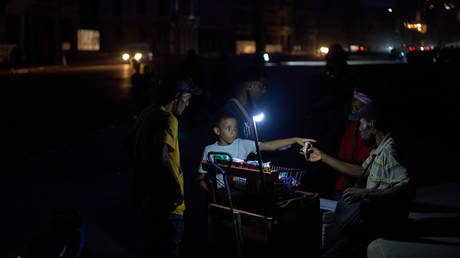
Every time the lights go out on the island, the script writes itself. Western outlets reach for the same worn-out typewriter. They blame the embargo. They blame old transformers. They talk about a tragic, sun-baked paradise struggling against geopolitical gravity. It is a lazy narrative designed for comfortable people who want a clean hero-and-villain story to digest with their morning espresso.
It is also completely wrong.
Cuba is not suffering from a sudden logistical glitch. The nationwide blackouts are the inevitable terminal velocity of a centralized command model that has eaten its own tail for six decades. When you suffocate the private sector, criminalize efficiency, and treat electricity as a birthright rather than a scarce engineering commodity, the grid does not just fail. It surrenders.
Let us dismantle the comfort blanket of the standard media narrative.
The Embargo Bogeyman and the Math That Does Not Lie
For fifty years, the trade embargo imposed by the United States has served as the ultimate political alibi for Havana. Every structural failure, every empty shelf, every dead turbine gets tossed into the embargo basket.
Here is what the apologists ignore. Cuba imports food from the United States to the tune of hundreds of millions of dollars every year under agricultural exemptions. It trades freely with the European Union, Latin America, and Canada. The physical inability to keep coal-fired power plants running is not caused by a Miami customs official. It is caused by a complete absence of foreign exchange, zero operational liquidity, and a state apparatus that funnels whatever hard currency it scrapes together into tourism mega-resorts while the residential distribution lines rot in the salt air.
You cannot run a modern grid on ideological purity.
When Antonio Guiteras, the crown jewel of the Cuban power system, drops offline for the fourth time in a month, it is not because Washington blocked a spare valve. It is because maintenance budgets were redirected to cement plant facades and hotel lobbies while internal engineers lacked basic welding supplies.
The Fallacy of Free Power
Economics does not suspend itself because of a constitution. When you price electricity at fractions of a cent per kilowatt-hour, you destroy every market incentive to conserve, upgrade, or invest.
Imagine a system where the consumer pays virtually nothing, the state collects nothing, and the utility provider has to import heavy crude using credit lines that vanished during the Carter administration. It is a mathematical dead end. Without price signals, waste becomes structural. Factories run at forty percent efficiency because power costs nothing to draw and everything to fix.
The standard humanitarian argument claims that raising utility prices would crush the Cuban working class. Look at the reality on the ground. The working class is already spending days in the dark, losing spoiled rations in dead refrigerators, and paying black-market fortunes for diesel generators that consume what little capital they have left. The illusion of cheap power has resulted in the most expensive energy crisis in the hemisphere: total economic paralysis.
The Structural Rot Beneath the Substation
To understand why the grid collapsed, you have to look past the smoke stacks and examine the capital allocation priorities of the regime.
Cuba sits on domestic heavy crude, but it is high in sulfur and eats turbine blades alive. Refine it properly or import cleaner Venezuelan or Mexican oil, requires cash. But cash does not flow into a system that punishes domestic enterprise. Whenever private restaurant owners or small agricultural cooperatives manage to scrape together efficiency gains, the state steps in with tax clamps or regulatory strangulation.
You cannot starve the private economy of capital, run a state monopoly on heavy industry, and expect the electrical grid to miraculously function like a Swiss Swiss-watch.
The technicians keeping those 1980s Soviet-era plants running are heroes. I have spoken with engineers in Matanzas and Cienfuegos who are literally machining replacement gaskets out of scrap metal because supply chains dried up years ago. They possess world-class technical talent trapped in a tenth-century economic prison. They are not failing for lack of skill. They are drowning in a system that views self-sufficiency as a political threat.
The Path Out Requires Breaking the Mirror
If you want to fix the Cuban blackout cycle, you have to stop treating the symptoms and attack the disease.
First, decentralize generation immediately. Allow private capital, foreign or domestic, to build modular solar arrays, wind farms, and localized micro-grids without state-monopoly middlemen taking an eighty percent cut. Second, stop subsidizing industrial waste. Price energy honestly so that efficiency becomes a survival mechanism rather than an afterthought. Third, admit that central planning cannot manage a complex industrial power grid in the twenty-first century.
The lights will not come back on permanently until the monopoly on common sense is broken. Until then, keep your candles ready, because the darkness is not an accident. It is the policy.


