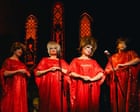
Walk down Kent Street in the heart of Sydney’s central business district, and you will find a building of weathered stone that has watched the city grow since 1858. It has soaring gothic arched windows. It has sandstone that absorbs the damp winter cold. For three-quarters of a century, it functioned as a house of God. Then, in the 1930s, the church was deconsecrated. The altar was cleared, the holy water removed, and the spiritual lease on the property officially expired.
For nearly ninety years, the building lived a quiet, secular life as a children’s school and a community theatre. It was a shell of a religious past, safely converted into a container for human stories.
But buildings, like people, carry ghosts. And in the second week of July 2026, those ghosts decided to wake up.
Consider a young performer—let’s call her Maya. Maya spent her teenage years in a deeply conservative suburb, sitting in hard wooden pews every Sunday, sweating through sermons that explicitly told her that who she loved was an abomination. She survived by escaping into the arts. To Maya, the opportunity to perform in a historic, decommissioned sandstone church wasn't just a gig. It was a reclaiming of space. It was a way to stand under the same vaulted ceilings that once symbolized her exclusion and say, I am here, I am beautiful, and I am not ashamed.
Maya is one of more than 1,500 artists, performers, technicians, and crew members who were supposed to find a home, and a paycheck, at the Divine Playhouse over the next twelve months. The venue, run by the queer-led group Heaps Gay Events, was backed by a $100,000 grant from the New South Wales government and the explicit support of the City of Sydney. It was designed to invest $650,000 directly into an independent arts sector that is still gasping for air after years of economic bruising.
Instead, after being open for exactly seven days, the doors are locked. The sandstone is silent again.
The collapse happened with dizzying speed. When Heaps Gay first announced the project, they called it the Unholy Playhouse. It was a cheeky, classic piece of queer irony—a nod to the building's past and a welcoming hand to those who had been made to feel "unholy" by traditional institutions. But local Christian groups felt immediate pain and anger.
The venue's organizer, Kat Dopper, did what any empathetic community builder does: she listened. In good faith, she rebranded the space to the Divine Playhouse before the doors even opened. She wanted the art, not the controversy, to be the focus.
But on opening night, the friction turned into a firestorm.
Outside, seventy protesters gathered, holding signs and praying. Inside, the performances were raw, irreverent, and confrontational. There were drag queens dressed as nuns. There was a performer dressed as a pig offering french fries as communion. To the artists, this was a centuries-old tradition of carnivalesque satire—using the symbols of authority to dismantle the weight of that authority.
To the religious groups outside, like the Prodigal Sons and Fit for the Kingdom, it was a deliberate, agonizing mockery of the things they hold most sacred. They felt wounded. They felt targeted.
The reaction was swift and clinical. The landlord, a commercial property group named KCSYD Pty Ltd, sent a formal breach notice to the tenant. The document did not cite noise complaints or property damage. Instead, it ordered the venue to immediately cease "engaging in offensive trade".
"Offensive trade."
Historically, the legal definition of offensive trade has been reserved for abattoirs, tanneries, and chemical plants—industries that produce toxic fumes, unbearable noise, or physical biohazards. By applying this archaic clause to a theatrical performance, the landlord did something terrifying to the local creative community. They equated queer performance, drag, and religious parody with literal toxic waste.
Now, the social media accounts for the Divine Playhouse have vanished. The scheduled shows are postponed or cancelled. A legal battle is brewing, with Heaps Gay exploring their options, but the financial damage to a fragile network of independent artists is already done.
The Premier of New South Wales, Chris Minns, publicly questioned if the building was the "best location" for these performances, and announced an investigation into how the government grant was allocated.
But the real problem lies elsewhere. It is not about a performance involving french fries, nor is it truly about a $100,000 grant.
It is about the terms of our shared existence in a modern city.
A liberal democracy is built on a highly uncomfortable, deeply fragile bargain. We agree to tolerate ideas, speech, and art that offend our deepest sensibilities, in exchange for the absolute right to express our own truths when they inevitably offend someone else.
If you are a person of faith, you have the absolute, hard-won right to stand on Kent Street and proclaim that the performances inside are sinful. You have the right to pray for the souls of the artists. You have the right to feel deeply, genuinely offended.
But when the feeling of offence is weaponized to evict the speaker, the bargain breaks.
Consider what happens next: if "causing offence" becomes a legally valid reason for a landlord to terminate a lease, who decides what is offensive? Today, it is a drag queen parodying a nun in a deconsecrated church. Tomorrow, could it be a gallery showing an exhibition about climate change because the landlord’s major investor is in coal? Could it be a bookshop hosting a reading of a novel that challenges traditional family structures?
When we allow commercial real estate contracts to dictate the boundaries of free expression, we do not protect the sacred. We merely privatize censorship.
We live in a world that is rapidly running out of physical spaces where people can gather without the expectation of buying a ticket to a luxury development. The very church on Kent Street is currently subject to a development application to turn it into luxury apartments.
Perhaps that is the ultimate irony. The holy ground that could not tolerate the messy, loud, provocative joy of a queer arts venue will, in all likelihood, eventually be carved up into high-end kitchens and minimalist living rooms for those who can afford the premium. The sandstone walls that once echoed with hymns, and briefly shook with the basslines of a marginalized community reclaiming their narrative, will be silenced by the ultimate, quietest authority of all: capital.
Maya will find another stage, eventually. Queer artists are nothing if not resilient; they have spent generations building stages out of nothing but crates and courage in a world that didn't want them to exist. But every time a door is locked, every time a "keep out" sign is hung because someone felt uncomfortable, the city becomes a little more sterile, a little more predictable, and a lot colder.
The heavy wooden doors of the old church on Kent Street remain shut. Inside, the lights are off, the stage is empty, and the only thing left in the historic sandstone hall is the quiet, heavy dust of a conversation we are still too afraid to have.

