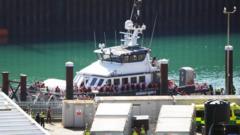
A woman lost her life in the English Channel after a small inflatable boat, severely overcrowded and structurally unsuited for the open sea, stalled and began taking on water off the coast of northern France. French maritime authorities and rescue vessels managed to pull dozens of survivors from the collapsing vessel, but for one individual, the intervention came too late. This death adds to a rapidly growing toll of fatalities in the world's busiest shipping lane. It is the direct consequence of a highly organized, multi-million-dollar human smuggling apparatus that has successfully adapted to every enforcement measure thrown its way.
For years, British and French policies have focused on physical deterrence, increased surveillance, and the militarization of the coastlines around Calais and Dunkirk. Yet, the data reveals a stark paradox. As the policing of beaches intensifies, the crossings do not stop. They simply become more dangerous. Smuggling networks have shifted their tactics, moving away from relatively coordinated departures to chaotic, mass-launch strategies designed to overwhelm border patrols through sheer volume.
To understand why people continue to board these fragile vessels, one must look at the structural mechanics of the smuggling market itself. The business model relies on a structural supply-and-demand mismatch. With legal paths to seeking asylum heavily restricted or non-existent for the vast majority of displaced individuals, the black market fills the void.
The Evolution of the Small Boat Market
In the mid-2010s, the primary route across the Channel involved stowing away on commercial trucks or slipping into containers at the Port of Calais and the Eurotunnel terminal. When millions of pounds were invested in high-security fencing, thermal imaging, and sniffer dogs at these major hubs, that specific route was effectively choked off.
The smugglers did not disband. They altered their methodology.
By 2018, the transition to small boats was well underway. Initially, networks utilized rigid-hulled inflatable boats or commercial-grade dinghies equipped with reliable outboard motors. These trips were expensive, often costing several thousand pounds per seat, and carried fewer passengers.
As law enforcement began targeting the supply chains of these vessels within Europe, seizing boats and monitoring marine supply stores, the smugglers adapted again. They turned to bespoke, low-quality inflatables manufactured cheaply in Asia, shipped in pieces across European borders, and assembled hastily in the dunes minutes before launch.
The physical reality of these modern "taxi boats" is terrifying. They are often constructed from substandard PVC, lack rigid hulls, and are powered by underpowered, refurbished engines that regularly fail mid-journey. A vessel designed to hold a maximum of fifteen people is routinely loaded with sixty or seventy. The floorboards, frequently made of cheap plywood, often buckle under the weight, exposing the rubber hull to the sea and causing the boat to deflate from the center.
The Strategy of Overwhelming Enforcement
The French coast guard and British Border Force operate under a strict legal duty of care dictated by international maritime law. If a vessel is in distress, they must rescue the occupants. Smuggling networks use this humanitarian obligation as a core component of their operational strategy.
They launch multiple overcrowded boats simultaneously from different points along a vast stretch of coastline. The goal is simple: blow past the capacity of shore-based gendarmes. When a boat is intercepted in the water, smugglers often instruct passengers to threaten to jump overboard or puncture the boat if authorities try to turn them back toward France. Once a vessel is compromised, the operation instantly shifts from law enforcement to a mass-rescue mission, forcing authorities to bring the passengers aboard and transport them to British soil.
This tactical dynamic explains why beach-side clashes between migrants and French police have escalated. With millions of Euros in potential profit riding on a single night's launches, smuggling gangs have become increasingly aggressive, using fireworks, sticks, and stones to defend their launch sites against police patrols.
The Financial Architecture of the Trade
This is not a loose collection of opportunistic criminals. It is a highly sophisticated, transnational corporate structure operating completely outside the law.
The financial transactions underlying the Channel crossings rarely involve direct cash handovers on the beaches of northern France. Instead, the industry relies on the Hawala system, an informal method of value transfer based on a vast network of brokers across Europe, the Middle East, and North Africa.
- The Escrow Phase: A migrant deposits the agreed fee (frequently between £2,000 and £5,000) with a Hawala broker in a hub city like Istanbul, Brussels, or London.
- The Token System: The broker issues a unique code or token to the migrant.
- The Payout: Only when the migrant successfully reaches the UK do they communicate the code back to the smuggler, who then presents it to the broker to unlock the funds.
This system protects both parties. The migrant knows the money won't be stolen upfront, and the smuggler is incentivized to ensure the crossing occurs. Because the money moves through trusted personal networks and ledger entries rather than traditional banks, tracking the financial flows is incredibly difficult for international intelligence agencies.
The profit margins are staggering. A single boat carrying sixty people at £3,000 per head generates £180,000 in gross revenue. The cost of the cheap inflatable, a disposable engine, and fuel rarely exceeds £10,000. Even after paying out lookouts, drivers, and beach bosses, the net return on a single successful launch is massive. This liquidity allows syndicates to quickly absorb the financial loss of seized equipment and immediately reinvest in new operations.
The Failure of Physical Deterrence
Political rhetoric on both sides of the Channel has long emphasized a "get tough" approach. Millions have been spent on drones, night-vision cameras, beach buggies, and joint intelligence cells. The underlying theory is that if you make the journey difficult and dangerous enough, people will stop trying.
Historical precedent and migration data suggest otherwise. Deterrence strategies rarely stop migration flows; they merely redirect them or increase the risk premium.
When policing increases on the beaches nearest to the UK, such as Calais, smugglers move their operations further south toward Boulogne-sur-Mer or north toward Belgium. This forces the heavily laden, unstable boats to travel much longer distances through open water, dramatically increasing the time they spend in the treacherous shipping lanes and significantly raising the probability of a structural failure or capsize.
Furthermore, the focus on arresting low-level "handlers"—the individuals tasked with piloting the boats or carrying them to the water—does little to disrupt the broader network. These pilots are often migrants themselves, offered a free or heavily discounted passage in exchange for steering the vessel. They are entirely disposable to the network kings sitting safely in apartments in Germany, the Netherlands, or the UK.
The Policy Dilemma
The crisis presents a massive political challenge with no easy solutions. Governments are caught between the humanitarian necessity of preventing mass drownings and the political pressure to maintain secure borders and reduce unauthorized entries.
One proposed alternative is the creation of safe and legal routes, allowing individuals to apply for asylum from outside the UK or at processing centers in Europe. Proponents argue this would instantly destroy the smugglers' market by offering a free, safe alternative to a dangerous sea crossing. Opponents counter that introducing such processing hubs would act as a pull factor, vastly increasing the total volume of claims and overwhelming administrative systems.
Another approach focuses on deeper intelligence sharing to disrupt the supply chain of inflatables before they ever reach the coast. This requires intense cooperation between multiple European states, as the components of a single crossing are often sourced across Germany, transported through Belgium, stored in French safe houses, and launched by networks led by Iraqi-Kurdish or Albanian syndicates. While this has resulted in major international busts, the sheer profitability of the trade means new suppliers emerge almost immediately to fill any gap in the market.
The tragedy off the French coast is not an isolated accident. It is the predictable outcome of a high-stakes chess game between state deterrence and market-driven smuggling networks. As long as the demand for passage remains absolute and the financial rewards for meeting that demand remain immense, fragile boats will continue to push off into the dark, and the maritime death toll will continue to rise.