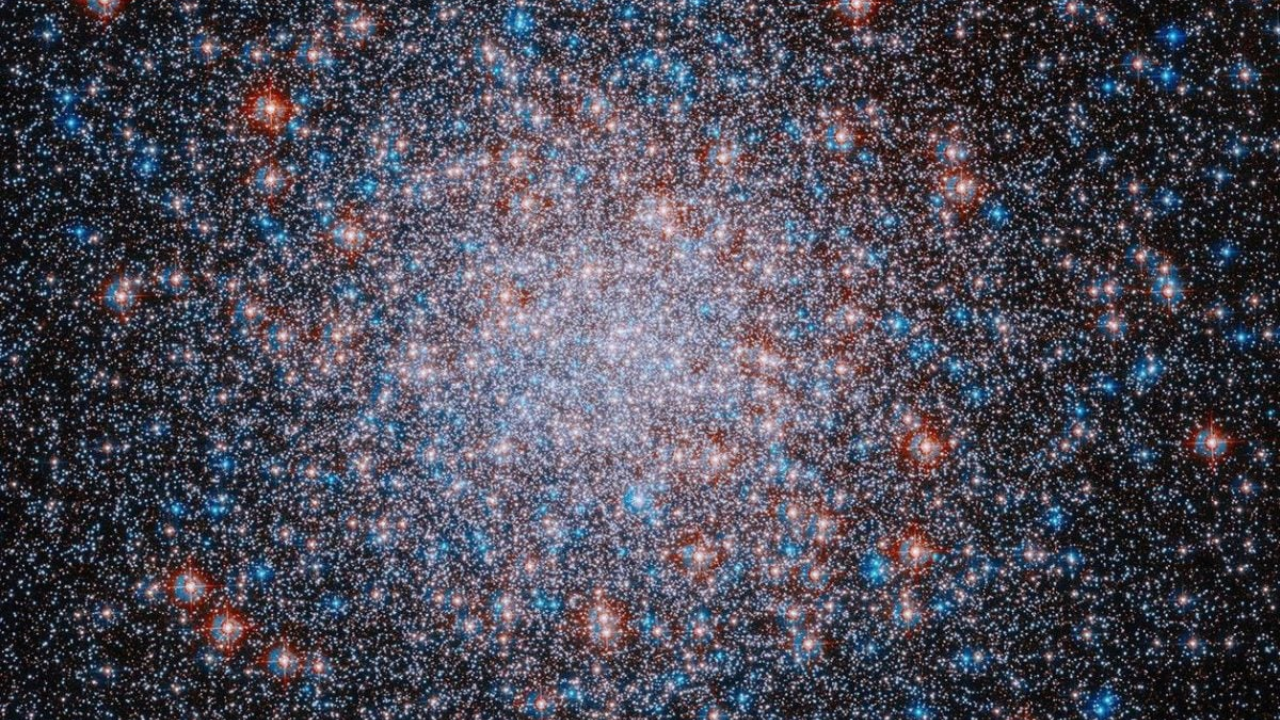
The National Aeronautics and Space Administration just released a stunning image of 500,000 ancient stars to mark America’s 250th anniversary, using the aging Hubble Space Telescope to capture a dense stellar cluster near the heart of our galaxy. While the image is a triumph of engineering and celestial photography, it serves a dual purpose. It is a calculated public relations maneuver designed to remind the public—and Congress—of the agency's historic achievements at a time when its modern flagship programs face severe scrutiny, delays, and budget overruns. NASA is leveraging the nostalgic brilliance of Hubble to secure its future in a rapidly privatizing space race.
The image itself focuses on a globular cluster, a tightly bound sphere of stars that formed in the earliest epochs of the universe. These stellar groupings are essentially cosmic fossils. They hold the chemical signatures of the primordial gas clouds that existed before modern galaxies took shape. By pointing Hubble's Wide Field Camera 3 at this dense population, astronomers filtered out the obscuring interstellar dust to reveal a brilliant swarm of blue and red giants.
The Overlooked Crisis of Space Science Funding
Behind the celebration lies a harsh operational reality. The Hubble Space Telescope is dying. Launched in 1990, the observatory has outlived its expected lifespan by decades, but it is showing unmistakable signs of mechanical fatigue.
Earlier this year, NASA was forced to transition Hubble to a single-gyroscope operational mode after a series of failures in its pointing stability systems. While the agency maintains that this change will extend the telescope's life into the 2030s, it severely limits its efficiency. The telescope can no longer schedule observations with the same flexibility, and tracking fast-moving objects like comets or asteroids is now nearly impossible.
The decision to feature Hubble for the Semi-quincentennial rather than the newer, more powerful James Webb Space Telescope is a deliberate nod to institutional legacy. Hubble is an American icon. It is a household name that evokes national pride. By tying this specific instrument to a major national milestone, the agency builds a sentimental shield around its astrophysics portfolio, which is currently vulnerable to sweeping federal budget cuts.
Scientific Value Versus Public Relations Value
Astronomers use globular clusters to measure the age of the universe and validate models of stellar evolution. Because all the stars in a cluster formed at roughly the same time from the same material, they provide a controlled environment for studying how mass dictates a star's lifecycle.
The scientific data gathered from this observation will undoubtedly feed academic papers for years. Yet, the timing of the release transforms raw data into political capital. Space exploration has always been tied to national identity and geopolitical signaling. The Apollo missions were ideological battles fought in Earth orbit. Today, the battlefield has shifted to deep space logistics and lunar permanence, fields where NASA is no longer the sole dominant player.
Commercial aerospace companies now launch more payloads into orbit annually than civil space agencies. This shift has altered the dynamic in Washington. Lawmakers increasingly question why public funds should support monolithic, decade-long government projects when private entities claim they can achieve similar goals faster and cheaper.
The Hidden Costs of Deep Space Exploration
Maintaining aging hardware in low Earth orbit requires constant financial compromise. Every dollar spent keeping Hubble operational or troubleshooting its degrading instruments is a dollar diverted from future missions, such as the Nancy Grace Roman Space Telescope or the Habitable Worlds Observatory.
Consider the trade-offs involved in modern astronomy.
| Observatory | Primary Spectrum | Operational Constraints | Core Funding Status |
|---|---|---|---|
| Hubble Space Telescope | Optical, Ultraviolet | Degraded gyroscopes, orbital decay | Decreasing annual allocation |
| James Webb Space Telescope | Infrared | Limited fuel supply, micrometeoroid vulnerability | Stable but high baseline costs |
| Nancy Grace Roman | Wide-field Infrared | Development delays, launching late 2020s | Vulnerable to shifting political priorities |
The broader astrophysics community is quietly divided on this strategy. Some researchers argue that squeezing the last drops of data from Hubble is a misuse of resources that could be better spent accelerating next-generation projects. Others maintain that Hubble’s unique capability to see in ultraviolet light—something the infrared-optimized James Webb Telescope cannot do—makes it irreplaceable.
Technical Realities of the 500,000 Star Image
Capturing a half-million stars in a single frame is not a simple matter of pointing and shooting. The core of a globular cluster is so dense that individual stars blur together into a solid wall of light when viewed through standard equipment.
To resolve individual points of light, NASA engineers utilized a technique called dithered sampling. The telescope takes multiple exposures, shifting its gaze by mere fractions of a pixel between each shot. Computer algorithms then combine these offset images, reconstructing the scene at a higher resolution than the physical sensor could normally achieve.
This process requires extreme stability. With only one functioning gyroscope, Hubble must rely heavily on its fine guidance sensors to lock onto guide stars. If the telescope drifts by even a milliarcsecond during an exposure, the entire image becomes useless smear. The success of the anniversary image is less a demonstration of cutting-edge technology and more a showcase of extraordinary engineering improvisation.
The Looming Orbital Descent
The clock is ticking on Hubble's physical existence. Without a propulsion system of its own, the telescope is locked in a slow, irreversible descent toward Earth's atmosphere. Every solar flare expands the upper atmosphere, increasing drag on the spacecraft and lowering its orbit.
A few years ago, discussions surfaced about a potential private mission to boost Hubble into a higher orbit, extending its life for another decade. Those talks stalled under the weight of regulatory hurdles, liability concerns, and technical risks. If a private capsule docks with Hubble and accidentally damages its fragile exterior, a national treasure is lost. If NASA refuses to take the risk, the telescope will re-enter the atmosphere sometime in the mid-to-late 2030s, burning up over an ocean.
This reality turns the anniversary image into an elegy. It is a brilliant display of what American engineering accomplished at the tail end of the twentieth century, used to justify the agency's relevance in the twenty-first.
NASA must convince a skeptical public that its value lies not just in its glorious history, but in its ability to execute complex, long-term scientific endeavors that private industry has no financial incentive to pursue. Commercial outfits care about satellite constellations, asteroid mining, and space tourism. They do not fund the study of 13-billion-year-old stellar remnants. The defense of civil space funding rests entirely on this distinction, and images like this are the ultimate weapon in that fight.