Rust smells like old iron, wet earth, and the stubborn persistence of men who refuse to let things break.
If you stand on the freezing banks of the St. Marys River in Michigan's Upper Peninsula on a bitter November morning, the sound hits you long before you see anything. It is a low, chest-rattling roar. It is the sound of thousands of tons of concrete being poured, of crane engines screaming against the wind, of an industrial heartbeat that refuses to flatline.
For generations, this cold stretch of water between Lake Superior and Lake Huron has been the narrow bottleneck through which the lifeblood of North America flows. Most people never think about it. They turn on their stoves, drive their cars, or look out at skyscrapers of gleaming glass, entirely detached from the raw minerals that made those things possible. They do not think about the Soo Locks. They do not think about the fact that if this single watery throat closes for even a month, entire assembly lines across the United States grind to a panicked halt.
Right now, that vital throat is undergoing the largest open-heart surgery of its engineering life.
The $3.2 billion Soo Locks project has officially crossed its halfway mark in its grueling final phase. This is not just a dry headline about government spending or infrastructure milestones. It is a race against time, fatigue, and the brutal physics of the Great Lakes.
To understand why this matters, you have to look backward.
Imagine standing here in 1968. The industrial engine of the United States was running white-hot. Steel was king, and the freighters—massive floating cities known locally as thousand-footers—were carving paths through the ice month after month. Back then, the Army Corps of Engineers built the Poe Lock. It was a marvel, capable of swallowing the largest ships traversing the inland seas. But there was a glaring, dangerous vulnerability built into the design.
There was only one chamber big enough to handle those monster freighters.
Think about that for a second. Only one. If a mechanical failure, an errant ship collision, or simple catastrophic fatigue took the Poe Lock out of commission, over seventy percent of the heavy cargo capacity moving out of Lake Superior would instantly be trapped. No iron ore from the rich mines of Minnesota. No taconite pellets feeding the blast furnaces of Indiana and Ohio. Just quiet docks, silent mills, and a cascading economic shockwave that would ripple across the continent within days.
It was a single point of failure on a continental scale.
For decades, experts warned about it. For decades, budgets stalled, political winds shifted, and the concrete of the older, smaller Sabin and MacArthur locks continued to age. The water gnawed at the steel gates. The freeze-thaw cycles of Michigan winters cracked the stone.
Then came the push to build a new heavy-lift lock in the footprint of the old Sabin and Brown, a project known officially as the New Lock at the Soo. It was promised, delayed, downsized, revived, and finally funded with the kind of bipartisan urgency that usually only follows a crisis.
Now, halfway through that final, grueling chapter, the reality of the construction is breathtaking.
Consider what it takes to build a chamber large enough to lift a thousand-foot freighter twenty-one feet—the exact drop of the rapids between Superior and Huron—using nothing more than the raw, silent gravity of water.
You do not just pour concrete and hope for the best. You fight the river every inch of the way.
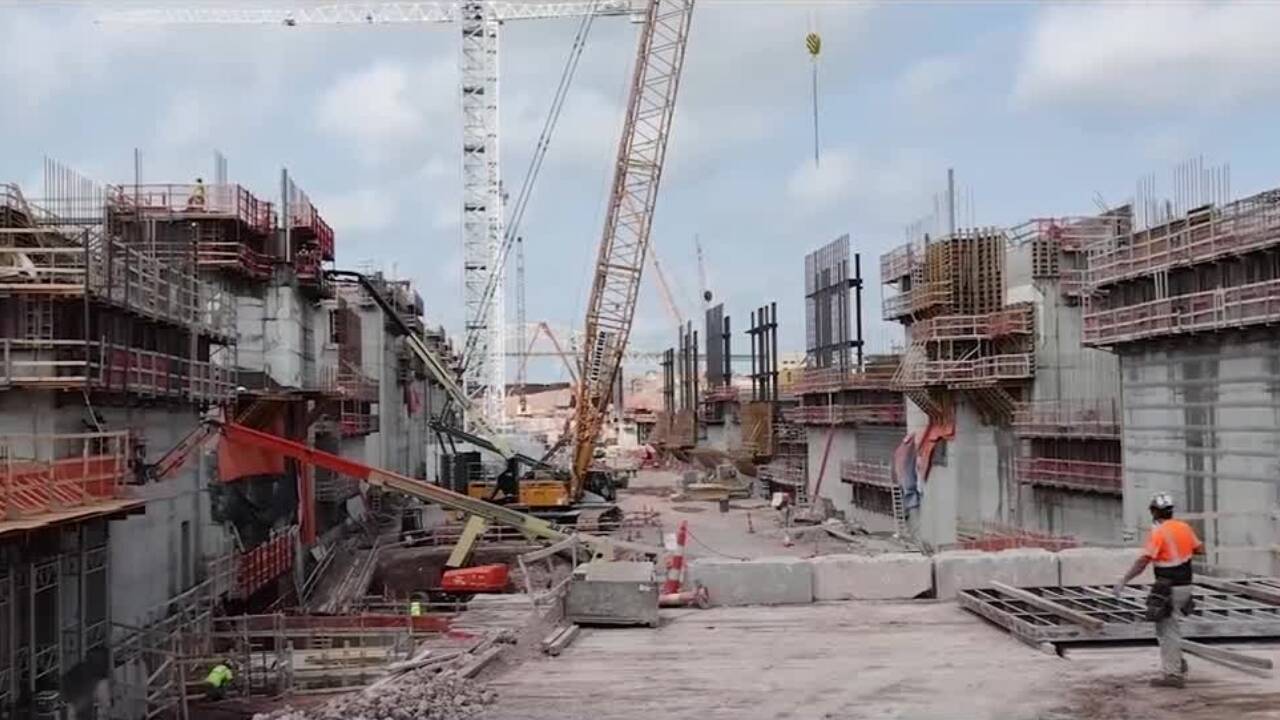
Construction crews work shifts that defy normal human rhythms. During the dead of a Michigan winter, when the wind howls off the lake and drives needles of ice horizontal, workers are down in the cofferdams. They are wrapped in heavy orange gear, their breath pluming in the floodlights, tying rebar cages the size of houses. Every pour of concrete has to be monitored meticulously. If the mix gets too cold before it cures, the ice crystals expand inside the matrix, destroying the structural integrity before the structure has even been born.
A hypothetical worker, let’s call him Dale, has spent thirty years on these locks. His father worked here before him, maintenance crew, the kind of man who could tell you the exact year a hydraulic valve was installed just by the sound it made when it closed. Dale remembers when the talk of a new lock was just a bitter joke muttered over thermos coffee in the breakroom.
"Everyone knew we were riding a bicycle with a flat tire," Dale says, recalling the mood from a decade ago. "You just keep pedaling harder and praying you don't hit a pothole. We knew the Poe was getting tired. You can patch a wound so many times before the stitches just pull through the meat."
Today, Dale watches the massive monolith walls rising into the gray sky. They are smooth, gray giants of engineering, designed to stand for the next century.
Reaching the 50 percent mark in this final phase means the heavy civil work—the towering concrete walls, the massive culverts that will rush water in and out to fill the chamber in minutes, and the structural foundations—are finally locking into place. But the remaining half of the project is where the invisible complexity lives. It is the installation of the massive electro-mechanical gates, the hydraulic actuators that weigh as much as locomotives, and the computerized control systems that must coordinate the movement of millions of gallons of water with surgical precision.
It is a dance of incredible proportions. A freighter like the Paul R. Tregurtha—over a thousand feet long, carrying seventy thousand tons of iron ore—glides into the lock chamber. There is only feet of clearance on either side. The deckhands toss their heavy lines to the wall. The massive upstream gates close, sealing the ship in a concrete trench.
Then, the water begins to drop. Or rise.
There are no pumps. No electric motors pushing the water up or down. It is all elevation and gravity, controlled by massive subterranean valves that open and close to let the lake do the heavy lifting. It is a nineteenth-century concept executed with twenty-first-century tolerances.
When people ask why this project costs $3.2 billion and takes years, they are looking at the wrong ledger. They are looking at a pile of money instead of looking at the alternative.
The alternative is a broken supply chain that leaves steel mills cold, automotive plants idle, and power plants scrambling for fuel. The Great Lakes water highway moves over eighty million tons of cargo every single year. Iron ore, coal, limestone, cement—the literal skeleton of American manufacturing moves past Sault Ste. Marie. If the Poe Lock fails without a backup, the United States economy experiences a cardiac arrest that no amount of stimulus checks can fix overnight.
This is why the engineers on site do not talk much about the politics of the funding. They talk about tolerances, grout mixtures, and safety inspections. They talk about the legacy they are pouring into the bedrock.
Standing on the edge of the excavation pit, looking down at the massive gray floor where ships will soon float, you realize something profound about human ambition. We spend trillions of dollars chasing ephemeral things—digital currency, social algorithms, fleeting trends that vanish by next Tuesday. Yet our true survival still depends entirely on our willingness to mix sand, gravel, and cement, and build massive stone walls to hold back the fury of water.
The project is on track. The walls are up. The steel is arriving.
Out on the lake, cutting through the slate-gray swells under a darkening sky, a loaded freighter blows its deep, resonant horn. It is a sound that has echoed across these waters for over a century. A warning. A greeting. A declaration that commerce is moving, the channel is open, and the work continues.
Down in the pit, the floodlights flicker on against the gathering dusk, casting long shadows over the concrete ribs of a new era. The titan is waking up. And the river, for now, is held in check.