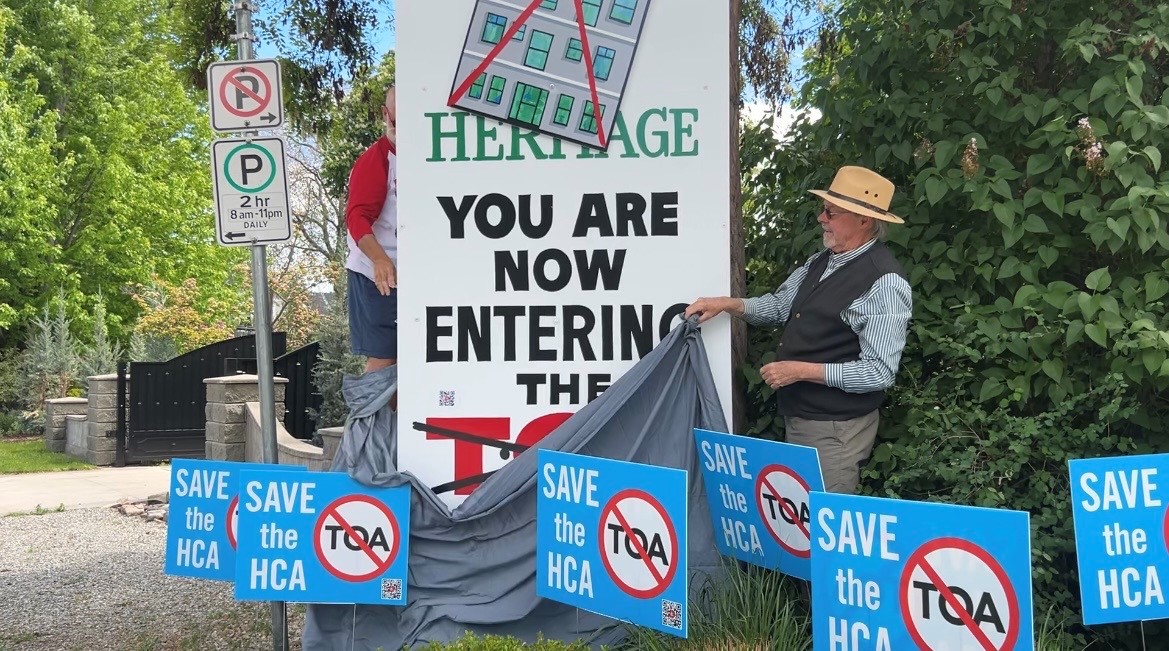
The air in Kelowna’s heritage district usually smells of parched pine needles and the faint, cooling moisture of Okanagan Lake. It is a neighborhood of wide porches, gnarled maple trees, and houses that have watched the city grow from a lakeside outpost into a gleaming hub of glass towers. But lately, the silence on these streets has been replaced by a low, vibrating anxiety. It isn’t the sound of construction—not yet. It is the sound of a community realizing that their history is being weighed against a transit map.
Consider Susan. She is a composite of the many residents currently walking their dogs past the heritage plaques on Abbott Street, feeling like ghosts in their own yards. She bought her home twenty years ago, banking on the promise of "heritage conservation." Now, she looks at the provincial government’s Transit-Oriented Development (TOD) legislation and sees a wrecking ball disguised as progress.
The conflict isn't just about height. It is about the erasure of a visual language.
British Columbia’s new housing mandates are aggressive. The goal is simple on paper: build more homes near transit hubs to solve a crushing housing crisis. In Kelowna, this means a massive radius around the Pandosy Street transit exchange is now designated for high-density growth. Under these rules, buildings could soar to ten stories or more in areas that currently feature nothing taller than a chimney. For the people living in the shadow of this plan, it feels less like an evolution and more like an eviction of their neighborhood’s soul.
The Math of Displacement
Proponents of the plan point to the numbers. Kelowna is one of the fastest-growing cities in Canada. People need places to live. If we don’t build up, we sprawl out, eating into the very orchards and vineyards that make the valley iconic. The logic is cold, hard, and technically correct.
But logic rarely accounts for the way a street feels at 4:00 PM when the sun hits the cedar siding of a 1920s bungalow.
The heritage area isn't just a collection of old wood. It is a carbon sink. It is a walkable canopy. When you replace a single-family home on a large, treed lot with a mid-rise concrete block, you aren't just adding units. You are removing a permeable surface that absorbs the valley's heat. You are cutting down trees that have provided shade for a century. The "green" argument for transit-oriented density often ignores the environmental cost of demolishing existing, functional infrastructure.
The residents aren't saying "no" to housing. They are asking why the "how" has to be so blunt.
The Invisible Stakes
When a city decides that a neighborhood is "under-utilized," it performs a sort of fiscal alchemy. It turns homes into "units." This shift in vocabulary is where the human element gets lost. For a developer, a heritage home is a hurdle. For the family next door, it is the barrier that keeps their backyard from becoming a fishbowl.
The provincial mandate effectively strips away much of the local government's power to say no. In the past, a ten-story proposal in a heritage zone would trigger months of public hearings. Neighbors would gather, voices would be heard, and compromises—setbacks, height tiers, architectural styling—would be hammered out. Now, those hearings are being bypassed to speed up the "supply."
This creates a peculiar kind of grief. It is the loss of agency.
Imagine standing in your garden, knowing that the provincial government has essentially green-lit a tower that will block your sun, and there is no podium for you to stand at to object. The democratic process has been traded for a fast-track. This isn't just a Kelowna problem. It is a template being applied across the province, but in Kelowna, where the geography is tight between the mountains and the water, the pressure is more acute.
The False Choice
We are often told we must choose: we either support the heritage "nimbys" or we support the "homeless and the young." It is a convenient binary that serves political talking points, but it is a lie.
There is a middle ground called "gentle density." It involves townhomes, triplexes, and courtyard housing that respects the scale of a neighborhood while doubling or tripling the number of people who can live there. But the current TOD legislation doesn't encourage the gentle. It encourages the massive. Because the land values in Kelowna are so high, a developer isn't going to buy a multi-million dollar heritage lot to build a four-unit rowhouse. They need the ten stories to make the "pro forma" work.
The law of the market is dictating the shape of our history.
The residents of the Abbott Street and Marshall Street areas aren't just fighting for their views. They are fighting for the idea that a city's growth should be a conversation, not a mandate. They are pointing out that once a heritage district is perforated by concrete towers, the "district" ceases to exist. It becomes a collection of anomalies, old houses looking up at glass balconies, stripped of their context and their dignity.
A Question of Legacy
Cities are not museums. They are living organisms that must grow or die. But growth without memory is just sprawl with a better view.
As the sun sets over the lake, casting long, golden shadows across the heritage bricks, the residents gather on porches to discuss their next steps. They talk about "carve-outs" and "exemptions," words that sound dry but are actually desperate prayers for the survival of their way of life. They are looking for a way to welcome the future without being crushed by it.
The real tragedy would be building a city that has enough rooms for everyone but has lost the very character that made people want to move here in the first place. If we ignore the human scale of our streets, we aren't building a community. We are just building a warehouse for people.
The map says this is a transit-oriented development zone. The people living there say it is a home. Somewhere in the gap between those two definitions, the future of Kelowna is being decided.
The excavator is idling. The blue-prints are signed. The only thing left is to decide if a neighborhood is worth more than the sum of its square footage.