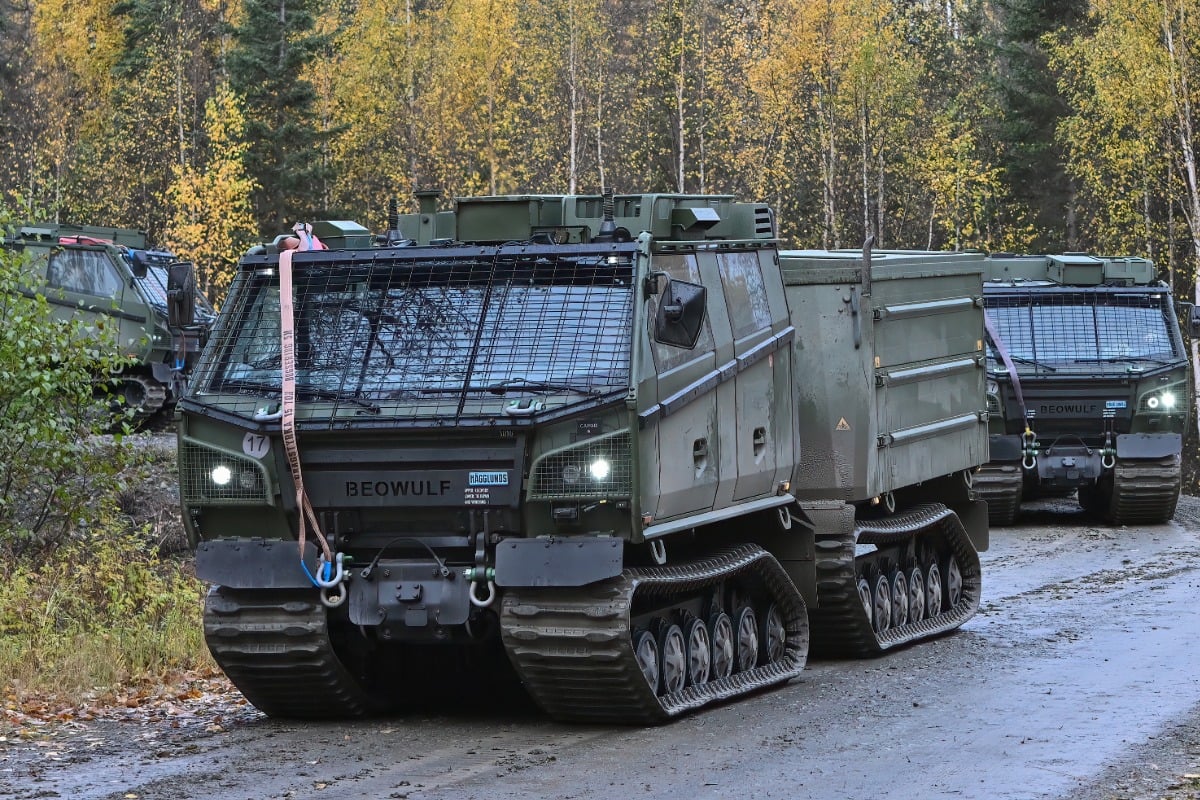
At seventy degrees north latitude, the cold is not an environmental condition. It is a physical adversary.
When the wind sweeps across the frozen expanse of the Arctic, it carries a specialized kind of cruelty. Exposure will kill a human being in minutes. Standard military grease turns into a substance resembling hardened epoxy. Steel becomes brittle enough to shatter like cheap glass under sudden impact. In this wilderness, if your machinery fails, you do not wait for a tow truck. You simply freeze. Read more on a connected subject: this related article.
For decades, the strategic calculus of global conflict ignored these outer edges of the map. The ice was a natural barrier, an impenetrable shield of white space. But the ice is changing, thinning out, opening up shipping lanes and revealing vast, untouched reserves of rare earth metals and natural gas. The world is looking north, and the United States military has quietly realized that its traditional iron—the heavy, rumbling tanks and armored personnel carriers designed for the fields of Europe or the deserts of the Middle East—is completely useless here.
Try driving an conventional armored vehicle into a deep snowdrift or across a thawing peat bog, and it will bury itself to the axle. The massive weight concentrated on narrow tracks behaves exactly like a stone dropped into water. Additional journalism by The Next Web explores comparable views on this issue.
This reality explains why a $35 million contract modification signed quietly at the end of June 2026 carries an importance far outweighing its budget line. The U.S. Army just ordered another batch of its most specialized, unarmored survivors: the Cold Weather All-Terrain Vehicle, or CATV.
Built by BAE Systems Hägglunds in northern Sweden, where engineers live and breathe sub-zero engineering, the vehicle—known colloquially as the Beowulf—looks less like a weapon of war and more like a high-tech caterpillar. It is a dual-body machine, split into two distinct cabins connected by an articulated steering joint.
To understand why this bizarre configuration matters, think of a human hand traversing a mattress. If you press down with a single fist, you sink deeply. If you lay your forearm flat, your weight distributes, and you stay on top. The Beowulf uses massive, wide rubber tracks spread across both of its connected bodies. The pressure it exerts on the ground is lower than a human footprint. It glides over snowdrifts that would swallow a humvee whole.
Consider a hypothetical team of infantry scouts deployed near the Arctic Circle. The mission requires moving twenty miles through uncharted tundra to monitor a remote choke point. In an older vehicle, the journey is a grueling gamble. Deep snow slows momentum to a crawl, burning through fuel at a catastrophic rate. If the ice cracks over an unexpected swamp or river crossing, the vehicle sinks, and the mission becomes a race for survival.
But the Beowulf handles the landscape differently. When the front cabin encounters a vertical ridge of ice, it climbs up, while the rear cabin pushes it forward from below. If the ice gives way completely and the vehicle plunges into open water, it does not sink. It floats. The tracks act as paddles, churning through the frigid slush at a steady clip until the front cabin hooks its nose onto the next solid ledge and pulls the entire unit back onto the ice sheet.
This go-anywhere capability is reshaping how planners view northern sovereignty. For years, the military relied on the aging Bv206, a platform designed in the late twentieth century that had grown tired, cramped, and mechanically weary. The transition to the modern CATV platform provides more than just updated electronics; it provides a survival cell. The interior is pressurized, heavily insulated against temperatures that drop past minus forty, and modular enough to shift from an infantry transport to an emergency ambulance or a mobile command center within hours.
The real tension in modern military readiness lies exactly here, in the quiet procurement of tools designed for environments where the weather is a deadlier enemy than any opposing force. It is easy to focus on the flashy, high-tech systems—the stealth jets, the laser defense grids, the autonomous drones. But none of those platforms can project presence if the human beings tasked with operating them cannot survive the night on the ground.
By expanding its fleet of these articulated Arctic crawlers, the military is acknowledging a simple, unyielding truth. The high north cannot be tamed by brute force or heavy armor. It can only be navigated by matching the environment's hostility with sheer engineering cleverness, ensuring that when the world's attention turns to the ice, the people sent to defend the border have a machine that refuses to let them freeze.