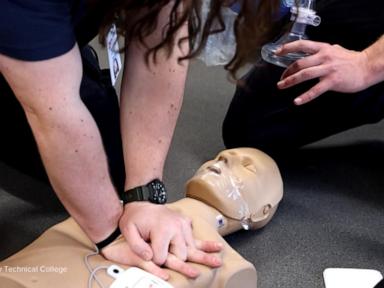
You’ve seen the movies where a training exercise suddenly turns real. Usually, it’s a cliché script meant to build tension. But for a group of EMT students at Fox Valley Technical College, that "script" became a terrifying reality on a Wednesday morning that changed their lives—and saved their instructor’s.
Karl Arps, a 72-year-old veteran instructor with a quarter-century of experience, was in the middle of a lecture when the unthinkable happened. He wasn't just talking about heart attacks; he was demonstrating the signs of one. Then, his hand curled. His face contorted. He started snoring—a classic sign of agonal breathing.
When the Teacher Becomes the Patient
Logan Lehrer, one of the students in the room, didn't immediately jump up. Why? Because Arps was a good teacher. Lehrer actually thought it might be a test or a very committed bit of acting. That’s a common psychological hurdle in emergencies—the "denial phase" where your brain tries to convince you everything is fine.
But Lehrer felt a pit in his stomach. This didn't feel like a joke. When another instructor, Traci Blondeau, tried to "snap him out of it" and failed, the room shifted from a classroom to a trauma bay in seconds.
The irony is thick here. Arps was literally teaching his students how to save a life when his own heart stopped. He went into full cardiac arrest. In that moment, the students ceased being pupils and became the very professionals Arps had spent years molding.
The Brutal Reality of Cardiac Arrest Statistics
Most people think CPR is a magic wand. It’s not. If you collapse on the street, your odds of walking out of the hospital are grim—usually less than 10%.
According to the American Heart Association, over 350,000 out-of-hospital cardiac arrests happen every year in the U.S. alone. The survival rate for a bystander-witnessed arrest is slightly better, around 13%, but it’s still a coin flip where the coin is weighted against you.
What changed the math for Karl Arps? Three things:
- Immediate Recognition: They didn't wait five minutes to see if he’d wake up.
- High-Quality CPR: They took turns, ensuring nobody got too tired to give effective compressions.
- Early Defibrillation: They used an AED before the ambulance even arrived.
For every minute that passes without a shock from a defibrillator, the chance of survival drops by about 10%. If those students had fumbled for even three minutes, Arps’s chances would have plummeted.
The Success That Defied the Odds
Arps later told reporters that in his 25 years of practice, he can count the number of "CPR saves" he's seen on one hand. Usually, you get a pulse back, the ambulance rushes them away, and the patient passes away in the ICU a few days later.
Arps didn't just get a pulse back. He underwent triple-bypass surgery and walked out of the hospital seven days later. That’s not just a "save"; that’s a miracle of modern medicine and perfect execution by his students.
What You Can Learn from the Fox Valley Incident
You don't need to be an EMT student to save a life, but you do need to stop overthinking it. Here’s what actually matters when the person next to you hits the floor:
- Check for "Normal" Breathing: If they’re gasping or making snoring sounds (agonal breathing), their heart has likely stopped. Don’t wait.
- Push Hard and Fast: You need to go 2 to 2.4 inches deep. Yes, you might crack a rib. Do it anyway. Aim for 100-120 beats per minute—think the beat of "Stayin' Alive" or "Another One Bites the Dust."
- Find the AED: Most public buildings have them. Open it. It will literally talk to you and tell you exactly what to do. You cannot "accidentally" shock someone who doesn't need it; the machine won't let you.
Karl Arps ended up giving his students life-saving pins and some treats as a thank-you. But the real reward was the look on his face when he walked back into that college. He spent his career wondering if his students were actually listening. Now, he knows they were.
If you’ve been putting off a CPR class, let this be the push you need. You aren't just learning a skill for a resume; you’re learning how to be the person who changes a "10% survival rate" into a "walking out of the hospital" story. Go find a local Red Cross or American Heart Association class this weekend. Don't wait until you're the one feeling that pit in your stomach.
Students learning CPR save instructors life
This video provides the firsthand account of the students and the instructor involved in the Fox Valley Technical College incident, highlighting the emotional and technical aspects of the rescue.
http://googleusercontent.com/youtube_content/1