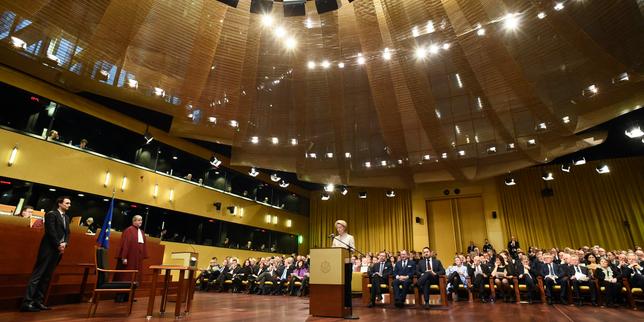
The Court of Justice of the European Union decides how nearly 450 million people live. Its rulings shape data privacy, corporate monopolies, environmental rules, and basic human rights across the continent. You would think an institution with that much power would operate under the highest standards of transparency. It doesn't.
When it comes to managing potential conflicts of interest, the European Court of Justice remains one of the most secretive bodies in the European ecosystem.
Judicial independence is a vital principle. Nobody wants politicians dictating legal outcomes. But the Luxembourg-based court frequently uses independence as a shield to deflect legitimate scrutiny. Right now, judges and advocates general essentially police themselves. That lack of external oversight creates a culture where questionable ties, corporate-sponsored academic gigs, and rapid career shifts into the private sector go unchecked.
If you look closely at how the institution handles internal ethics, the cracks are hard to ignore. The current system relies on blind trust. In a modern democracy, blind trust is a terrible strategy.
Why Self Regulation Fails in Luxembourg
The core issue rests on who handles compliance. If a judge faces a potential conflict of interest, the decision to step aside is mostly left to the individual or the president of the court. The public rarely learns why a judge recused themselves, or more importantly, why they chose not to.
This internal mechanism lacks independent eyes. The court operates under a Code of Conduct that looks fine on paper. It tells members to avoid any situation that could give rise to an impression of bias. But look at the enforcement. There is no independent ethics committee with the teeth to investigate, penalize, or publicly report on breaches. Everything happens behind closed doors.
When decisions are made in the dark, public suspicion grows. If a judge has ties to a specific industry or a former client, the public has a right to know how that connection is managed during high-stakes litigation. Instead, the court provides a wall of silence. They expect the public to believe that judges can completely detach from their past professional networks without any systemic verification. It is an outdated way of running a judiciary.
The Revolving Door problem is Real
What happens when a top European jurist leaves office? They become highly valuable assets for private law firms, corporate lobbies, and multinational entities. The knowledge they hold is elite. The networks they possess are even more valuable.
The court has implemented cooling-off periods, but they are notoriously weak compared to other international standards. Former members frequently move into advisory roles where they help corporations navigate the exact laws they used to interpret. They don't always appear directly in the courtroom right away, but they pull the strings behind the scenes. They write legal briefs, guide litigation strategies, and show private interests how to exploit loopholes in European law.
This transition from public guardian to corporate strategist happens with alarming regularity. When a former judge joins a major international law firm, it sends a troubling signal to the public. It suggests that public service is just a stepping stone to a lucrative corporate career. Without strict, lengthy, and independently enforced bans on post-term employment, the revolving door keeps spinning, blurring the line between public justice and private profit.
Paid Speeches and Secret Calendars
Judges don't live in a vacuum, and they shouldn't. They teach, write, and speak at conferences. But these academic pursuits frequently cross into grey areas.
Many judges participate in events organized by university faculties, legal associations, or think tanks that receive substantial funding from corporate donors. Sometimes the events themselves are directly sponsored by law firms representing clients with active cases before the court.
Who pays for the flights? Who covers the luxury hotel stays? Are there honorariums involved? The court doesn't provide a clear, itemized public registry for these details. We get vague declarations of interests that don't give the full picture.
When a jurist speaks at an exclusive seminar attended by elite corporate lawyers, it matters. It creates unequal access. Average citizens can't pay thousands of euros to attend a private legal retreat to rub shoulders with the people shaping European law. The lack of granular transparency around these external activities makes it impossible to know if corporate interests are buying subtle influence under the guise of academic discourse.
The Myth of Judicial Independence as a Shield
Whenever civil society organizations or investigative journalists demand better transparency, the court relies on a predictable defense. They claim that external oversight would compromise their judicial independence. They argue that if an outside body investigates their finances or professional relationships, it could be used to pressure judges politically.
This argument is deeply flawed. Transparency does not weaken independence. It strengthens it.
An independent judiciary needs public trust to survive. If citizens believe that rulings are influenced by cozy relationships, elite networks, or future job prospects, the authority of the court crumbles. True independence means being free from improper influence, and the best way to prove that freedom is to let the sunlight in. Pretending that judges are infallible beings immune to normal human incentives is naive.
The court fiercely resisted being included in the unified EU ethics body that civil society groups fought for. They wanted to maintain their exceptional status. By isolating themselves from broader European accountability trends, they are actively damaging their own institutional credibility.
What Needs to Change Right Now
Fixing this broken system requires concrete structural reform, not more vague declarations or voluntary guidelines. The court needs to modernize its approach to ethics immediately.
First, the court must establish an independent ethics panel composed of retired jurists and transparency experts who have no active ties to the institution. This panel needs the power to review judges' financial holdings, past client lists, and external engagements. They should make binding recommendations on recusals.
Second, the court must publish a comprehensive, searchable public registry. This registry should include:
- Detailed reasons for every single judicial recusal.
- Full funding sources for all external academic and speaking engagements.
- Complete meeting logs of court leadership with outside interests.
- A public list of cases where former court members are involved behind the scenes.
Third, the cooling-off period needs to be extended to at least three years for any work involving matters related to EU law. Former judges should be banned from advising private clients on how to defeat European regulations that they helped establish.
The European Court of Justice cannot continue to operate like an elite, closed club. Power demands accountability. If the court expects European citizens to respect its rulings, it must open its doors and prove that its justice is completely blind, entirely impartial, and absolutely transparent.