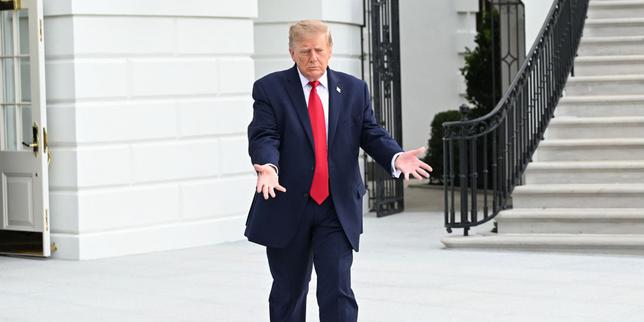
President Donald Trump has flatly rejected Iran's hardline roadmap to reopen the Strait of Hormuz, setting off a dangerous diplomatic stalemate that leaves global energy markets tethered to a knife-edge. Tehran insists it will not budge on an uncompromising list of prerequisites before any substantive talks or normalization can begin, creating an unyielding impasse where neither side possesses the political room to surrender an inch of ground.
That rejection crystallized a reality that career diplomats and military strategists have tracked with quiet dread since the current conflict flared. The Persian Gulf remains crippled by an ongoing naval standoff that defies conventional diplomatic resolution. The White House views Tehran's terms not as a genuine opening for peace, but as an aggressive demand for unilateral capitulation. Tehran counters that Washington started the cycle of coercion and must pay the full economic and military price before a single tanker passes unmolested through the narrow waters. Meanwhile, you can read related events here: The Shadow Heir And The Rubble Of Tehran.
Behind this public posturing lies a grinding war of attrition fought across maritime corridors, diplomatic backchannels, and economic pressure points. The stakes could hardly be higher. Before the outbreak of hostilities, roughly a quarter of the world's seaborne oil trade and a massive share of global liquefied natural gas transited this twenty-one-mile-wide maritime bottleneck. When the conflict erupted and Iranian forces choked traffic through the strait, energy supply chains shuddered. The subsequent implementation of a U.S. naval blockade aimed at starving Iran of crude revenues transformed a localized exchange into a worldwide economic hazard.
To understand why a diplomatic off-ramp remains completely out of reach, one must examine the precise architecture of Iran's demands. Tehran has formalized its position into a rigid set of prerequisites. These conditions demand an immediate halt to hostilities on all fronts, the total lifting of American and allied economic sanctions, the unfreezing of billions in sovereign assets held abroad, massive financial reparations for war damages, guarantees against future military strikes, and an arrangement that grants Iran and regional partners supervisory control over maritime traffic in the strait. To understand the full picture, we recommend the excellent report by The New York Times.
From the perspective of any American administration, this list is a non-starter. No sitting U.S. president can unilaterally lift congressional statutory sanctions, nor can they legally bind future executives to ironclad non-intervention pledges. More fundamentally, demanding that Washington dismantle its economic pressure tools and naval presence before negotiations even commence asks the White House to reward the very actor responsible for closing an international waterway. Washington views the proposition as a transparent attempt to salvage a strategic victory out of battlefield stagnation.
Yet Tehran's intransigence is equally rooted in domestic survival. The clerical leadership and the Islamic Revolutionary Guard Corps have framed their conditions as non-negotiable markers of national sovereignty. To back down now, after absorbing heavy blows from U.S. and Israeli air campaigns and enduring crippling economic isolation, would invite internal instability that the regime cannot afford to risk. Hardliners inside the Iranian parliament argue that any sign of weakness will only invite further coercion. Consequently, state media outlets routinely cast the seven conditions as the ultimate terms of an American defeat, reinforcing a domestic narrative of unyielding resistance.
History offers a brutal lesson on the enduring vulnerability of this maritime corridor. Decades ago, during previous eras of conflict in the Gulf, tanker wars demonstrated how easily a narrow geographic bottleneck could be weaponized by weaker naval actors against technologically superior adversaries. The geography itself favors asymmetric disruption. Iran cannot permanently close the Strait of Hormuz in the face of overwhelming American naval might, but the United States cannot permanently secure every square mile of the waterway against asymmetric harassment, drifting mines, and shore-based missile threats without committing an unsustainable volume of resources indefinitely.
The economic fallout radiates far beyond the immediate Middle Eastern theater. Major energy importers across Europe and Asia, heavily reliant on a steady stream of crude and liquefied natural gas from the Gulf, have absorbed severe price volatility. Even as preliminary estimates indicate that partial flows through offshore transfers and escorted convoys have recovered to a fraction of pre-war levels, the cost structure of global trade has fundamentally shifted.
Insurance underwriters in major markets have responded to the persistent threat of mine strikes and drone attacks by slapping prohibitive war-risk premiums on commercial vessels entering the Persian Gulf. Shipowners must calculate whether the profit margin of a successful voyage justifies the catastrophic risk of hull damage or total loss. These financial hurdles act as an invisible tax on global commerce, stoking inflationary pressures that ripple through manufacturing, agriculture, and consumer goods worldwide.
Oman, which has historically served as the primary diplomatic bridge between Washington and Tehran, has found its traditional mediation efforts repeatedly stymied. The fundamental disagreement centers on sequencing. Tehran demands that sanctions and naval blockades be lifted first as an act of good faith before it permits unfettered transit. Washington insists that the strait must be fully opened and verified as safe before any economic relief can be discussed. This diplomatic chicken-and-egg dilemma ensures that every round of backchannel talks collapses before reaching substantive ground.
The diplomatic deadlock has forced the United States to attempt a high-stakes workaround. Rather than accepting Tehran's terms, the White House has relied on naval escort operations, military patrols, and aerial overwatch to punch holes through the blockade and guide commercial tankers past danger zones. Cargo volumes have clawed their way back up from the catastrophic zeros seen in the opening weeks of the conflict, reaching a fragile recovery status. Yet this military escort model is deeply imperfect. Tankers traversing the southern Persian Gulf continue to report harrowing encounters, floating mines, and persistent harassment by fast attack craft.
The security situation in the wider region exacerbates these maritime tensions. Iran and its regional network have demonstrated a capacity to project retaliation well beyond the immediate theater, targeting critical infrastructure and military outposts across the Gulf states. Drone strikes and missile interceptions over neighboring countries serve as a constant reminder that any miscalculation in the narrow waters of Hormuz can instantly escalate into a wider regional conflagration.
Politically, the timing compounds the friction. Domestic political shifts in Washington, marked by congressional midterm elections that altered the balance of power on Capitol Hill, have left foreign policy actors navigating shifting sands. Whispers of internal divisions within the executive branch regarding the utility of prolonged military pressure have occasionally surfaced, but the overarching posture remains resolute. Trump has expressed confidence that sustained pressure will ultimately break Tehran's resolve, arguing that Washington's objectives can be achieved through total victory rather than a compromised settlement.
Behind the locked doors of foreign ministries, international mediators find themselves trapped in a frustrating holding pattern. Neither Washington nor Tehran is willing to alter its baseline assumptions. The United States demands that Iran surrender its bargaining chips and accept maritime security terms dictated from the outside. Iran demands that the United States dismantle its entire coercive apparatus before it even discusses opening the gate it bolted shut.
This is the fundamental trap of modern great-power coercion. When superpowers rely on maximalist economic blockades and regional actors possess the capacity to hold global energy hostage through asymmetric means, diplomacy becomes a casualty of mutual intransigence. Shipping companies and energy traders are thus left to navigate a permanent state of limbo, learning to price in perpetual risk while statesmen posture for domestic audiences.
The standoff persists, sustained by mutual distrust and the grim realization that the next escalation is only ever a single miscalculated maneuver away.