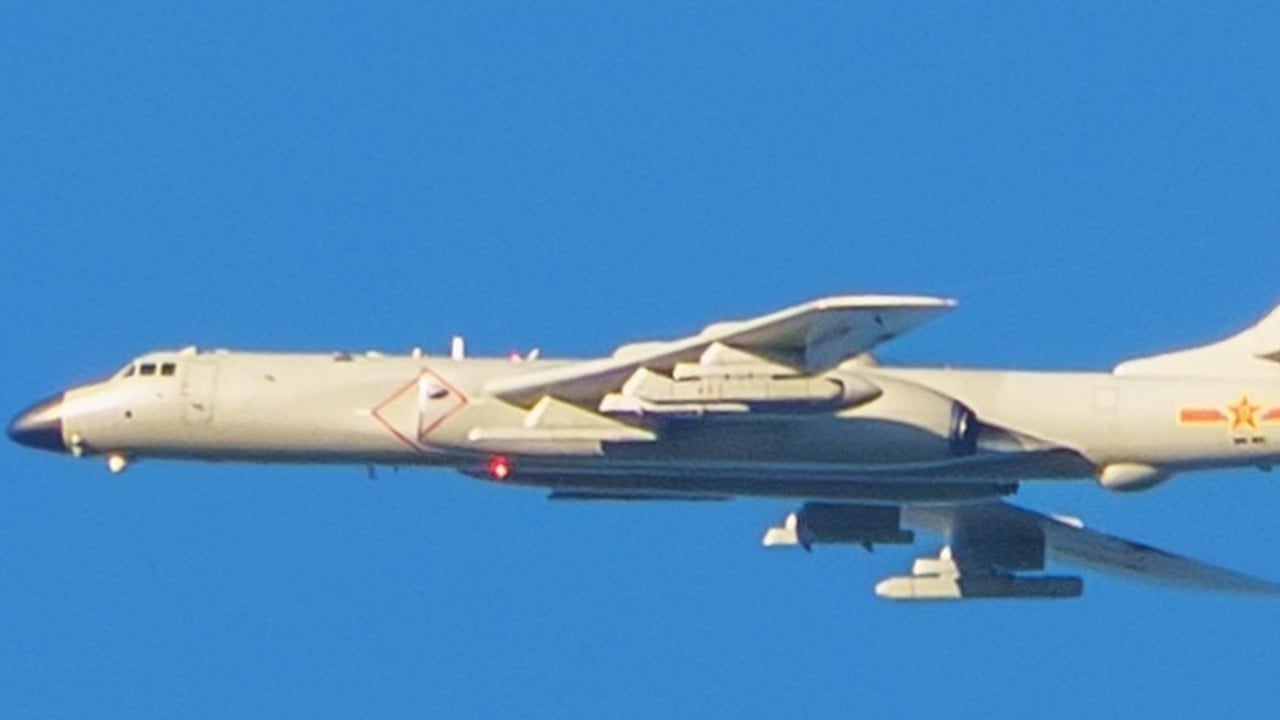
Yes, China is actively equipping its H-6K strategic bomber with heavy electronic warfare and standoff jamming capabilities. Visual evidence from state media broadcasts and open-source satellite imagery confirms that the People’s Liberation Army Air Force (PLAAF) has begun pairing the aging, Cold War-era airframe with massive wing-mounted electronic countermeasure pods. Rather than retiring a subsonic bomber that cannot survive modern air defenses on its own, Beijing is repurposing the H-6K into a high-powered flying jamming platform designed to blind enemy radar networks and escort stealth strike packages across the Western Pacific.
The move makes cold, operational sense. You do not need a sleek, radar-evading fuselage to win an electromagnetic fight from 300 miles away. You need electrical power, internal volume, and payload capacity. The H-6K has all three in abundance.
The Physics of Turning a Bomber Into a Jammer
To understand why the PLAAF is bolting electronic warfare suites onto a design rooted in the 1950s Soviet Tupolev Tu-16, look at the basic physics of radio frequency interference. Electronic attack is a brute-force numbers game governed by power and antenna aperture. Small tactical fighters—even specialized ones like the U.S. Navy’s EA-18G Growler or China’s own J-16D—face strict limits on how much raw electricity their engines can generate and how much cooling fluid they can circulate through their wings.
The H-6K does not have that problem. Powered by two Russian-designed Soloviev D-30KP-2 turbofan engines—or domestic WS-18 equivalents—the aircraft carries massive fuel reserves and sits on a wide airframe capable of hauling roughly 12 metric tons of ordnance. Swap out a few heavy anti-ship cruise missiles for dedicated electrical generators and high-gain active electronically scanned array (AESA) jamming pods, and the bomber transforms into a mobile power station.
In practical terms, this allows the H-6K to project directional beams of radio frequency noise across multiple frequency bands simultaneously. Instead of merely protecting itself from an incoming surface-to-air missile, an H-6K equipped with standoff jamming pods can blanket an entire sector of airspace. It creates an electromagnetic corridor, masking the radar signatures of lower-flying strike fighters, drones, and cruise missiles trailing behind it.
What the Imagery Actually Shows
For years, defense analysts tracked incremental upgrades to the H-6 family—from the H-6H to the H-6K, and later the navalized H-6J and aerial-refuelable H-6N. The standard H-6K already carried small, self-defense electronic countermeasure pods on its outer wingtips. Those were strictly defensive tools meant to confuse terminal missile seekers during the final seconds of an engagement.
Recent photographs circulating on Chinese defense forums and verified through official military documentaries show something entirely different. Under the inner and mid-wing pylons—stations normally reserved for KD-20 land-attack cruise missiles or YJ-12 supersonic anti-ship missiles—airframes have appeared carrying oversized, streamlined pods featuring distinct dielectric radome panels on their forward and aft sections.
These are not self-protection jammers. Their size, cooling vents, and multi-faceted antenna arrays point directly to high-output standoff electronic attack. By mounting these pods on the H-6K, the PLAAF bridges a critical operational gap. Tactical electronic warfare jets like the J-16D have the speed and agility to fly alongside strike fighters into contested airspace, yet they lack the loiter time to sustain a multi-hour blockade or campaign far beyond the First Island Chain. The H-6K can orbit outside the engagement envelope of Patriot or Aegis air defense batteries for hours, pumping continuous interference into opposing sensor networks.
Solving the Taiwan and South China Sea Air Defense Problem
Any conflict in the Western Pacific will be decided in the electromagnetic spectrum long before the first kinetic warhead finds its target. Over the past two decades, Taiwan, Japan, and the United States have built an interlocking web of long-range surveillance radars, airborne early warning aircraft, and mobile surface-to-air missile systems.
If the PLAAF launches a conventional air assault across the Taiwan Strait, its aircraft face immediate detection the moment they lift off from mainland airbases. Even China’s premier stealth fighter, the J-20, is not invisible. Stealth reduces detection ranges; it does not grant immunity, especially when tracked by low-frequency VHF radars or multi-static sensor networks linking ground stations with E-2D Hawkeye surveillance planes.
This is where the jammed H-6K earns its keep. Operating in orbits over the East China Sea or the Luzon Strait, a pair of jamming-configured H-6Ks can target the specific frequencies used by long-range early warning radars and data links.
Consider a hypothetical scenario during a naval blockade. A strike group of J-16 fighters and H-6J bombers approaches from the west, carrying anti-ship missiles aimed at surface vessels operating east of Taiwan. Behind them, at an altitude of 35,000 feet and a distance of 250 miles, two electronic warfare H-6Ks activate their wing pods. By directing high-powered noise and deceptive false-target signals straight into the radar receivers of defending destroyers and land-based batteries, the jamming bombers compress the defenders' radar horizon. Instead of detecting the incoming strike package at 200 miles, defending operators might only see clear tracks at 60 miles—cutting their reaction window from twenty minutes down to less than five.
The Structural Flaws Beijing Cannot Engineer Away
Turning an old bomber into an electronic attack platform is clever, economical, and dangerous. It is also fraught with serious operational vulnerabilities that Chinese state media conveniently ignores.
First, a jamming aircraft is a screaming beacon. The moment an H-6K turns on its high-powered emitters, every passive electronic support measures (ESM) receiver within 500 miles knows exactly where it is, what altitude it is flying at, and what frequency bands it is targeting. You cannot hide while broadcasting kilowatts of radio energy into the sky.
Second, the H-6K is slow, non-stealthy, and completely unmaneuverable. With a maximum cruise speed around Mach 0.75 and the radar cross-section of a small office building, the aircraft is a prime target for long-range interceptor missiles. Modern air-to-air weapons—such as the U.S. AIM-120D AMRAAM, the upcoming AIM-260 JATM, and the Standard Missile 6 (SM-6)—include "home-on-jam" guidance modes. Rather than being defeated by electronic noise, the missile seeker simply locks onto the source of the interference and rides the jamming beam straight into the bomber's fuselage.
To keep an electronic warfare H-6K alive, the PLAAF must dedicate precious fighter escorts to fly defensive combat air patrols around it. Every J-20 or J-16 assigned to babysit a vulnerable jamming bomber is a fighter taken away from offensive sweep missions. If those escorts are overwhelmed or forced to burn through their fuel fighting off allied interceptors, the H-6K becomes an easy kill.
How This Fits Into China’s Broader Electromagnetic Doctrine
For decades, Western military planners viewed electronic warfare as a supporting niche—something handled by a handful of specialized squadrons tacked onto the edge of a strike package. China took the opposite path. Under the doctrine of Integrated Network Electronic Warfare, Beijing treats the electromagnetic spectrum as a primary warfighting domain on par with land, sea, air, and space.
The PLAAF has spent the last ten years systematically fielding a layered family of electronic warfare aircraft to cover every range and altitude band:
- Tactical Escort: The J-16D, a twin-seat heavy fighter stripped of its internal cannon and infrared search-and-track sensor to carry wingtip electronic intelligence pods and underwing jammers, flies directly alongside strike fighters into heavily defended airspace.
- Persistent Surveillance and Medium-Range Jamming: The Y-9G (GX-11), built on a four-engine turboprop transport airframe, provides long-endurance electronic intelligence gathering and communications jamming.
- Heavy Standoff Attack: The modified H-6K brings the sheer electrical wattage and high-altitude line-of-sight needed to suppress theater-level radar networks from outside standard missile engagement zones.
By mixing turboprops, tactical fighters, and strategic bombers, China avoids relying on a single airframe. Even if an adversary develops countermeasures tailored to defeat the J-16D’s tactical pods, they still have to contend with the brute-force power output radiating from an H-6K orbiting miles behind the front line.
The Real Cost of Extending a 1950s Airframe
There is an unspoken admission baked into this upgrade program. The PLAAF is stretching the H-6 airframe to its absolute physical limits because its next-generation stealth bomber, the Xi’an H-20, remains delayed and unproven in operational service.
Every mission profile added to the H-6K fleet—anti-ship strikes, ballistic missile launches, aerial refueling, and now heavy standoff jamming—places mounting stress on airframes and production lines at the Xi’an Aircraft Industrial Corporation. While newer H-6 variants are freshly built airframes utilizing modern composite materials and digital fly-by-wire avionics, the fundamental aerodynamic design remains tethered to mid-20th-century engineering.
Powering next-generation AESA jamming pods also creates immense thermal management headaches. High-power gallium nitride (GaN) transmit/receive modules generate tremendous heat. If the pods' internal ram-air heat exchangers fail or become degraded during high-altitude operations in humid Pacific weather, the system must throttle back its power output to avoid melting its own electronics. Maintaining these complex pods at forward operating bases along the Chinese coast requires specialized diagnostic equipment and highly trained technicians—a logistical bottleneck that rarely shows up in glossy military parade footage.
What Comes Next in the Spectrum War
Do not expect the H-6K to suddenly render Western air defenses obsolete. Modern phased-array radars like the AN/SPY-6 on U.S. Navy destroyers and the AN/APG-81 on the F-35 Lightning II are specifically engineered with frequency agility, low-probability-of-intercept waveforms, and digital beamforming that can null out directional jamming signals.
Instead, the emergence of the jamming-capable H-6K signals an escalating war of attrition in signal processing and raw wattage. Beijing is betting that by flooding the skies with high-powered, multi-band interference from safe standoff distances, it can degrade allied sensor networks just enough to let hypersonic anti-ship missiles and stealth strike packages slip through the cracks.
For defense planners in Washington, Tokyo, and Taipei, the takeaway is straightforward. Countering China’s bomber fleet is no longer just about intercepting cruise missiles before they hit a runway or an aircraft carrier. It now requires hunting down the flying power stations orbiting hundreds of miles behind the fight—and doing it while blind.



