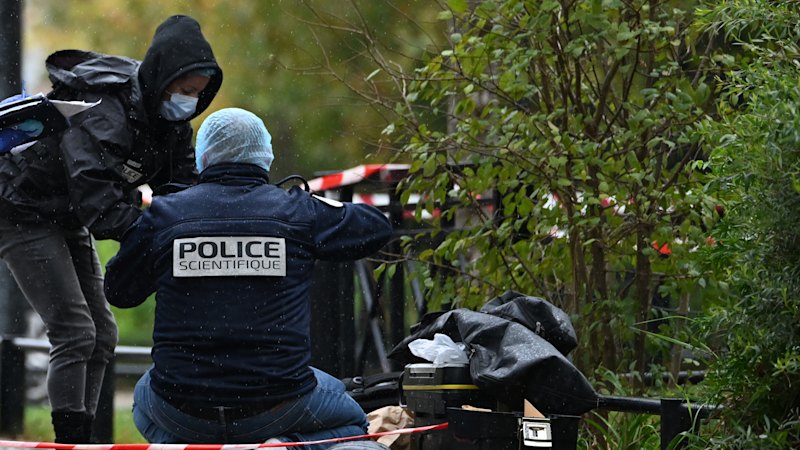
Police slapped the "terrorist attack" label on a deadly shooting outside Paris within hours. Predictable. Lazy. Comfortably neat.
Every time violence erupts on the periphery of a major European capital, the instant reflex is to sort it into a pre-cut ideological box. If there is a manifesto, a grievance, or a recognizable banner, the label sticks. If there is not, investigators still rush to frame the event through the familiar lens of counterterrorism because that is the machinery already warmed up, funded, and waiting for a cue.
That reflex is a trap. It makes public officials look decisive while quietly distorting how security agencies, media outlets, and citizens actually understand violence. When every fatal shooting outside Paris gets folded into the terrorism bucket, we stop asking sharper questions about criminal networks, local policing gaps, radicalization without ideology, and the sheer momentum of armed disorder.
I have spent years watching security analysts and policy teams burn credibility by treating a label as an explanation. Calling a shooting terrorism does not tell you why a perimeter failed. It does not tell you how a firearm crossed a border or why an attacker chose an outer district instead of a landmark. It just hands everyone a convenient headline before the evidence settles.
The Label Trap That Blinds Security Analysts
A "terrorist attack" is not a casual synonym for a shocking or deadly crime. In legal and security practice, terrorism refers to the unlawful use of violence and intimidation, especially against civilians, in the pursuit of political, religious, or ideological aims. That distinction matters. If you blur every mass casualty event or targeted lethal attack into terrorism, the term loses analytical precision.
When police announce early that a shooting outside Paris is being treated as terrorism, the public hears a verdict. Analysts hear a directive. Suddenly, every detail gets filtered through one lens: Who inspired the shooter? Which cell or online network was involved? Was this part of a broader plot?
Sometimes those questions hit the mark. Often, they pull attention away from mechanics that look far less cinematic and far more common. Organized crime disputes spill into public spaces. Personal vendettas turn lethal with military-grade or illicitly sourced weapons. Lone offenders with severe instability latch onto violent imagery after the fact rather than acting on a coherent strategic plan.
Imagine a scenario where a gunman opens fire on the outskirts of a major city after a chaotic mix of personal grievances, drug-market friction, and fragmented online extremism. If investigators lock onto the ideological angle on day one, they can spend precious hours chasing foreign links while missing a local supplier or a glaring failure in municipal surveillance. By the time the picture clears, the initial narrative has already hardened into public memory.
I have seen security briefings where teams spent weeks mapping ideological networks for an incident that turned out to be rooted in street-level trafficking and untreated crisis behavior. The report looked thorough on paper. It missed the actual point of failure completely.
Why "Outside Paris" Changes the Equation
Geography in a major metropolitan area is never neutral. "Outside Paris" covers a massive, varied belt of suburbs, transit corridors, industrial zones, and commuter hubs—often grouped under la banlieue or the wider Île-de-France region—that operate very differently from central tourist or administrative districts.
Central Paris gets dense, visible security saturation. Iconic sites have layered protection, rapid-response patrols, and constant eyes. The outer ring stretches across jurisdictions, rail lines, and neighborhoods where resource allocation, socioeconomic pressures, and policing dynamics look entirely different.
When a shooting happens outside the core, treating it purely as a national security shockwave ignores local friction. Response times vary by municipality. Information handoffs between local police, national judicial authorities, and anti-terror prosecutors can get messy fast. In France, specialized anti-terrorism prosecutors (Parquet national antiterroriste) have specific jurisdiction when facts suggest an enterprise aimed at seriously disturbing public order through intimidation or terror. That legal mechanism exists for real threats, yet early public framing often outpaces verified intent.
Here is a blunt truth most commentary avoids: an attacker operating outside central Paris does not have to be a master strategist to cause chaos. Suburbs and transit arteries offer fast exits, uneven coverage, and crowded bottlenecks at rush hour. Looking only for grand ideological plots misses how opportunistic and geographically specific urban violence can be.
Dismantling the Questions Everyone Keeps Asking
When a deadly shooting hits the news near Paris, the search queries follow a predictable script. People want quick certainty. Most of those questions are framed around the wrong premise.
"Was this an organized terrorist cell?"
Probably not—and asking that first sets the bar backwards. Modern security researchers, including figures like Marc Sageman and Peter Neumann who have studied extremist violence for years, have long pointed out that threat actors frequently operate through loose networks, self-radicalization, or hybrid grievances rather than rigid, top-down cells. Even when ideology is present, it often mixes with personal alienation, criminal history, or impulsive rage. Assuming an organized cell exists before seeing evidence wastes time; proving whether a network actually coordinated anything should be the burden of investigation, not the starting assumption.
"How can police stop attacks outside major cities?"
You cannot police every street corner in a sprawling metro region 24/7 without turning daily life into a checkpoint. Asking how to lock down every outer district misses how prevention actually works. Effective prevention happens upstream and laterally: disrupting illegal firearms pipelines, sharing intelligence cleanly between local precincts and national units, intervening early when individuals flash warning signs of violence, and stabilizing neighborhoods before criminal or extremist recruitment gains traction. Heavy-handed perimeter theater after shots are fired is reactive; quiet, unglamorous coordination is what moves the needle.
"Does a terrorism label mean the threat level just jumped?"
Not necessarily. A single lethal incident can be horrific without signaling a coordinated wave of attacks. Conversely, a non-ideological shooting with an unrecovered shooter and a porous weapon supply can pose an immediate danger to residents even if no political cause is attached. Treating "terrorism" as the only measure of severity distorts risk. Danger comes from capability, access to weapons, and operational gaps—not just the label printed on the initial press release.
What Actually Works When Violence Hits
If you are an analyst, a security lead, a journalist, or simply someone trying to make sense of breaking news without getting played by sensationalism, change how you process the first 48 hours.
- Separate the charge from the motive. Investigators often open terrorism inquiries early to preserve specific legal powers and investigative tools. That is a procedural step, not proof of ideological mastermind status. Read early announcements with that distinction in mind.
- Track the weapon and the route, not just the rhetoric. Ask how the shooter got the gun, how they moved through the area, and where response bottlenecks occurred. Those details expose real vulnerabilities that survive any political spin.
- Demand boring, verifiable facts over dramatic narratives. Watch for overconfident claims about "lone wolves" or " sleeper networks" made before ballistics, digital forensics, and witness timelines are reconciled. Restraint in coverage is a feature, not a flaw.
- Look at local capacity alongside national policy. National counterterrorism doctrines get all the airtime, yet local policing, mental health services, and municipal coordination shape everyday safety on the ground.
The Cost of Getting This Perspective Wrong
Taking a contrarian stance on high-emotion security stories carries real risks, and pretending otherwise would be dishonest. Under-calling a genuine ideological plot can look naive if a coordinated network later surfaces. Pushing back against official framing right after a tragedy can also sound dismissive to grieving families or communities shaken by gunfire.
That is why precision matters. Skepticism is not denial. When evidence points to ideological terror, call it what it is without flinching. When the evidence is thin, mixed, or pointing toward criminal or personal violence wrapped in a convenient label, say so plainly.
The biggest danger in modern security coverage is not asking too many questions. It is letting a single word shut the rest of the investigation down before it even starts. Stop chasing the label. Follow the mechanics.