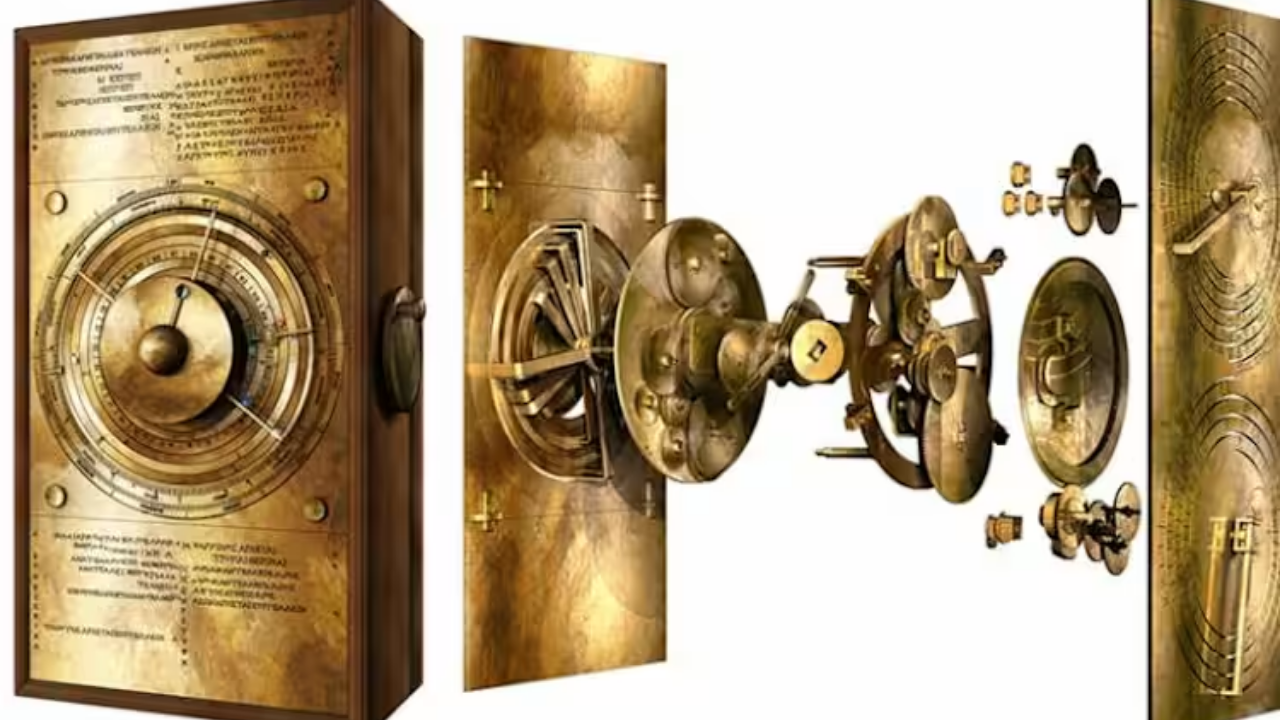
Calling the Antikythera Mechanism "the world’s first analog computer" is a marketing gimmick dressed up as archaeology.
Every few months, a tech blog recycles the same breathless headline about how ancient Greeks built a bronze laptop two millennia ago. They treat a shoebox-sized geared box from a Roman-era shipwreck like an isolated miracle—a sudden flash of genius that vanished into the dark ages, setting humanity back a thousand years.
That narrative is lazy. Worse, it obscures what the device actually represents.
If you look at the Antikythera Mechanism through the lens of modern Silicon Valley, you miss the brutal reality of ancient engineering, the real purpose of the machine, and why the Greeks never built an industrial revolution on top of it. It was not a computer. It was an astrolabe on steroids, an ideological status symbol, and a monument to a civilization that valued cosmic philosophy over practical labor.
Stop Calling It a Computer
Let’s get the definitions straight before we romanticize bronze gears.
A computer, by any rigorous engineering standard—whether Charles Babbage’s Analytical Engine or the device you are reading this on—is programmable. It takes variable inputs, executes conditional logic, and solves general problems.
The Antikythera Mechanism does none of those things.
It is a fixed-function kinematic calculator. You turn a hand crank on the side, and a series of interlocking bronze gears with triangular teeth rotates pointers across several dials. Those pointers track the Metonic cycle (a 19-year lunar-solar calendar), the Saros cycle (used to predict eclipses), the positions of the sun and moon, and the four-year cycle of the Panhellenic games, including the Olympics.
That is an extraordinary feat of mechanical gear-cutting. It is not computing. Comparing the Antikythera Mechanism to a modern computer is like comparing a wind-up music box to a recording studio. Both produce music, and both require precision manufacturing, but one is an automated playback loop while the other is a creative engine.
Derek de Solla Price, the Yale physicist and historian of science who spent decades X-raying the corroded fragments in the mid-twentieth century, famously described it as "an ancient Greek computer" to capture the public imagination and secure funding for his research. The label stuck because journalists love a time-traveling anomaly. Historians of technology, like Michael Wright and Tony Freeth, have spent the last thirty years doing the actual, grueling work of reverse-engineering the gear trains—and their findings point to something far more grounded in Hellenistic astronomy than sci-fi anachronism.
The Myth of the Lone Genius
The standard pop-science story treats the Antikythera Mechanism as an inexplicable outlier, an alien artifact dropped into the Aegean Sea around 70 BCE.
It wasn't. If you find one hyper-complex bronze geared device at the bottom of the ocean, you are not looking at a one-off prototype. You are looking at the sole surviving example of an entire craft tradition.
Ancient metallurgy was brutal, expensive, and unforgiving. Bronze corrodes in seawater, and on land, old bronze gets melted down to make spearheads, coins, or statues. The only reason we have the Antikythera Mechanism is because a Roman cargo ship sank near Crete, burying the box in anaerobic mud that halted total disintegration while turning the metal into brittle atacamite.
We know from Cicero’s De Re Publica that Archimedes built geared planetaria in Syracuse in the third century BCE, which the Roman general Marcellus looted and brought back to Rome. Cicero described a bronze sphere that reproduced the motions of the sun, moon, and five known planets, accurately simulating solar and lunar eclipses.
The Antikythera Mechanism wasn't magic. It was the culmination of centuries of Babylonian astronomical record-keeping fused with Greek geometric modeling—specifically the epicyclic theories of Hipparchus of Rhodes.
Look closely at the lunar mechanism inside the device. The moon does not move at a constant speed across our sky because its orbit around Earth is elliptical. Ancient Greeks didn't know about elliptical orbits; they believed celestial bodies moved in perfect circles. To explain why the moon speeds up and slows down, Hipparchus invented a mathematical trick using off-center circles (epicycles).
The engineers behind the Antikythera Mechanism solved that math physically. They mounted a gear onto another gear using a pin-and-slot mechanism. As the drive gear rotated, the pin slid back and forth in the slot, causing the driven gear to accelerate and decelerate at the exact rate needed to mimic the moon’s variable velocity.
That pin-and-slot assembly is pure mechanical brilliance. Yet it also exposes the profound limitation of the Greek mindset: they built an intricate machine to preserve a flawed geometric dogma rather than questioning why the sky didn't fit their circles.
Why It Didn't Spark an Industrial Revolution
Here is the question every tech enthusiast asks: If the ancient Greeks could cut thirty-plus precision gears out of bronze, calculate lunar anomalies, and build differential-style mechanisms, why didn't they invent the steam engine, the mechanical clock, or the factory?
The standard answer blames the fall of Rome, Christian superstition, or the burning of the Library of Alexandria. Those explanations are historically illiterate.
The Greeks didn't fail to industrialize because they lost the blueprints. They failed to industrialize because their entire economic and philosophical worldview despised manual labor.
In the Greco-Roman world, physical work was what enslaved people did. Free citizens pursued politics, rhetoric, warfare, and pure philosophy. Hero of Alexandria famously built the aeolipile—a spinning steam turbine—in the first century CE. He used it as a temple novelty and a party trick. Nobody attached it to a water pump or a grain mill because human muscle was cheap, abundant, and disposable.
When labor is free, automation is a waste of capital.
Furthermore, classical Greek philosophers drew a rigid boundary between episteme (pure theoretical knowledge) and techne (craftsmanship and mechanical skill). Plutarch noted that Archimedes himself viewed mechanics and every art that ministers to common uses as "ignoble and vulgar," refusing to leave behind any written treatise on his practical inventions, focusing entirely on abstract geometry.
The Antikythera Mechanism survived social stigma only because it served the highest philosophical purpose: demonstrating the divine, mathematical order of the cosmos. It wasn't built to save time, measure factory shifts, or navigate ships across oceans.
The Navigation Lie
Let’s dismantle another persistent myth: that sailors used the Antikythera Mechanism to navigate the Mediterranean.
Anyone who has ever stepped onto a wooden boat in open water knows this is absurd.
First, the device has no magnetic compass, no sextant sights, and no way to measure latitude or longitude. Even if it could tell you the exact phase of the moon and the date of the next lunar eclipse, knowing an eclipse will happen in three weeks does nothing to keep your trireme off a reef in a squall.
Second, bronze gears exposed to salt spray seize up within days. The Antikythera Mechanism was housed in a wooden frame with delicate inscribed bronze doors, meant to sit on a table in a scholar’s study or a wealthy patron's villa.
Third, its gearing had massive mechanical backlash. Because the triangular teeth were filed by hand—likely using templates and dividers—there was inevitable slop between the meshing gears. As Tony Freeth and the Antikythera Mechanism Research Project demonstrated through micro-focus X-ray computed tomography, errors in tooth spacing meant that turning the crank forward and backward produced noticeable lag. In a study room, a user could gently advance the crank to demonstrate cosmic cycles to guests. On a pitching ship deck, the mechanism would have been useless.
It was a conversation piece for the ultra-wealthy. Imagine a modern billionaire commissioning a custom $2 million mechanical astronomical watch from Patek Philippe—not because they need to know what time it is, since their phone already tells them, but to signal intellect, wealth, and mastery over time itself. That is what sat on that Roman cargo ship.
What Modern Engineers Actually Get Wrong
I have watched hardware startups burn through tens of millions of dollars chasing the same fallacy that blinds people to the truth about Antikythera: confusing technical complexity with utility.
Engineers love elegance. When we see a 2,100-year-old epicyclic pin-and-slot gear train, our brains light up. We project our own obsession with technological progress onto ancient artisans. We assume they were trying to build toward our present.
They weren't.
To be fair, the anti-hype stance has one major blind spot: underestimating how deeply physical tools shape abstract thought. Even if the Antikythera Mechanism was an elite philosophical toy, building it forced ancient craftsmen to standardize gear ratios, master bronze casting and cold-working, and translate abstract trigonometry into physical tolerances. Those techniques didn't vanish entirely; they migrated into Byzantine sundial-calendars, Islamic astrolabes, and eventually the monumental cathedral clocks of medieval Europe.
The lineage is real, even if the "lost computer" mythology is fake.
The Questions People Keep Asking—And Why They're Flawed
Did the Antikythera Mechanism predict the future?
No. It projected cyclical patterns based on historical observation. Predicting a lunar eclipse using the 18-year Saros cycle isn't prophecy; it’s arithmetic. The Babylonians were doing it on clay tablets centuries earlier without a single bronze gear. The mechanism just automated the lookup table so a Greek aristocrat didn't have to do the math in front of his dinner guests.
How did they cut the gears without modern machine tools?
With patience, scribes, files, and geometric division. You don't need a CNC mill to make a 223-tooth gear. You need a compass, a straightedge, basic trigonometry to divide a circle into equal arcs, and a skilled metalworker willing to spend weeks filing triangular teeth by hand. Ancient craftsmen weren't primitive; they simply substituted time and human dexterity for industrial machinery.
Could ancient technology have rivaled modern tech if Rome hadn't fallen?
Not a chance. Rome fell five centuries after the Antikythera Mechanism was built, and in those five hundred years, geared astronomical calculators never evolved into general-purpose machines. Without an economic incentive to replace human labor, precision mechanics stayed trapped inside luxury curiosities, water clocks, and theatrical automata.
The Real Lesson Sitting in Athens
Go to the National Archaeological Museum in Athens and look at the green, calcified fragments behind the glass.
Stop looking for a motherboard. Stop imagining what would have happened if Archimedes had access to lithium-ion batteries and silicon wafers.
Look at the Greek inscriptions etched onto the back plate—an actual user manual explaining how the pointers correspond to celestial events. Look at the sheer obsession required to carve miniature calendar scales onto metal sheets using hand tools.
The Antikythera Mechanism proves that human intellect hasn't upgraded a single bit in two thousand years. The artisans in Rhodes or Corinth who filed those bronze teeth possessed the exact same spatial reasoning, mathematical rigor, and engineering grit as the people designing aerospace turbines today.
What changed wasn't brainpower. What changed was what we decided was worth building.
The ancients built a machine to mirror the heavens because they believed humanity’s highest calling was to contemplate cosmic perfection. We build machines to automate spreadsheets, optimize ad clicks, and shave milliseconds off stock trades.
Stop calling the Antikythera Mechanism an ancient computer. You aren't elevating the Greeks—you're flattering yourself.