California has a massive weed problem, and it's fueling catastrophic fires across the state.
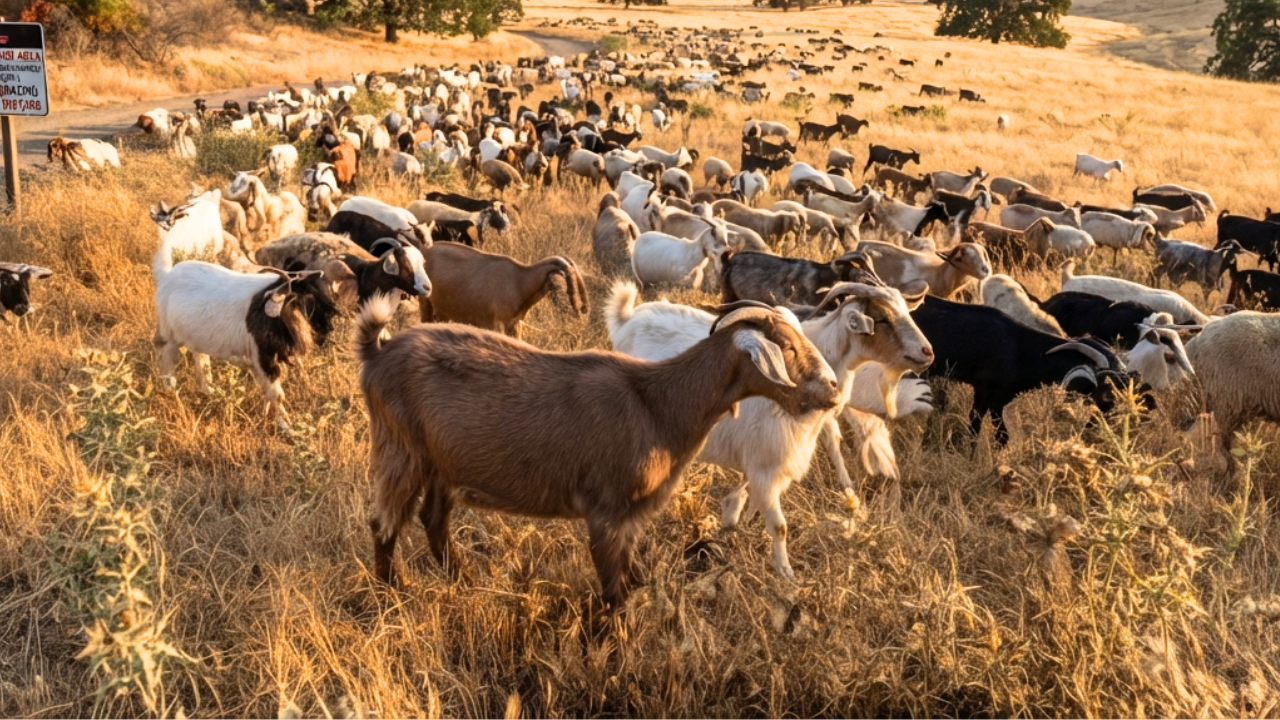
Instead of relying solely on heavy machinery, chemical herbicides, or dangerous prescribed burns, land managers are turning to a surprisingly low-tech solution. They're hiring hundreds of hungry goats and sheep to eat through dense brush and invasive plants.
It works. It's clean. And in many cases, it's cheaper than traditional clearing methods.
Herbivory grazing programs deploy specialized herds across thousands of acres every year, targeted specifically at aggressive invasive weeds like yellow starthistle, mustard weed, and cheatgrass. These non-native plants dry out early in the summer, creating fine fuels that ignite in seconds and carry flames rapidly into forest canopies. Sending in four-legged clearing crews cuts those fuel loads down before fire season hits its stride.
Why Invasive Weeds Make California Wildfires So Much Worse
Invasive plants aren't just an eyesore. They fundamentally rewrite fire ecosystems.
Native Mediterranean and chaparral ecosystems evolved alongside periodic fires. But non-native annual grasses and broadleaf weeds grow rapidly during winter rains, carpet the soil, and then die off completely when temperatures rise. By early June, acres of lush green hillside transform into a dense mat of tinder-dry kindling.
When a spark hits invasive weeds, the resulting fire spreads much faster than it would through native perennial plants. Native vegetation usually retains moisture longer into the summer months. Invasive weeds, on the other hand, act like a fuse leading straight to shrubs and trees.
Standard mechanical mowers often can't reach steep canyon walls, rocky bluffs, or narrow easements behind suburban neighborhoods. Herbicides carry environmental risks, especially near protected watersheds or residential zones. That leaves targeted livestock grazing as one of the most effective ways to clear treacherous terrain safely.
How Goats and Sheep Actually Clear Wildfire Fuel
Not all livestock eat the same things, which is why grazing contractors often mix species depending on the land.
Goats are aggressive browsers. They prefer taller brush, woody stems, leaves, and tough vegetation. They'll climb near-vertical hillsides, stand on their hind legs to reach overhanging branches, and comfortably devour thorny briars that other animals avoid. Their tough digestive systems can handle plants that are toxic to other livestock.
Sheep are grazers. They stay closer to the ground, focusing on soft grasses, broadleaf weeds, and low-lying invasive vegetation.
When you put a mixed herd of 400 goats and sheep onto a hillside, you get a top-to-bottom clearing crew.
- Top-down clearing: Goats strip the higher brush and ladder fuels—the vegetation that allows a ground fire to climb up into tree crowns.
- Ground-level stripping: Sheep mow down the underlying grass layer, breaking up the continuity of the fuel bed so fires can't travel horizontally across the soil.
- Seed suppression: Consuming seeds before they mature reduces the seed bank in the soil, slowing down weed regrowth season after season.
Herds are contained using portable electric fencing and moved systematically across target areas. Specialized herding dogs keep the livestock grouped, while guard animals like lamas or livestock guardian dogs protect them from native predators like coyotes and mountain lions.
The Cost and Logistical Reality of Biological Fire Prevention
While hiring a herd sounds simple, running a contract grazing operation requires precise logistical planning.
Contractors must haul water tanks, set up mobile fencing, manage livestock health, and transport hundreds of animals from project to project in specialized trailers. It isn't just turning animals loose in a field—it's managed targeted grazing.
Cost varies depending on slope, vegetation density, and location. Clearing an acre with targeted grazing typically costs anywhere from $800 to $1,500 per acre, which can be competitive with hand-crew labor on difficult, steep terrain where heavy machinery can't operate. Municipalities, utility companies, and private landowners increasingly view this as a necessary investment compared to the millions required to suppress an active wildfire or rebuild destroyed infrastructure.
There are limitations, though. Goats and sheep don't discriminate between invasive weeds and rare native plants if left in one area for too long. Overgrazing can cause soil erosion on fragile slopes. Because of this, botanists and land managers closely monitor grazing intensity, moving the herd as soon as the target fuel load is reduced to safe levels.
Steps for Property Owners and Communities
If you manage land in a high-risk wildfire zone, targeted grazing might be an option worth evaluating alongside standard defensive space strategies.
- Assess your terrain: If your property features steep slopes, rocky soil, or dense brush where mowers can't safely go, contract grazing is often the safest alternative.
- Check local regulations: Many California counties and cities have clear guidelines for temporary grazing permits, especially in suburban interface areas.
- Combine strategies: Livestock grazing works best alongside other fuel reduction tactics. Use grazers to clear large, hard-to-reach acreages, then maintain defensible space around structures using hand tools and proper landscaping techniques.
- Pool community resources: Small parcels rarely justify the mobilization costs of a commercial herd. Neighbors working together to aggregate adjacent properties can split transportation costs and make contract grazing financially viable.