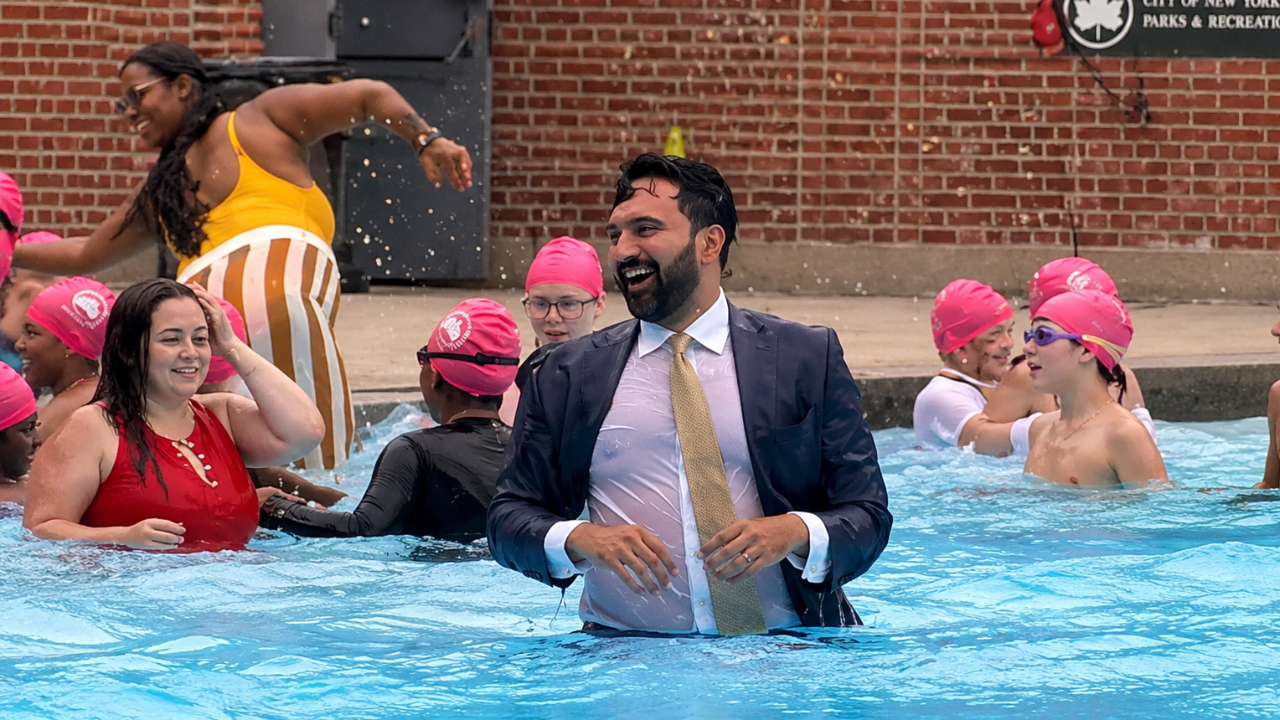
New York City Mayor Zohran Mamdani recently made headlines by jumping headfirst into a public pool while wearing a sharp, tailored suit and tie. The image of a high-ranking politician plunging fully clothed into chlorinated water makes for perfect social media feed fodder, sparking immediate viral traction and lighthearted commentary. Yet behind the dripping wet wool and the carefully managed camera angles lies a deeply calculated public relations strategy designed to distract from a stark reality. New York City public pools are facing systemic operational failures, critical lifeguard shortages, and decades of deferred maintenance that no amount of political theater can fix.
The tradition of city officials visiting municipal pools to mark the start of the summer season is older than the modern subway system. It is a ritual designed to broadcast equity, accessibility, and a common touch. When a politician dives in with their expensive formal wear still on, they are attempting to signal an urgency of connection with everyday working-class New Yorkers who rely on these free public spaces to escape the brutal summer heat. But looking past the immediate spectacle reveals the deeper mechanics of modern political communication and the structural crises plaguing urban recreation infrastructure. If you enjoyed this piece, you should read: this related article.
The Anatomy of a High-Stakes Public Relations Stunt
Political stunts succeed when they create a sharp, memorable contrast. A suit represents bureaucracy, institutional stiffness, and the elite corridors of power. A public pool represents the raw, chaotic energy of the urban working class. By forcing these two worlds to collide in a single splash, a politician attempts to instantly dismantle the barrier between the governing class and the governed.
The logistics behind these moments are rarely accidental. Advance teams scout the location to ensure the water clarity is optimal for photography. Press pools are positioned at precise angles to capture the trajectory of the leap. The choice of attire itself is deliberate, opting for fabrics that retain structure when soaked rather than clinging awkwardly. It is a highly managed performance masquerading as spontaneous joy. For another look on this story, check out the recent update from Associated Press.
This specific brand of performance art targets a younger, media-savvy electorate that consumes political messaging through short-form video clips and memes. The goal is simple. The administration wants to generate positive sentiment and dominate the news cycle before critics can raise questions about budget cuts, shortened operating hours, or broken facilities. It uses a flash of humor to preemptively disarm serious policy critique.
A Century of Wet Political Trademarks
The fully clothed pool plunge is not an invention of the current administration. It draws on a long, storied lineage of New York City executives using public water to score political points.
During the mid-twentieth century, Mayor Fiorello La Guardia frequently weaponized public works openings to project an image of a tireless, hands-on reformer. He would routinely show up at newly constructed public pools, roll up his trousers, and wade into the water alongside neighborhood children. For La Guardia, the pools were physical proof that his administration was successfully wrestling control of the city away from corrupt Tammany Hall machine politicians and delivering tangible benefits to the public.
Decades later, Mayor John Lindsay took the tradition a step further during the hot, politically volatile summers of the late 1960s. Facing intense racial tensions and urban unrest, Lindsay famously walked the streets of neighborhoods like Harlem and Brooklyn in his shirt sleeves. He would frequently cool off by jumping into public pools or standing directly in the spray of opened fire hydrants. It was a visceral, highly effective method of projecting calm, demonstrating personal accessibility, and signaling that the city government had not abandoned its most vulnerable neighborhoods during a crisis.
The modern iteration of the stunt strips away much of that historical weight, replacing genuine crisis management with a hyper-fixation on digital optics. Where past mayors used the water to prove they were present during times of immense civic strain, contemporary officials frequently use it to manufacture a sense of normalcy and progress that does not align with the operational reality on the ground.
The Grim Reality of the Urban Swim Crisis
While the mayor dries off and changes into a fresh set of clothes, millions of New Yorkers face a vastly different experience when trying to access the city's public pools. The shiny veneer of the viral video quickly fades when confronted with the actual state of municipal recreation.
The most pressing issue facing the city's aquatic infrastructure is a chronic, severe shortage of certified lifeguards. For consecutive summer seasons, New York City has struggled to recruit and retain the necessary personnel to keep its fifty-plus outdoor pools safely operational. This shortage has direct, painful consequences for working families. Without adequate staff, the Parks Department is routinely forced to implement rolling closures, shut down specific sections of large Olympic-sized pools, and completely cancel vital free swim lesson programs for children.
The recruitment failure is rooted in a combination of low wages, arduous certification processes, and bureaucratic mismanagement. While private beach clubs and suburban municipalities raised their hourly pay rates to adapt to shifting economic realities, the city remained sluggish, bound by rigid civil service rules and protracted union negotiations. The result is a system where the pools exist, but the human capital required to run them safely does not.
Deferred Maintenance and the Cost of Neglect
The problems extend far beneath the surface of the water. New York City’s public pool system is a aging network, with many of its grandest facilities dating back to the New Deal era of the 1930s. These massive concrete structures require constant, aggressive maintenance to combat the corrosive effects of weather, chemicals, and heavy daily usage.
Decades of austerity budgeting and deferred maintenance have left many facilities in a state of quiet decay. Broken filtration systems regularly force emergency closures during the hottest weeks of the year. Cracking pool decks, outdated locker rooms, and malfunctioning plumbing systems are common complaints among patrons. In many lower-income neighborhoods, the local public pool operates as a crumbling relic rather than a premier civic asset.
When a city administration prioritizes the production of a viral video over the unglamorous work of capital funding and infrastructure repair, it reveals a fundamental misalignment of priorities. A suit can be dry-cleaned in twenty-four hours. Fixing a broken Olympic-sized filtration system takes months of bureaucratic approvals, engineering assessments, and millions of dollars in capital allocation.
The Illusion of Accessibility
Public pools are fundamentally radical spaces. They are among the few remaining urban arenas where individuals of every socio-economic background, race, and neighborhood gather in a state of shared vulnerability and recreation. They are essential tools for public health, community cohesion, and climate resilience in a city experiencing increasingly severe heatwaves.
When political figures use these spaces as backdrops for personal branding exercises, they risk commodifying a vital public service. The stunt creates a false impression of universal accessibility. It suggests that the city’s recreational spaces are thriving, joyful, and wide open to all. The family standing in a two-hour line under a boiling sun because half the pool is closed due to a lack of lifeguards knows a completely different truth.
Effective governance is measured by operational efficacy, not by the number of views a video accumulates on a social media platform. The real test of an administration's commitment to public recreation is found in the tedious details of the city budget, the efficiency of the hiring pipeline for seasonal workers, and the long-term capital plan for structural renovations.
The next time a politician jumps into a city pool fully clothed, the public should look past the splash. They should look at the closed sections of the deck, check the reduced operating hours posted on the chain-link fence, and ask why the unglamorous work of running a city is so often traded for a momentary piece of digital performance art.