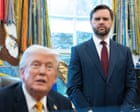
The media cycle moves with a predictable friction when a politician's past collides with their present. When The Atlantic republished JD Vance’s decade-old, deeply critical essays about Donald Trump, the consensus narrative framed it as a straightforward exposure of hypocrisy. This interpretation is flawed. To view Vance’s transition from a self-described "never-Trump guy" to a MAGA standard-bearer as mere opportunism is to misunderstand the fundamental restructuring of American conservatism over the last ten years. The archival excavation of Vance's early writings does not expose a contradiction; it provides the literal roadmap of how the modern populist right was engineered.
Vance’s 2016 critiques were not standard establishment talking points. He was writing as an insider-outsider, a product of the very working-class communities Trump rallied, but educated within the elite institutions Trump mocked. By re-examining the exact mechanics of Vance's ideological shift, we see something more complex than a standard political flip-flop. We see a deliberate, intellectualized migration that mirrored a broader, systemic shift among conservative intellectuals who realized that the old Republican orthodoxy was dead, and that Trumpism was the only viable vehicle for their goals.
The Appalachian Translate and the Elite Audience
To understand the weight of Vance’s early anti-Trump commentary, one must look at the specific function he served in 2016. The publication of Hillbilly Elegy coincided precisely with Trump’s rise, turning Vance into the designated translator of the white working class for a bewildered coastal elite. His early essays, including those published in The Atlantic, were highly effective because they spoke the language of the mainstream intelligentsia while claiming authentic roots in the Rust Belt.
During this period, Vance argued that Trump was an opioid for the masses—a temporary, destructive coping mechanism that offered easy answers to structural economic decline. He diagnosed the anger of his hometown communities but rejected Trump’s cultural grievances as a viable solution. This positioning made him a darling of centrist and liberal media outlets. They used his voice to validate their own assessments of the Trump phenomenon.
The shift began when the political utility of being a translator expired. Vance recognized early that diagnosing regional decay from a position of detached academic observation provided cultural capital but zero legislative leverage. The realization was pragmatic. If you want to reshape the economic policy of a nation, you cannot remain an ombudsman for the elite; you have to capture the machinery of the dominant political movement.
The Structural Realignment of Economic Populism
The core of Vance's intellectual migration lies in economic policy, an area where the traditional Republican platform completely decoupled from its voter base. For decades, the GOP championed free trade, deregulation, and entitlement reform. Vance’s early writings already showed fractures with this consensus, even while he critiqued Trump's rhetoric.
When Vance entered formal politics, he explicitly abandoned the free-market fundamentalism of the Reagan era. He began advocating for tariffs, industrial policy, and aggressive antitrust enforcement—positions historically associated with the left wing of the Democratic Party. This was not an adoption of Trumpism out of fear; it was a recognition that Trump had shattered the old economic consensus, creating a vacuum that a new generation of nationalists could fill.
The Realignment of the Conservative Coalition
| Old GOP Orthodoxy | The New Populist Consensus |
|---|---|
| Unfettered Free Trade Agreements | Protectionist Tariffs and Reshoring |
| Corporate Deregulation as a Priority | Selective Antitrust Enforcement Against Tech |
| Skepticism of State Intervention | Active Industrial Policy to Protect Domestic Labor |
| Traditional Foreign Policy Interventionism | Strategic Isolationism and Realism |
This chart illustrates that the shift was structural, not merely rhetorical. Vance’s current policy positions align closely with a specific brand of national conservatism that views the state not as an enemy to be minimized, but as a tool to protect domestic workers and families. The republication of his old essays highlights the tension between his past cultural analysis and his current structural execution.
The Tech Undercurrent and the Silicon Valley Pipeline
The mainstream analysis of Vance’s evolution frequently overlooks his professional ties to Silicon Valley, specifically his relationship with billionaire venture capitalist Peter Thiel. This connection is vital. It explains how Vance transitioned from a cultural commentator to a well-funded political operative with a distinct ideological framework.
Thiel’s circle did not view Trump as a temporary aberration, but as a disruptive force capable of breaking stagnant political gridlock. Vance’s time in venture capital exposed him to an intellectual subculture that was deeply skeptical of both corporate globalization and progressive institutional dominance. When Vance returned to Ohio to found an advocacy organization and later run for the Senate, he brought this tech-inflected, post-liberal philosophy with him.
This network provided more than just financial backing for his Senate run. It offered an alternative intellectual ecosystem that insulated him from the disapproval of the mainstream media figures who had once lauded him. The disapproval of the coastal establishment ceased to matter because Vance was now building power within an entirely different elite structure.
The Media Illusion of the Pure Turncoat
Mainstream commentary relies heavily on a binary narrative of political purity versus corruption. When an outlet republishes past statements that contradict current actions, the implicit goal is to shame the subject or disillusion their followers. This strategy consistently fails in the current political environment.
For Vance's current base, his transformation is viewed as an asset, not a liability. It is framed as a conversion narrative—the story of an intelligent man who was initially blinded by institutional orthodoxy but eventually saw the reality of the political landscape. Every past quote used against him by mainstream media outlets serves to reinforce his current bona fides as someone who understands the elite machine intimately enough to reject it.
The focus on individual hypocrisy obscures the more significant reality. Political figures at this level rarely change their public stances purely out of caprice. They change them because the underlying tectonic plates of the electorate have shifted. Vance didn't just change his mind; he changed his constituency.
The Mechanics of Post-Liberal Governance
What Vance represents now is the institutionalization of the populist movement. Trump’s initial run was chaotic, driven by instinct and rhetorical grievance rather than a cohesive policy agenda. Vance represents the second generation of this movement: disciplined, ideologically coherent, and deeply focused on using the levers of state power to achieve specific outcomes.
His trajectory shows that the debate over whether he was "right" in 2016 or "right" now is entirely beside the point. The relevant factor is his position at the vanguard of a political movement that has successfully co-opted the Republican Party. By analyzing his early work alongside his current legislative focus, we see a politician who mastered the art of elite validation, recognized its limitations, and pivoted to where the actual power resided. The archive isn't an indictment; it is the blueprint of a cold, calculated climb to the center of American power.