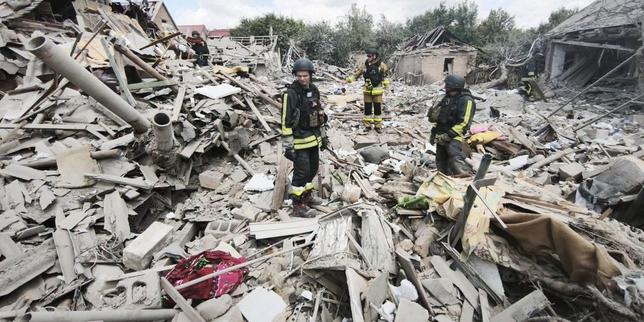
A brutal overnight wave of Russian missile and drone strikes across the Zaporizhzhia oblast has left three civilians dead and at least 18 others wounded, exposing a critical and deepening vulnerability in Ukraine's frontline air defense grid. While international headlines frequently focus on the symbolic battles for ruined Donbas towns, Moscow is executing a systematic, attritional campaign to turn Ukraine’s industrial engine into an unlivable wasteland. The latest casualties are not collateral damage. They are the predictable result of a severe deficit in low-altitude interceptors and a Western supply chain that measures assistance in political cycles rather than ammunition burn rates.
The Frontline City Trapped in an Air Defense Blind Spot
Zaporizhzhia occupies a precarious geographic reality. Situated mere dozens of miles from the active trenches of the southern front, the city and its surrounding oblast are subjected to a deadly cocktail of weaponry that shorter-range systems struggle to contain, and long-range systems cannot afford to waste missiles on. For another perspective, check out: this related article.
During the latest nocturnal assault, Russian forces utilized a combination of Iranian-designed Shahed loitering munitions, S-300 anti-aircraft missiles reprogrammed for crude land-attack missions, and guided aerial bombs known as KABs. This mix is intentional. It is designed to overwhelm local air defense commanders with a high volume of diverse radar signatures moving at varying speeds and altitudes.
For a city like Zaporizhzhia, the math is cruel. An S-300 missile fired from occupied territory in the south takes less than two minutes to impact its target. Air raid sirens often sound simultaneously with the explosions, leaving residents no time to seek hardened shelter. Similar analysis on the subject has been published by NPR.
The three deaths recorded in the latest strike occurred in residential sectors where older brick buildings offer zero protection against the supersonic kinetic energy of a repurposed air defense missile. Eighteen others remain hospitalized, some with life-altering shrapnel wounds, pulling local emergency services and medical infrastructure to the brink of collapse.
The Interceptor Deficit
Ukraine’s air defense is structured as a tiered network, but that network is fraying at the edges. Top-tier assets like the American-made Patriot systems and the European SAMP/T are kept near Kyiv or vital strategic infrastructure to guard against ballistic and hypersonic threats. This leaves frontline oblasts reliant on older Soviet-era systems like the Buk-M1 or S-300, alongside Western medium-range donations such as NASAMS and IRIS-T.
The problem is not the quality of these systems; it is the sheer volume of targets.
- S-300 Land Attacks: Russia possesses thousands of aging S-300 interceptor missiles. When used against ground targets, they are highly inaccurate but devastatingly destructive, making them perfect weapons of terror against urban centers.
- The Drone Swarm Attrition: Cheap Shahed drones are sent ahead of complex missile strikes specifically to force Ukrainian batteries to expend expensive, limited ammunition.
- The KAB Threat: Guided aerial bombs fitted with glide wings are dropped from Russian aircraft deep within their own airspace, well beyond the reach of mid-range Ukrainian air defenses.
Using a million-dollar Western interceptor to shoot down a twenty-thousand-dollar drone is a losing proposition over a prolonged timeline. Yet, failing to shoot it down means allowing it to strike a power substation, a water treatment plant, or an apartment block. Local commanders are forced into an impossible triage every single night, deciding which neighborhoods to protect and which to leave exposed.
The Strategic Objective Behind the Civilian Terror
Moscow’s campaign against Zaporizhzhia is often characterized in Western media as senseless violence or blind frustration. That assessment is dangerously naive. There is a clear, cold military logic at play behind these nightly barrages.
By keeping the civilian population of Zaporizhzhia under constant, unpredictable threat of death, Russia aims to trigger a secondary migration crisis. A city depopulated of its workforce cannot sustain the heavy industries that feed the Ukrainian war effort. Zaporizhzhia is a vital hub for steel production, machine building, and energy infrastructure. If the workers flee west, the economic foundation of Ukraine's resistance erodes.
+-----------------------------------------------------------------+
|              THE FRONTLINE AIR DEFENSE TRIAGE                   |
+-------------------------------+---------------------------------+
| Target Type                   | Tactical Dilemma                |
+-------------------------------+---------------------------------+
| Guided Aerial Bombs (KABs)    | Launch aircraft out of range    |
| Repurposed S-300 Missiles    | Flight time under 120 seconds   |
| Shahed Loitering Munitions   | Rapidly depletes stockpiles     |
+-------------------------------+---------------------------------+
Furthermore, these strikes force the Ukrainian General Staff to make agonizing deployments. Every air defense battery moved south to protect the citizens of Zaporizhzhia is a battery removed from protecting the logistics hubs in western Ukraine, the grain ports of Odesa, or the maneuvering brigades on the eastern front. Russia is using civilian blood as a lever to thin out Ukraine's military capabilities across a one-thousand-kilometer frontline.
The Failure of the Sanctions Regime
The wreckage pulled from the impact sites in Zaporizhzhia tells another troubling story. Microelectronic components recovered from downed Russian missiles and drones consistently reveal Western-manufactured chips, circuitry, and sensors. Despite multiple rounds of international sanctions intended to choke off Russia’s military-industrial complex, transshipment routes through third countries in Central Asia and the South Caucasus remain highly active.
Russia has successfully shifted its economy to a total war footing. Factories in the Ural Mountains are operating on three-shift schedules, producing more ammunition and assembling more missiles than they did prior to the escalation of hostilities. The West, by contrast, still treats defense production as a corporate, just-in-time endeavor, hamstrung by regulatory delays and a lack of long-term state procurement commitments.
Redefining the Parameters of Western Support
The tragedy in Zaporizhzhia underlines the reality that current Western strategy is designed to keep Ukraine in the fight, but not to let them win it. Providing enough air defense to mitigate disasters while withholding the tools necessary to neutralize the threat at its source is a policy written in civilian casualties.
To protect cities like Zaporizhzhia, Ukraine does not just need more interceptor missiles. It needs the explicit authorization and the capability to strike the airfields, launch platforms, and logistics nodes inside the Russian Federation from which these nightly attacks originate.
"Defending against a swarm of drones and incoming missiles is like trying to wipe up water from a bursting pipe without ever turning off the main valve."
Until Ukrainian forces can systematically target the Russian bomber fleets and missile launchers before they deploy their payloads, cities within one hundred miles of the border will continue to burn. The current policy of restricted usage regarding long-range Western weaponry ensures that the skies over Ukraine remain a shooting gallery where the civilian population pays the ultimate price for geopolitical timidity.
The dynamic on the ground proves that defensive measures alone are a slow path to defeat in an attritional conflict. Air defense grids are finite. Factories can build missiles faster than Ukraine can deploy launchers if those factories remain untouched by the realities of the war they are fueling.
The 18 wounded citizens currently fighting for their lives in Zaporizhzhia's hospitals are a stark reminder that deterrence cannot be achieved through shields alone. It requires a sword. Without a fundamental shift in how Western allies view the geographic boundaries of Ukrainian counter-operations, the overnight reports from the Zaporizhzhia oblast will simply repeat themselves, with the casualty counts climbing higher while the world watches from a comfortable distance.