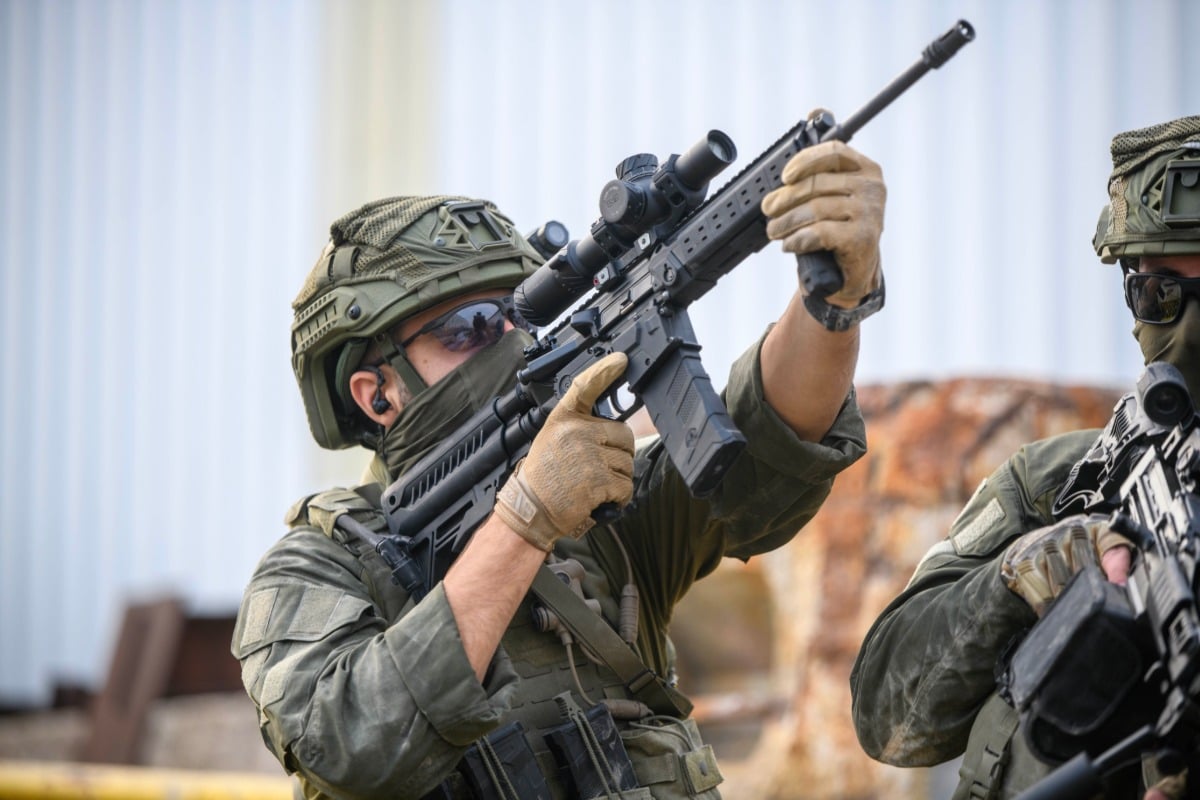
Military analysts love a shiny new rifle contract. The defense press treats every modular upgrade package rolling out near Eastern Europe like a tactical awakening. The lazy consensus goes something like this: regional militaries bordering Russia and Ukraine are scrambling to modernize their small arms platforms because modularity and caliber conversions win modern wars.
It is a comforting fantasy for procurement officers and defense contractors alike. It is also entirely wrong.
I have spent the last decade watching state defense budgets bleed out on incremental barrel changes and ergonomic furniture while artillery shells rewrite the geometry of modern combat. When a military near the frontline thinks a localized rifle upgrade program is going to move the needle on their strategic survivability, they are rearranging deck chairs on the Titanic.
Let us look at what is actually happening on the ground and why the current fascination with frontline rifle upgrades misses the forest for the trees.
The Modularity Myth in Artillery Wars
The current narrative surrounding rifle upgrades near the conflict zone usually centers on multi-caliber capability, quick-change barrels, and advanced optic mounting rails. Vendors pitch these features as essential for troops facing fluid, high-intensity environments.
The premise sounds logical in a PowerPoint deck. Troops might need to switch from standard intermediate cartridges to specialized loads, or adapt their platforms for urban clearance versus open-field skirmishes.
Here is the brutal truth: small arms fire accounts for a microscopic fraction of casualties in high-intensity peer conflicts.
Drone-dropped munitions, counter-battery radar, electronic warfare suppression, and massed indirect fire dominate the modern battlefield. If your infantrymen are engaging targets frequently enough with their primary rifles for a modular barrel system to alter your combat effectiveness, your combined-arms doctrine has already suffered a catastrophic failure.
Spending capital on rifle overhauls when your logistics chain lacks redundant drone countermeasures or secure tactical radios is not modernization. It is an expensive vanity project.
The Procurement Trap
Militaries near the Russian perimeter face severe fiscal constraints. Every dollar, euro, or currency unit diverted toward boutique rifle modifications is a dollar stolen from critical capabilities that actually keep soldiers alive.
Let us break down the real priorities of modern attrition warfare:
- Electromagnetic Resilience: If your platoon cannot communicate without being jammed or geolocated, your rifle's sub-MOA accuracy at three hundred meters is irrelevant.
- Medical Logistics: Tourniquets, rapid evacuation protocols, and frontline surgical stabilization save exponentially more lives than a lighter chassis or a reciprocating charging handle.
- Unmanned Systems Integration: Every squad needs organic reconnaissance capability far more than they need a secondary upper receiver in a niche caliber.
When defense ministries buy into the rifle upgrade hype, they fall for the oldest trap in the defense procurement playbook: buying hardware that looks good in a press release rather than software and systems that solve actual tactical bottlenecks.
The Flawed Premise of Border State Readiness
People often ask why nations bordering Ukraine and Russia are suddenly rushing to test, evaluate, and procure Western-style or locally upgraded small arms platforms. The question itself assumes that small arms are the pacing item of their defense readiness.
They are not.
The rush to upgrade rifles is often driven by political signaling rather than tactical necessity. Ministries of defense want to show NATO partners, domestic taxpayers, and potential adversaries that their forces are abandoning Soviet legacy standards. Adopting a NATO-compatible rail or a modernized chassis is an easy political win. It looks active. It looks progressive.
Operationally, however, a soldier with an upgraded rifle who lacks artillery ammunition, counter-drone protection, or secure battlefield networks is just a more expensive casualty waiting to happen.
I have watched procurement boards prioritize ergonomic pistol grips while their battalions starved for basic night vision maintenance parts. The mismatch between perceived needs and empirical battlefield reality is staggering.
What Actually Works
If you want to understand how a frontline nation should actually spend its defense budget, look away from the small arms rack entirely.
First, secure the supply chain for high-consumption consumables. In an artillery-heavy conflict, small arms ammunition burn rates are secondary to the massive deficit in mortar rounds, spare barrel liners for heavy machine guns, and replacement power packs for vehicles.
Second, decentralize maintenance. A rifle platform that requires factory-level intervention for minor receiver tolerances is a liability in a contested zone. True tactical utility lies in rugged simplicity, not complex modular systems that demand specialized armorer tools and clean-room environments to reconfigure.
Third, invest heavily in individual and squad-level situational awareness. Give every team leader a reliable, unjammable feed of local airspace telemetry. That will save more lives in a week than a generation of rifle upgrades will over a decade.
The Strategic Blind Spot
The defense industry sells what is profitable, not necessarily what is decisive. Upgrading a rifle line generates steady, predictable contracts, maintenance revenue streams, and attractive photo opportunities for defense ministers looking to project strength.
Drones, electronic warfare hardening, and logistics resilience are messy, unglamorous, and difficult to showcase on social media. Yet those are the exact elements deciding the outcome of the conflicts defining our era.
Stop pretending that a better fire selector switch or a lighter handguard prepares a nation for the realities of modern state-on-state violence.
The next time a defense contractor pitches a revolutionary small arms upgrade package for frontline deployment, ask them how many drone interceptors that budget could buy instead.
Then watch how fast the conversation changes.


