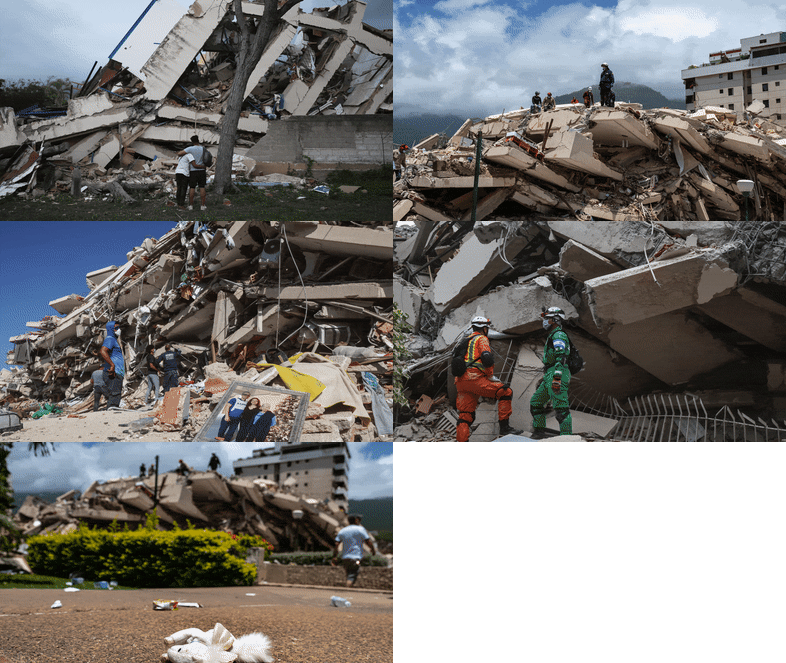
The grand socialist housing experiment in Venezuela has literally crumbled into dust. The initiative, known as the Gran Misión Vivienda Venezuela, was launched with immense fanfare as the crown jewel of the country's social welfare state, promising millions of modern apartments for the working class. Today, those same structures stand as hazardous, decaying concrete shells. The rapid deterioration of these homes stems directly from systemic corruption, the total collapse of national infrastructure, and a complete disregard for basic engineering standards in favor of rapid political theater.
What began as an ambitious state-led effort to eradicate homelessness has transformed into a widespread public safety emergency. Across major cities like Caracas, Maracaibo, and Valencia, high-rise apartment complexes built under the state banner are suffering from severe structural failures, lack of running water, and collapsing sewage systems. To understand how a multi-billion-dollar state project deteriorated so quickly, one must look past the simple narrative of economic decline and examine the specific, flawed mechanisms of its construction and management.
The Architecture of Patronage
The housing program was never designed merely as an engineering project. It functioned primarily as an engine for political loyalty. When the government began mass-producing these complexes, speed and visual impact took precedence over structural integrity and geological surveys.
Contracts were routinely awarded not to experienced civil engineering firms, but to politically connected domestic entities and international allies with little oversight. In the rush to meet arbitrary construction deadlines tied to election cycles, crews poured concrete without allowing proper curing times. Soil testing was frequently bypassed entirely. As a result, massive multi-story buildings were erected on unstable hillsides and shifting terrain.
Today, the consequences of those rushed decisions are visible in the shifting foundations of complexes across the country. Walls are splitting open, stairwells are detaching from main structures, and entire blocks are tilting perceptibly. The state did not create sustainable neighborhoods; it created high-density vertical slums built on a foundation of political expedience.
Economic Collapse and the Death of Maintenance
A building is not a static object. It requires constant financial input to survive the elements and the wear of daily use. When Venezuela hyperinflation struck, the entire financial mechanism supporting these housing complexes evaporated.
The government kept rents artificially low or non-existent, meaning there was never a localized fund established for building maintenance. When elevators broke down, there were no spare parts available in the country to fix them. When water pumps burned out, the cost of a replacement exceeded the annual budget of the entire residential complex.
Residents suddenly found themselves trapped on the upper floors of fifteen-story buildings with no working elevators and no running water. Families were forced to carry heavy plastic jugs of water up dark, unlit stairwells every single day. The state economic policy stripped citizens of the purchasing power required to maintain their own properties, while the municipal governments lacked the revenue to step in and assist.
Concrete Without Infrastructure
Building a home requires more than just erecting walls. It requires connecting that home to a functional grid of utilities. The housing program failed spectacularly because it added hundreds of thousands of high-demand residential units onto an electrical and water grid that was already on the verge of collapse.
Many complexes were completed and handed over to residents before they were actually connected to the municipal water supply or the electrical grid. Temporary, illegal hookups became permanent solutions. Thick bundles of exposed, hazardous electrical wires still hang across the facades of these buildings, posing a constant fire hazard to the thousands of people living inside.
Water shortages are chronic. In many of these socialist housing developments, water arrives through the pipes for only a few hours every two weeks. The lack of consistent water pressure has caused sewage systems to back up, flooding the ground floors of buildings with raw waste. The state focused entirely on the visible shell of the house while completely ignoring the invisible, vital infrastructure required to make a city livable.
The Human Cost of Structural Neglect
The residents who moved into these apartments believed they were securing a stable future for their children. Instead, they find themselves living in a state of constant anxiety, wondering if their ceilings will cave in or if their entire building will be condemned.
In many developments, the concrete used was of such low quality that it has begun to flake away, exposing the iron rebar underneath to the tropical humidity. Once moisture reaches the internal steel structure, rust sets in, causing the metal to expand and crack the surrounding concrete from the inside out. This process, known as concrete spalling, is structurally catastrophic and highly visible in almost every major housing complex built during that era.
Local community groups have tried to organize basic repairs, but the scale of the damage requires heavy machinery and industrial materials that are impossible for ordinary citizens to acquire or afford. The state, having moved on to other political priorities, offers no assistance, leaving residents marooned in decaying structures that pose a daily threat to their lives.
The collapse of these homes is not a tragedy caused by a natural disaster. It is the direct, predictable outcome of a system that prioritized propaganda over engineering, loyalty over competence, and short-term political gains over long-term structural viability. The concrete towers that once symbolized a revolutionary promise now stand as a stark, decaying warning about the cost of institutional neglect.