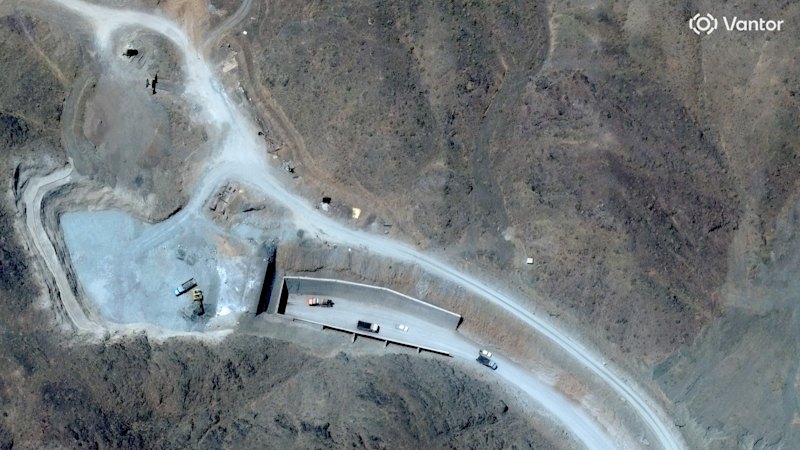
In June 2025, B-2 stealth bombers dropped massive bunker-buster bombs on Iran's nuclear facilities, an offensive that the White House declared had completely obliterated the Islamic Republic’s atomic ambitions. It was a triumphant moment of military theater, designed to project absolute American supremacy. Yet, just over a year later, the administration is preparing the public for another round of airstrikes, this time targeting a colossal underground fortress known as Pickaxe Mountain.
This sudden shift reveals a glaring reality that military officials hoped to keep quiet. The highly publicized 2025 airstrikes did not destroy Iran's nuclear program; they merely drove it deeper underground, where conventional weaponry can no longer reach it.
The primary target of this renewed focus is Kūh-e Kolang Gaz Lā, or Pickaxe Mountain, situated just two kilometers from the heavily damaged Natanz nuclear complex. While Washington insists that this unfinished site must be neutralized before it becomes operational, independent intelligence analysts and weapons experts paint a far more complicated picture. The threat of a new bombing campaign ignores the physical limitations of the American arsenal and downplays the survival of Iran's existing highly enriched uranium stockpile, which was quietly relocated before the first bombs even fell last year.
The Illusion of Obliteration
The narrative of total destruction began to unravel almost immediately after the smoke cleared from the June 2025 strikes. The Pentagon had deployed the GBU-57 Massive Ordnance Penetrator, a 30,000-pound precision-guided bomb designed to smash through reinforced concrete and rock. These weapons are the heaviest conventional bombs in the American inventory, and they succeeded in collapsing the surface entrances and causing severe structural vibrations at Fordow and Natanz.
However, physical destruction on the surface does not automatically translate to the eradication of materials buried deep inside the earth.
Iran’s Fordow enrichment plant was constructed at a depth of roughly 90 meters beneath a mountain ridge. The GBU-57 bunker-buster is rated to penetrate approximately 60 meters of earth or reinforced concrete before detonating. This mathematical disparity meant that while the upper levels of the facility were crushed and the power grids severed, the deepest chambers—and the sensitive materials housed within them—remained largely intact.
Even more concerning for Western intelligence is the movement of Iran's enriched uranium. Before the 2025 strikes commenced, satellite surveillance and regional intelligence sources indicated that Iranian nuclear scientists successfully relocated a massive portion of their 60 percent enriched uranium stockpile. Approximately 440 kilograms of this near-weapons-grade material was moved from the vulnerable halls of Fordow to the fortified tunnel complexes of Isfahan.
Because Isfahan was targeted primarily with standoff Tomahawk cruise missiles rather than heavy bunker-busters, these deep tunnels survived unscathed. The material remains there today, buried but entirely salvageable.
The Fortress Under the Granite
If Fordow presented a difficult target for American planners, Pickaxe Mountain represents an entirely different class of engineering challenge. Construction on this deep tunnel complex began in late 2020 following a series of sabotage operations at the above-ground Natanz facility. Rather than rebuilding on the surface, the Iranian government chose to burrow directly into the solid granite of the mountain.
Satellite imagery reveals a massive engineering operation that has actually accelerated since the 2025 strikes. Spoil piles of excavated rock grow larger by the week, indicating that the underground footprint is expanding at an unprecedented rate.
The primary issue for military planners is the sheer depth of the new facility.
+--------------------------------------------------------------+
|                     TARGET DEPTH COMPARISON                   |
+--------------------------------------------------------------+
| US Bunker Buster (GBU-57) Max Penetration:   ~60 meters      |
|                                                              |
| Fordow Underground Facility Depth:           ~90 meters      |
|                                                              |
| Pickaxe Mountain Fortified Depth:            100 to 600 m    |
+--------------------------------------------------------------+
Independent geological assessments suggest that the core research and enrichment halls at Pickaxe Mountain are buried under a roof of solid granite ranging from 100 meters to as deep as 600 meters. If these assessments are accurate, the facility is completely impervious to any conventional weapon in existence. No amount of GPS-guided ordnance dropped from B-2 bombers can penetrate hundreds of meters of solid granite.
To counter this reality, some defense intellectuals in Washington have begun advocating for highly risky ground operations. These theoretical plans involve deploying special operations forces to seal the tunnel entrances permanently, or to physically seize the stockpiles before they can be secured deeper inside the mountain.
But executing a ground assault on a heavily defended military facility deep inside Iranian territory is a recipe for catastrophic escalation. The political cost of dead or captured American commandos would dwarf any temporary setback such a raid might inflict on the Iranian nuclear infrastructure.
The Cost of Blind Spots
Perhaps the most dangerous aspect of the current escalatory spiral is the complete lack of verified information. Following the strikes of June 2025, Tehran suspended all cooperation with the International Atomic Energy Agency. International inspectors were expelled, and remote monitoring cameras were disconnected.
As a result, Western intelligence agencies are flying blind.
Without boots on the ground or inspectors inside the facilities, the United States is relying almost entirely on satellite imagery and signals intelligence to estimate Iran's capabilities. While satellite photos can show the size of dirt piles and the movement of heavy machinery, they cannot reveal what is happening inside the finished tunnels. They cannot tell us how many centrifuges have been installed, or whether scientists are actively processing the surviving stockpile of 60 percent enriched uranium.
This information vacuum creates a dangerous feedback loop.
Hardline policymakers in Washington interpret the lack of transparency as proof that Iran is on the verge of assembling a nuclear warhead. In Tehran, the constant threats of military action convince the regime that their only hope of survival is to complete the Pickaxe Mountain fortress as quickly as possible, creating a true nuclear deterrent that would make any future American strike unthinkable.
The cycle of bombing and rebuilding has only served to narrow the diplomatic window to zero.
By framing every military strike as a total victory, successive administrations have boxed themselves into a corner where diplomacy is viewed as weakness, yet the military options on the table are increasingly ineffective against a deeply buried adversary.
The Strategic Dead End
The reality of the situation is that the United States cannot bomb its way out of this crisis.
If the administration goes ahead with its threat to strike Pickaxe Mountain, the result will likely be a repeat of last year's campaign. The entrances will be damaged, some surface facilities will be destroyed, and the public will be told that the threat has been neutralized.
Meanwhile, deep within the granite tunnels, the work will continue.
Iran has spent decades preparing for this exact scenario, distributing its nuclear expertise, industrial capacity, and raw materials across a massive network of underground sites. You cannot destroy knowledge with a bunker-buster, nor can you collapse a mountain of solid stone with conventional weapons.
The push to target Pickaxe Mountain is not a solution; it is a costly holding action that risks triggering a wider regional war while failing to solve the underlying problem. Until Washington acknowledges the physical limits of its military power and the resilience of Iran's subterranean engineering, it will remain trapped in a cycle of empty victories and growing danger.
For a deeper look at the strategic layout of these underground facilities and the growing tensions in the region, watch this detailed analysis on the US warning to strike Pickaxe Mountain. This video explains the tactical challenges of targeting the deeply buried facility and what it means for global energy markets.