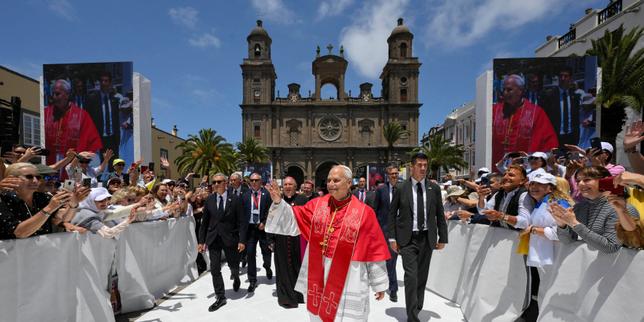
Pope Francis—reigning as Leo XIV in a striking continuity of the Vatican’s geopolitical focus—recently stood on the shores of the Canary Islands to deliver a blistering indictment of Western apathy, declaring that humanity cannot accustom itself to counting the dead at sea. But beneath the pontiff's moral outrage lies a cold, structural crisis that moral rhetoric alone cannot solve. While the Vatican frames the escalating Atlantic migration route as a failure of human empathy, an investigation into the mechanics of European border policy, shifting human smuggling networks, and West African socioeconomic pressures reveals a more cynical reality. The tragedy in the Canaries is not a byproduct of passive indifference; it is the predictable result of a deliberate, externalized border strategy engineered by the European Union.
For decades, Brussels has sought to push its frontiers outward, paying third-party nations to act as continental gatekeepers. Yet, as routes through the Mediterranean tighten due to aggressive Libyan coast guard interceptions and Tunisian crackdowns, the human flow has not stopped. It has merely redirected to the deadliest maritime path on earth.
The Atlantic Route Realities
The numbers coming out of the archipelago are staggering, yet they fail to capture the mechanical horror of the crossing. Migrants are no longer just departing from nearby Morocco or Western Sahara. They are launching from Senegal, Gambia, and Mauritania.
They travel in cayucos. These are long, wooden fishing boats designed for coastal waters, not the volatile currents of the open Atlantic. Smugglers pack up to 200 people into these vessels, equipping them with unreliable outboard motors and barely enough fuel to make the journey. If a motor fails, or if the navigator misses the tiny target of the Canary Islands, the Atlantic current sweeps the boat out into the open ocean. They become "ghost boats." Weeks or months later, these vessels wash up in Cape Verde, or as far away as the Caribbean, filled with the mummified remains of those who starved or died of dehydration.
The Vatican’s appeal to the global conscience ignores the mathematical certainty of this route. European border agency data indicates a massive surge in arrivals to the Canaries over the past two years. This is not an accident of geography. It is the direct consequence of closing the Central Mediterranean route. When one corridor shuts, another opens. The Atlantic route is simply the path of greatest resistance and highest mortality.
The Externalization Gamble That Failed
To understand why the Canary Islands have become a graveyard, one must look at the bilateral agreements signed in Brussels, Madrid, and Rabat. Europe’s primary tool for managing migration is financial leverage.
[EU Funding & Security Aid] ---> [North/West African Nations] ---> [Strict Border & Maritime Enforcement]
                                                                                |
                                                                                v
                                                                   [Displacement of Routes to
                                                                    High-Risk Atlantic Waters]
The model relies on a simple transaction. Europe provides hundreds of millions of euros in development aid, security equipment, and surveillance technology to transit countries. In return, these nations deploy their military and police forces to prevent departures.
- The Moroccan Clampdown: Moroccan authorities have significantly tightened control over the Mediterranean coast and the land borders around the Spanish enclaves of Ceuta and Melilla.
- The Mauritanian Pressure: Joint patrols involving the Spanish Guardia Civil and Mauritanian coast guards have increased surveillance around Nouadhibou.
- The Resulting Displacement: Smugglers have moved their operations further south, deep into Senegalese territory, lengthening the sea journey from a few dozen miles to over a thousand kilometers.
This strategy achieves a temporary political victory for European governments facing domestic anti-immigrant pressure. It reduces the visible numbers on certain frontiers. However, it completely fails to address the supply side of the migration equation. The demand for passage remains constant because the underlying drivers in West Africa are intensifying.
The Myth of Economic Choice
European political discourse frequently separates arrivals into "genuine refugees" fleeing war and "economic migrants" seeking better wages. This distinction is collapsing under the weight of ecological and industrial realities in West Africa.
Consider the collapse of artisanal fishing in Senegal. Over the past decade, foreign industrial trawlers—many operating under European Union agreements or Chinese flags—have systematically overfished the waters off the West African coast. Local fishermen, using traditional wooden pirogues, find their nets empty. Their livelihoods have been destroyed by the very continent that now bars its doors to them.
When a Senegalese fisherman sells his family assets to buy a seat on a cayuco, he is not participating in a lifestyle choice. He is responding to an existential threat. The wooden boat he boards is often the exact same vessel he used to fish with, now repurposed for human cargo because it can no longer generate revenue from the sea.
The Smuggling Syndicate Enterprise
The Vatican often speaks of human traffickers as predatory monsters operating in the shadows. While accurate regarding their disregard for human life, this description obscures the highly sophisticated, market-driven nature of modern smuggling networks. These are not disorganized criminals; they are agile logistical enterprises.
Smuggling networks in West Africa operate with corporate efficiency. They utilize encrypted messaging applications to coordinate departures, track weather patterns, and monitor the positions of European maritime patrol aircraft. They offer tiered pricing models based on the perceived safety of the vessel or the likelihood of a successful crossing.
+-------------------+-----------------------------------+-----------------------------------+
| Feature           | Standard Cayuco Crossing          | High-End Managed Passage          |
+-------------------+-----------------------------------+-----------------------------------+
| Vessel Type       | Overcrowded wooden fishing boat   | Large fiberglass hull, twin engines|
| Navigation        | Basic GPS or compass              | Satellite phone, experienced crew |
| Cost per Person   | €1,000 – €2,000                   | €4,000 – €6,000                   |
| Survival Rate     | High risk of drift / failure      | Monitored closely via tech        |
+-------------------+-----------------------------------+-----------------------------------+
Corruption acts as the lubricant for this machine. The sums of money generated by a single cayuco launch can exceed €200,000. In regions where local police or military officers earn a fraction of that in a year, bribing a port official or a beach patrol commander is standard operating procedure. European funded radar systems and patrol boats are only as effective as the personnel operating them. When the profit margins of smuggling outpace the state salaries of border guards, the border becomes porous.
Spain’s Domestic Crucible
While the Pope delivers encyclicals from a position of moral neutrality, the Spanish autonomous community of the Canary Islands faces the administrative reality of the crisis. The local infrastructure is permanently on the brink of collapse.
The most acute pressure point is not the reception of adult migrants, but the care of unaccompanied minors (menores no acompañados). Under Spanish law, adult migrants can be detained in centers and eventually transferred to the mainland or scheduled for deportation. Minors, however, fall under the direct jurisdiction of the regional government, which is legally obligated to house, educate, and protect them.
The Jurisdictional Standoff
The Canary Islands currently host thousands of unaccompanied minors in retrofitted schools, military barracks, and emergency camps. The regional government has repeatedly begged the central Spanish administration in Madrid to mandate the distribution of these minors across Spain’s other 16 autonomous communities.
The response has been a masterclass in bureaucratic paralysis. Wealthier regions, particularly those governed by conservative or right-wing coalitions, resist accepting quotas. They argue that taking in more minors creates a "pull effect" that encourages more families to send their children on perilous journeys. This political gridlock leaves the islands isolated, serving as a de facto open-air detention camp, much like Lesbos in Greece or Lampedusa in Italy.
The Spanish mainland avoids the political cost of migration by keeping the phenomenon contained on its geographical periphery. The islands suffer the economic and social strain, while Madrid can claim to be managing the situation through emergency funding allocations that do little to fix the structural deficit.
The Flaw in the Vatican’s Moral Framework
Pope Leo XIV’s declaration that we cannot accustom ourselves to counting the dead is a powerful rhetorical stance, but it exposes the limits of religious diplomacy in the face of modern statecraft. The Vatican operates on the assumption that policy changes when hearts change. Statecraft, conversely, operates on the assumption that policy changes when incentives change.
For European leaders, the political risk of appearing weak on border control far outweighs the moral discomfort of casualties at sea. Right-wing populist movements across France, Germany, Italy, and Spain have successfully weaponized migration data to win elections. A spike in visible arrivals can destabilize a government; a spike in sea mortalities, hidden hundreds of miles out in the Atlantic, rarely does.
The Absence of Legal Pathways
The core contradiction of Europe’s migration policy is the total absence of viable, legal avenues for low-skilled labor migration. To apply for asylum or a work visa, an individual from Mali or Guinea must typically navigate a labyrinthine, expensive, and frequently corrupt consular process in their home country. The rejection rates for standard visas from these regions approach 90%.
[Desire to Migrate] ---> [Consular / Legal Application] ---> [90% Rejection Rate]
         |
         v
[The Illegal Alternative: Cayuco to the Canaries]
This creates an all-or-nothing dynamic. Because there is no orderly line to stand in, the only way to seek opportunity or safety in Europe is to violate its borders. By the time a migrant sets foot on a beach in Tenerife, they have already broken the law, enrichment syndicates have been paid, and lives have been lost. The system rewards defiance and punishes compliance.
The Mirage of Development Aid
The standard policy prescription offered by both European progressives and moderate conservatives is to "solve the problem at the source" by investing in local development. If West African nations are prosperous, the logic goes, their citizens will stay home.
This argument sounds reasonable, but it contradicts historical development data. Demographers have long documented a phenomenon known as the migration hump. When a very poor country begins to develop, migration rates do not drop; they rise.
Extremely destitute individuals cannot afford the thousands of euros required to pay a smuggler. As cash flow improves, infrastructure develops, and families acquire disposable income, they finally secure the capital necessary to fund a journey abroad. Development aid does not stop migration in the short or medium term. It finances it.
Furthermore, European development funding is frequently diverted into the pockets of ruling elites or conditioned on the purchase of European manufactured security goods. It becomes a circular economy where European taxpayer money is sent to West Africa to buy European thermal imaging cameras and patrol craft, leaving the structural poverty of the population untouched.
The Strategic Inertia
The crisis in the Canary Islands will continue because the current equilibrium, despite its human cost, serves the political interests of the decision-makers. Europe gets to maintain its internal open borders within the Schengen zone by pretending its external frontiers are secure. West African governments receive massive financial inflows and remittances from the diaspora, which exceed total foreign aid budgets. Smuggling cartels generate immense revenue.
The only losers are the migrants who drown in the Atlantic current and the local communities in the Canaries left to manage the human fallout of a broken continental strategy. Moral proclamations from the papacy provide compelling headlines, but they do nothing to alter the structural incentives driving the trade. Until Europe chooses between opening legal labor pathways or accepting the grim reality of indefinite maritime interdiction, the Atlantic route will remain an active conveyor belt of human misery. The bodies will continue to wash ashore, the numbers will continue to be counted, and the policy will remain exactly as it was designed.