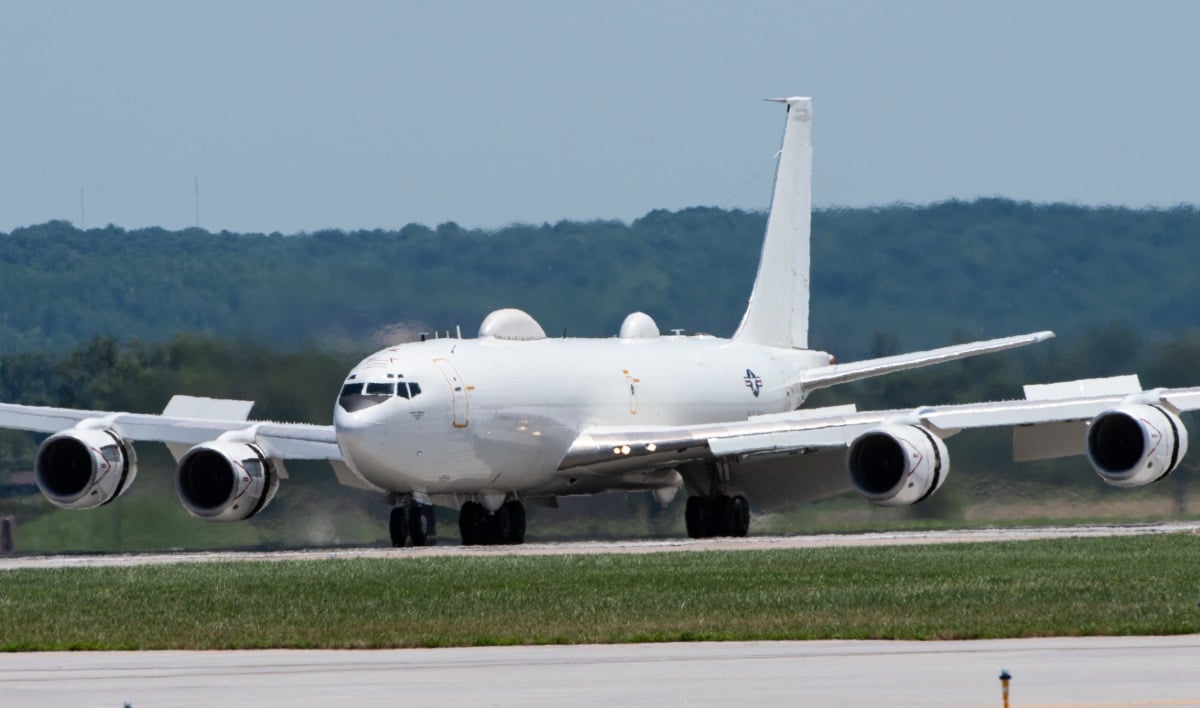
The United States Navy is quietly extending the lifespan of its E-6B Mercury fleet, the airborne command posts designed to maintain nuclear communications during World War III. While recent reporting frames this survival as a triumph of legacy engineering, the reality is far more concerning. The Pentagon is keeping these forty-year-old airframes flying because the multi-billion-dollar program meant to replace them is bogged down by procurement delays, shifting requirements, and a defense industrial base stretched to its absolute limit.
For decades, the E-6B Mercury has served as the backbone of the Take Charge and Move Out (TACAMO) mission. Its primary job is survival. If a nuclear first strike wipes out ground-based communications, these heavily modified Boeing 707s deploy miles-long trailing wire antennas to broadcast emergency action messages to ballistic missile submarines hidden beneath the ocean. They are the ultimate insurance policy.
But insurance gets expensive when the house starts aging. The fleet is getting old. Keeping a Cold War-era airframe operational in the 21st century requires an increasingly unsustainable amount of maintenance, money, and cannibalized parts.
The Logistics Nightmare of Forty Year Old Aluminum
The E-6B is not a modern aircraft. Underneath its radar domes and specialized communication gear sits the bones of a Boeing 707, a commercial airliner that first flew during the Eisenhower administration. Boeing shut down the 707 production line decades ago. This creates an immediate, severe supply chain crisis.
When a specialized bracket cracks on an E-6B wing today, mechanics cannot simply order a replacement from a catalog. They have three choices. They can pull the part from a mothballed aircraft sitting in the Arizona desert, they can custom-machine a single replacement part at astronomical expense, or they can wait for a specialized defense contractor to fabricate it from scratch. None of these options are fast. All of them keep vital strategic assets grounded for longer than the Navy publicly admits.
This is not just about metal fatigue. The internal systems are a patchwork of generational upgrades. Over the last twenty years, the Navy has repeatedly crammed new digital avionics, satellite communications, and secure networks into an airframe originally designed for analog dials. The thermal load alone is a constant battle. Modern electronics generate massive amounts of heat, requiring specialized cooling systems that sap power from the aircraft’s aging engines.
The Broken Pipeline for a Successor
The Navy knows the Mercury is on borrowed time. That is why they initiated the E-XX program, intended to migrate the TACAMO mission to a newer, more survivable platform. The service selected the Lockheed Martin C-130J-30 Super Hercules as the baseline airframe for the next generation.
It looked good on paper. The C-130J is a workhorse, currently in production, with a global supply chain already intact.
Then reality hit the defense acquisition process. Transforming a tactical cargo transport into a nuclear command post is not as simple as bolting radios into the cargo bay. The E-XX requires massive power generation upgrades to drive the Very Low Frequency (VLF) transmitters. It needs extensive electromagnetic pulse (EMP) hardening to ensure the electronics survive the atmospheric detonation of a nuclear warhead.
Integrating these systems into the C-130J has proven to be a bureaucratic and engineering slog. The specialized mission equipment is heavy, altering the flight characteristics of the aircraft. Engineering teams must figure out how to trail two separate wires—one nearly five miles long, the other about a mile long—from a turboprop aircraft without causing aerodynamic instability or catastrophic structural failure.
While the engineers bicker over weight distribution and electrical loads, the timeline keeps slipping. The first operational E-XX test aircraft was supposed to be delivering concrete data by now. Instead, the contract awards for full-scale mission system integration have faced repeated revisions. Every month of delay at the shipyard or engineering firm translates to another month the legacy E-6B fleet must pull double duty.
The Secret Submarine Complications
The delay of the E-XX does not happen in a vacuum. It directly collides with the Navy’s other massive nuclear modernization effort: the transition from Ohio-class ballistic missile submarines to the new Columbia-class.
The E-6B’s primary customer is the submarine force. If the aircraft cannot communicate, the submarines are deaf. The Ohio-class boats are reaching the end of their operational lives, meaning the Navy is managing two highly volatile, deeply complex transitions at the exact same time.
Consider the operational friction this creates. A hypothetical communication protocol update designed for the upcoming Columbia-class submarines must now be backward-compatible with the aging systems on the E-6B, while simultaneously being forward-compatible with the yet-to-be-built E-XX. Every single point of intersection between old and new technology introduces a fresh vulnerability. Cyber security experts have to validate that digital upgrades injected into the E-6B’s legacy architecture do not inadvertently open backdoors for foreign adversaries.
Rising Global Threats and Zero Margin for Error
The timing of this procurement bottleneck could not be worse. During the relative calm of the post-Cold War era, the Pentagon could afford to let major acquisition programs drag on for fifteen years.
That luxury is gone. The geopolitical environment has shifted dramatically. With Russia altering its nuclear doctrine and expanding its theater ballistic missile capabilities, and China rapidly building out its own nuclear triad in the Pacific, the demand for reliable strategic communication is higher than it has been since the mid-1980s.
The E-6B fleet is being flown harder than ever before. Higher operational tempo means faster wear and tear. The maintenance cycles are compressing, leaving fewer aircraft available for active alert at any given moment. The Navy maintains a strict rotation to ensure at least one aircraft is always airborne or ready to launch at a moment’s notice, but achieving that readiness metric requires a frantic shell game behind the scenes. Ground crews work around the clock, cannibalizing parts from aircraft undergoing scheduled overhauls just to get another bird into the sky.
The Financial Sunk Cost Trap
The fiscal reality of extending the E-6B is staggering. Congress continues to pour hundreds of millions of dollars into sustainment modifications for the Mercury fleet.
This money is a stopgap. It does not buy new capabilities; it merely buys time. Every dollar spent replacing a wiring harness or reinforcing a floor plate on a forty-year-old Boeing 707 is a dollar diverted from accelerating the E-XX program.
The Pentagon is trapped in a classic acquisition vice. They cannot stop funding the E-6B because they cannot afford a gap in nuclear command capabilities. Yet, by continuing to fund the legacy platform to keep it alive, they drain the financial and engineering resources needed to get its replacement off the ground. The defense industrial base only has so many specialized engineers who understand VLF communications and nuclear hardening. Currently, those engineers are split between fixing the past and designing the future.
The current situation is unsustainable, driven not by a strategic preference for old hardware, but by a systemic failure to deliver new platforms on schedule. The E-6B Mercury will keep flying because it absolutely has to, serving as a loud, vibrating, multi-million-dollar reminder that American defense procurement is failing to keep pace with the realities of modern deterrence.