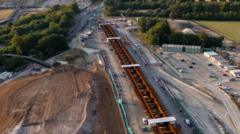
Britain cannot escape its own high-speed rail network. Despite the latest multibillion-pound budget reset pushing costs to an astronomical £102.7 billion and delaying full delivery into the 2040s, the complete High Speed 2 network will eventually be built because the alternative is the permanent strangulation of the British economy. The recent capitulation by the Department for Transport—lowering maximum operational speeds to 320km/h and formally extending the completion window—is not a death knell. It is the painful, bureaucratic birth of a project that has become too expensive to finish, yet entirely fatal to abandon.
The political class spent years treating this project as an expensive luxury or a glorified commuter shortcut. It is neither. Beneath the noise of broken promises and canceled northern legs lies a cold, unyielding reality of civil engineering, network capacity, and economic survival that no chancellor can ignore for long.
The Operational Chokehold on the West Coast Main Line
The fundamental misunderstanding of this entire saga is the belief that high-speed rail is about speed. It never was. The core justification is capacity, a technical bottleneck that is currently suffocating the conventional rail network.
The West Coast Main Line is the busiest mixed-use rail corridor in Europe. It forces fast intercity expresses, slow regional stopping services, and heavy freight trains onto the same tracks. This operational cocktail is a logistical nightmare. A single delayed commuter train outside Milton Keynes ripples across the entire network, causing delays from London to Glasgow.
To understand why the full line must eventually extend to Crewe and Manchester, look at what happens if the line terminates permanently at a flat junction in Handsacre, Staffordshire. High-speed trains running down from London will be forced to merge onto the existing, century-old Victorian tracks. Instead of resolving the bottleneck, this creates an acute operational choke point.
The network cannot physically handle the transition of high-speed rolling stock onto commuter tracks without drastically reducing the number of local services. Canceling the northern extensions means telling passengers in the North and the Midlands that their local services must be cut to accommodate trains coming from London. That is a politically and economically untenable position for any government, regardless of party affiliation.
The Illusion of Savings in Infrastructure Deletion
Slicing sections off a major infrastructure blueprint rarely saves linear money. The decision by previous administrations to scrap the leg to Crewe and Manchester was presented as a fiscal rescue mission. In reality, it was an accounting trick that ignored the massive contractual penalties, demobilization fees, and the sheer cost of redesigning connecting infrastructure.
Consider the physical reality of the ground already broken. Miles of land have been safeguarded, compulsory purchase orders processed, and engineering work completed. Walking away from these sites does not return money to the Treasury; it crystallizes billions in sunk costs while yielding absolutely zero economic return.
HS2 Capital Outlay Scenarios (Estimated Lifecycle Projections)
+------------------------+-----------------------+------------------------+
| Metric                 | Truncated Network     | Restored Full Network  |
+------------------------+-----------------------+------------------------+
| Projected Capital Cost | £87.7bn - £102.7bn    | Additional £25bn-£35bn |
| Network Bottlenecks    | Severe (Handsacre)    | Resolved               |
| Freight Expansion      | Negligible            | 70% Capacity Increase  |
| Decarbonization Impact | Marginal Shift        | Systemic Shift         |
+------------------------+-----------------------+------------------------+
Furthermore, the civil engineering industry prices uncertainty into every future public contract. When a state gains a reputation for canceling megaprojects mid-delivery, tier-one contractors raise their risk premiums. The structural instability of British infrastructure planning is precisely why building a mile of high-speed track in the UK costs significantly more than it does in France, Italy, or Japan. The latest project reset under the leadership team brought over from the Elizabeth Line is a belated attempt to inject competence into this broken system, but it cannot fix the damage caused by years of political indecision.
The Ghost of Northern Powerhouse Rail
You cannot build a modern transport network in the North of England without using the spine of a high-speed line. The proposed Northern Powerhouse Rail network, designed to link Liverpool, Manchester, Leeds, and Newcastle, relies entirely on the infrastructure hubs designed for the northern legs of the high-speed project.
The Manchester Airport Hub Paradox
Without the high-speed tunnels and stations planned under Manchester, the east-west connectivity of Northern Powerhouse Rail collapses into a series of expensive, slow upgrades to existing tracks. The station at Manchester Airport was designed to serve both networks. Deleting one renders the other structurally compromised and financially non-viable.
The Freight Capacity Crisis
The debate consistently ignores the movement of goods. The UK container ports are desperate for more rail freight capacity to take heavy goods vehicles off gridlocked motorways. The conventional network cannot grant this capacity because fast passenger trains take priority. By shifting express passenger services to a dedicated high-speed line, massive slots open up on the existing tracks for freight. If those services are never shifted, the freight logistics sector remains trapped in a Victorian bottleneck, driving up supply chain costs across the country.
The Inevitable Return to the Blueprint
The current compromise—running trains at 320km/h to save an estimated £2.5 billion and match European standards—is a pragmatic capitulation to current fiscal constraints. It strips out the gold-plated engineering demands that required experimental, unproven UK test tracks. But the structural requirements of the British economy have not changed.
The current state of truncation is an unstable equilibrium. Over the next decade, as the line between London Euston, Old Oak Common, and Birmingham Curzon Street nears completion in the late 2030s, the sheer absurdity of stopping the tracks in a Staffordshire field will become glaringly obvious. The congestion on the remaining sections of the West Coast Main Line will become unbearable.
A future Treasury, faced with a stagnant economy and a transport network incapable of supporting growth, will do what British governments always do when confronted with the consequences of short-term thinking. They will quietly reintroduce the canceled sections under a new name, using private finance initiatives or regional development corporations to obscure the capital cost.
The full network will be completed because geography and economics are indifferent to electoral cycles. You cannot run a G7 economy on an infrastructure foundation built in the 19th century, and no amount of political hand-wringing can alter the physical reality of a track layout that demands a comprehensive solution. The project will survive its creators because the country cannot survive without it.