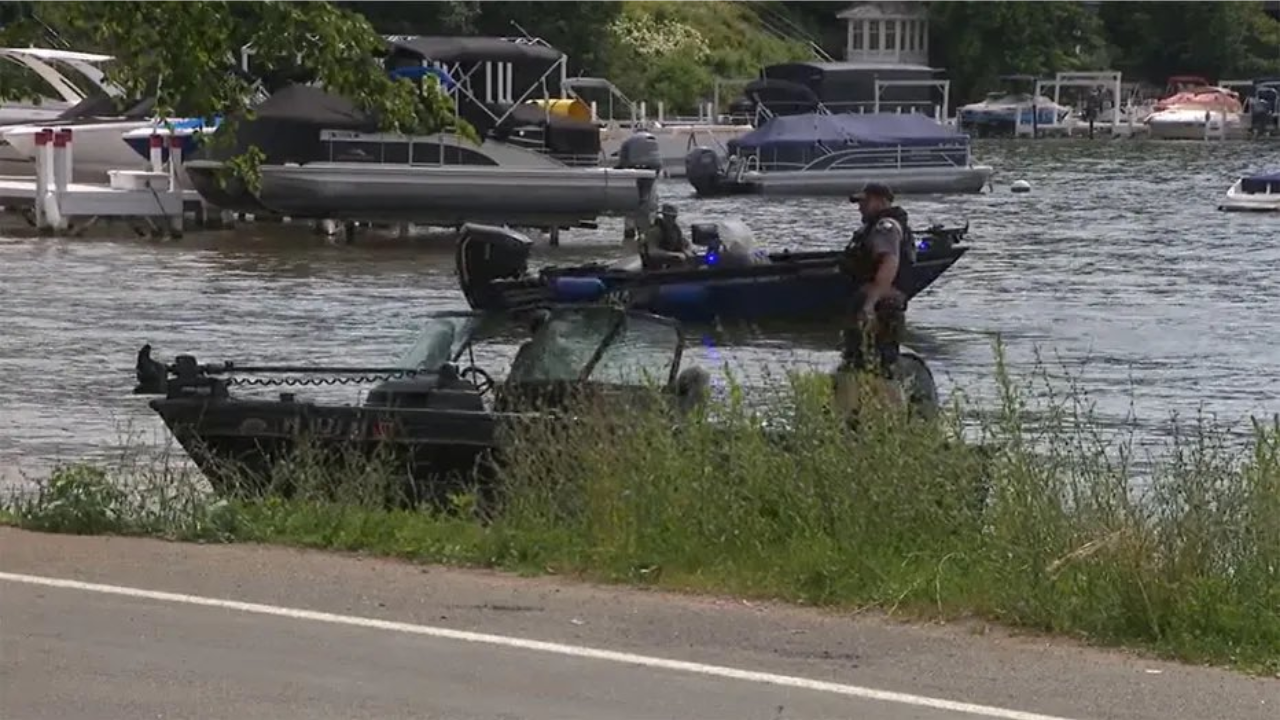
On July 3, 2026, a sudden and violent thunderstorm shattered the holiday weekend peace on Geneva Lake, Wisconsin, capsizing a private recreational motorboat and leaving three children dead despite their wearing life jackets. Seven other passengers, including six adults and one child, were rescued from the churning water as 65 mph wind gusts swept across Walworth County. While initial mainstream reports focused strictly on the tragic chronology of the storm, a deeper investigation reveals systemic vulnerabilities in inland waterway regulations, vessel weight dynamics, and the false sense of security provided by standard personal flotation devices.
The incident unfolded shortly after noon when a squall line slammed into southern Wisconsin. The boat, heavily laden with ten occupants, attempted to flee toward safe harbor but took on water and sank rapidly. When first responders finally breached the debris-clogged roads to reach the scene, they faced a grim reality that exposes the critical limits of rural emergency infrastructure.
The Mechanics of an Inland Squall
Inland lakes create a deceptive environment for recreational boaters. Because land masses surround the water, operators often assume they can reach the shoreline before a storm becomes hazardous. This assumption ignores the micro-meteorology of inland squalls, where wind speeds can accelerate instantly due to localized thermal gradients and downbursts.
On the afternoon of the capsize, a powerful squall line advanced rapidly across the Midwest. The National Weather Service had issued warnings, but the transition from calm water to a survival scenario occurred over a span of minutes. When a 65 mph gust hits a small body of water like Geneva Lake, it does not just generate large waves. It creates localized atmospheric pressure drops and whiteout spray that completely eliminates visibility.
For an operator steering a crowded vessel, navigating these conditions requires immediate adjustment to the boat’s angle of approach to the oncoming waves. A single mistimed wave can force water over the bow. Once water enters the hull, the stability of the craft degrades exponentially due to the free-surface effect, where shifting liquid weight sloshes from side to side, amplifying the vessel's tendency to roll.
Hull Capacity and Swamping Risks
The physical limitations of recreational motorboats are governed by strict mathematical realities that many casual operators fail to fully grasp. A vessel rated for ten passengers is often evaluated under ideal, flat-water conditions. It is a matter of weight distribution rather than mere body count.
Six adults and four children represent a substantial payload for a standard open-bow or mid-sized recreational craft. When a vessel is loaded close to its maximum capacity, its freeboard—the distance from the waterline to the upper edge of the hull—is significantly reduced. A lower freeboard means the boat has far less margin for error when waves begin to crest.
$$Freeboard_{dynamic} = Freeboard_{static} - \Delta h_{waves} - \Delta h_{load}$$
As the boat took on water, the static weight increased instantly. This created a compounding cycle. More water in the bilge lowered the boat further into the lake, making it even easier for subsequent waves to wash over the gunwales. In these moments, standard bilge pumps are utterly useless, as they are designed to clear minor condensation or small leaks, not hundreds of gallons of rushing lake water. The vessel becomes a dead weight, entirely at the mercy of the hydrodynamic forces acting upon it.
The Flotation Myth
Every child aboard the doomed vessel wore a life jacket. This fact is perhaps the most unsettling aspect of the Geneva Lake disaster, as it challenges a core tenet of water safety campaigns. The general public views a personal flotation device as a guarantee of survival. It is not.
Standard Type III life jackets, which are common among recreational boaters, are designed to keep a conscious person afloat in calm waters. They do not consistently turn an unconscious person face-up. In a chaotic capsize involving high winds and rapid sinking, several factors can render a life vest ineffective for a young child.
- Vessel Entrapment: If a boat flips completely upside down, passengers beneath the hull can be trapped by the very jackets meant to save them. The inherent buoyancy of the vest pushes the individual upward against the floor of the overturned boat, making it incredibly difficult to dive downward and swim out from under the wreckage.
- Hydrodynamic Force: Rough waves can submerge a small child repeatedly, even if they are wearing a vest. The constant splashing and spray can lead to involuntary water ingestion or secondary drowning, where water enters the lungs and causes asphyxiation over time.
- Hypothermic Shock: Even in July, prolonged exposure to agitated water combined with high winds can induce rapid body temperature drops in children, reducing their ability to keep their airways clear.
The investigation by the Wisconsin Department of Natural Resources must look beyond whether life jackets were present and examine the precise mechanisms of how these safety devices performed under extreme duress.
The Rural Rescue Bottleneck
When the 911 calls flooded into Walworth County at 12:10 p.m., the emergency response network was immediately choked by the storm's terrestrial destruction. This is the structural vulnerability that complicates inland water rescues. Unlike oceanic coastlines where the U.S. Coast Guard maintains dedicated, unimpeded maritime bases, inland lake rescue often relies on local sheriff departments and municipal police who must travel by land to launch their vessels.
Undersheriff Tom Hausner noted that rescue crews faced severe delays because local roads were blocked by uprooted trees and live, snapping power lines. The storm had effectively cut off the lake from the very people trained to save lives on it.
This creates an operational paradox. The worse the weather on the water, the more difficult it is for land-based rescue teams to reach the boat launches. By the time mutual aid from surrounding counties and the state arrived, the critical window for life-saving intervention had closed. The initial rescue of the seven survivors was likely executed by nearby boaters or immediate shore residents who happened to be in the right place at the right time, rather than a centralized emergency response.
Regulatory Deficiencies on Inland Waterways
The tragedy on Geneva Lake exposes a broader regulatory gap that persists across many states, including Wisconsin. Operating a powerful motorized watercraft requires far less training and vetting than driving a compact automobile.
In many jurisdictions, individuals born before a certain date are completely exempt from boating safety education requirements. Even for those who are required to take courses, the curriculum is largely theoretical, conducted online, and lacks any practical, hands-on handling assessments in adverse conditions. This creates a class of operators who understand basic navigation rules in sunny weather but possess zero training on how to manage a swamped vessel or interpret fast-moving barometric data.
Furthermore, there are no mandatory weather-related grounding laws for recreational boaters. While commercial aviation and commercial shipping are strictly bound by severe weather protocols, private boaters are free to venture out or remain on the water at their own discretion, regardless of impending storm fronts.
The current framework relies almost entirely on personal responsibility and voluntary compliance. When that compliance fails, or when the operational challenges of a sudden storm outpace the operator's skill level, the consequences are immediate and fatal. The three young lives lost on Geneva Lake are a stark testament to the reality that inland waters demand the same respect, preparation, and rigorous oversight as the open ocean.
The investigation will eventually release the names of the victims and the formal technical findings regarding the boat's design and mechanical status. However, the foundational issues—overloaded hulls, the limits of standard safety gear, and delayed rescue access—remain unaddressed threats to every family stepping onto a recreational boat this season.