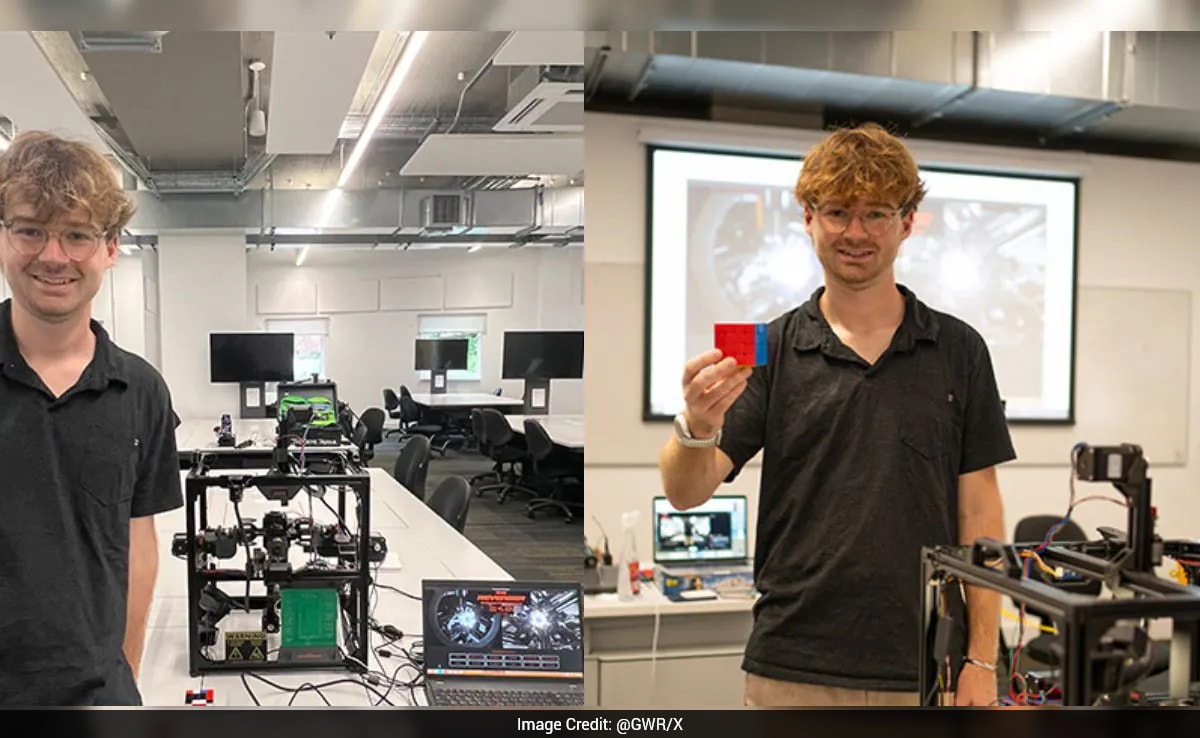
In a basement laboratory filled with the smell of scorched solder and ozone, a custom-built machine just shattered a record that stood for nearly a decade. The mechanical rig solved a 4x4x4 Rubik’s Revenge cube in 45 seconds, shaving significant time off the previous 1.18-minute mark. To the casual observer, this looks like a triumph of automation. To anyone who actually understands the brutal physics of torque and the limitations of consumer-grade sensors, it is a reminder of how far robotics still has to go.
Humans have been solving the 4x4x4 cube in under 20 seconds for years. Max Park holds a world record of 15.71 seconds. Why is it that we can send rovers to Mars and build cars that drive themselves, yet a machine struggles to outpace a teenager with a plastic toy? The answer lies in the messy intersection of mechanical friction, visual noise, and the sheer computational nightmare of the 4x4x4's internal mechanism.
The Mechanical Bottleneck
Most people assume the delay in robot cubing comes from the "brain." They think the computer is struggling to find the solution. This is a fundamental misunderstanding of the problem. Modern algorithms can find a solution for a 4x4x4 cube in milliseconds. The real war is fought in the actuators.
When a robot attempts to turn a layer of a 4x4x4 cube, it isn't just fighting the friction of the plastic. It is fighting the lack of tactile feedback. A human cuber "feels" when a layer is slightly misaligned and corrects it instantly with a flick of a finger. A robot, unless equipped with incredibly expensive haptic sensors, is flying blind. If a layer is off by even two degrees, the next move will jam the machine. This usually ends with the cube exploding into sixty-four individual pieces across the room.
To hit the 45-second mark, engineers had to move away from standard stepper motors. They turned to high-torque servos that can accelerate and decelerate with surgical precision. But speed creates heat. Heat expands the plastic of the cube. As the cube expands, the tolerances change. A machine calibrated for a cold cube will fail four turns into a high-speed solve because the core has expanded by a fraction of a millimeter.
The Vision Trap
Before the first motor even twitches, the robot has to "see" the cube. This sounds simple. It isn't.
Standard 4x4x4 cubes have six colors, but under different lighting conditions, those colors shift. A white sticker under a warm yellow LED looks remarkably like a yellow sticker. A red sticker in a shadow looks like a dark orange. Most record-breaking attempts require a controlled lighting environment that looks more like an operating room than a hobbyist's desk.
The 45-second solve utilized a multi-camera setup to eliminate the need for the robot to rotate the entire cube just to see the back face. By capturing all six sides simultaneously, the software builds a 3D map of the internal state. This "spatial awareness" is what allowed the machine to skip the traditional inspection phase that usually eats up five to ten seconds of a human solve. Yet, even with this advantage, the machine is still tethered to the reality of physical movement.
Parity Errors and Computational Waste
On a standard 3x3x3 cube, every piece has a fixed place. On a 4x4x4, you deal with "parity." This is a mechanical quirk where two pieces appear to be in the correct spot but are flipped in a way that is impossible on a smaller cube.
Humans recognize parity visually and execute a "long" algorithm to fix it—a sequence of 15 to 20 moves. For a robot, parity is a physical tax. Every extra move is another chance for a motor to slip or a gear to strip. The 45-second record was only possible because the software was optimized to predict parity early in the solve, integrating the fix into the reduction phase rather than treating it as a final correction.
The Cost of Speed
We have reached a point of diminishing returns. To get a 4x4x4 robot to solve the puzzle in under 10 seconds—the ultimate goal for many in the community—you cannot use a standard off-the-shelf cube. You have to re-engineer the puzzle itself.
Top-tier human cubers use "magnetic" cubes. Small neodymium magnets are embedded in the pieces to help them snap into alignment. Robots hate these. The magnetic pull creates a non-linear resistance that makes it harder for a motor to maintain a constant velocity. To break the 45-second barrier, this team actually had to de-magnetize their hardware and rely entirely on the precision of the motor controllers to stop the layers at exactly 90-degree increments.
There is also the matter of "popping." In the cubing world, a pop is when the internal tension fails and the cube falls apart. High-speed robots exert so much centrifugal force on the outer layers that the cube literally tries to fly apart. The 45-second machine used a custom-clamping mechanism that applied constant inward pressure, a "mechanical hug" that kept the cube together while the internal layers spun at thousands of RPMs.
Why We Should Stop Chasing Seconds
The obsession with the 45-second record misses a larger point about the state of robotics. We are very good at building machines that can do one specific thing very fast in a controlled environment. We are very bad at building machines that can adapt.
If you gave that record-breaking robot a cube that was slightly worn down, or one with a different shade of blue, it would fail. If you changed the ambient temperature by ten degrees, it would fail. The human cuber, Max Park, can solve a cube while being filmed by a dozen cameras, in a loud arena, using a cube he’s never seen before.
The real breakthrough isn't the 45-second timer. It’s the move toward "soft" robotics—using flexible grippers that mimic the human hand's ability to absorb shock and correct for misalignment. Until we stop treating the cube like a series of mathematical coordinates and start treating it like a physical object with unpredictable friction, the humans are going to keep winning.
The Problem with Luxury Hardware
It is tempting to throw money at the problem. You can buy industrial-grade arms from companies like Kuka or ABB that have sub-millimeter precision. These machines cost $50,000. They can move faster than the human eye can follow. But using a multi-ton industrial robot to solve a plastic toy is cheating.
The 45-second record is significant because it was done with relatively affordable components. It proves that software optimization and clever mechanical design can compensate for raw horsepower. It shows that we are learning how to manage "jitter"—those tiny, high-frequency vibrations that plague all robotic systems.
The Hidden Data Behind the Solve
When you look at the logs of the record-breaking run, you see something fascinating. The robot actually spent 12% of its "solve time" waiting. It wasn't waiting for the computer to think. It was waiting for the vibrations in the plastic to settle after a particularly violent turn.
This is the "settling time" problem. If the robot turns the top layer and immediately tries to turn the right layer while the cube is still shaking, the pieces won't line up. To break the record, the team had to write a "vibration dampening" algorithm that used the motors to actively counteract the shake of the cube. They were essentially using the robot's "muscles" to keep its "bones" still.
The Future of the 4x4x4
We are approaching the physical limit of what a plastic 4x4x4 cube can handle. Beyond this point, the plastic will simply melt or shatter under the stress of the turns. To go faster, we will need to change the materials. Carbon fiber cores, ceramic bearings, and synthetic lubricants are already being discussed in the high-end hobbyist circles.
But for the rest of us, the 45-second mark stands as a benchmark of what happens when you refuse to accept mechanical limitations. It isn't just about a toy. It's about the fact that we are finally teaching machines how to handle objects that aren't perfect. We are teaching them to navigate a world that is slippery, friction-heavy, and prone to falling apart.
If you want to see how this technology actually impacts your life, look at the next generation of warehouse robots or surgical assistants. They are using the same "vibration dampening" and "visual noise reduction" techniques pioneered by people obsessed with solving a 4x4x4 cube. The toy is just the testing ground. The real prize is a machine that can touch the world without breaking it.
The next time you see a headline about a robot breaking a record, don't look at the clock. Look at the hands. Watch how it handles the cube. If it looks stiff and clinical, it’s just a fast motor. If it looks fluid, almost hesitant, and then strikes with precision, you are looking at the future of how machines will interact with our reality.
Go pick up a 4x4x4 cube and scramble it. Feel the way the layers grind against each other. Now imagine trying to coordinate those movements at 100 turns per second. That is the gap we are currently trying to bridge. It is a gap measured not in seconds, but in the subtle, nearly invisible nuances of physical touch.