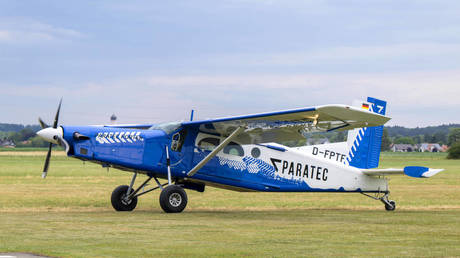
An aircraft carrying eleven people plunged vertically into a grassy field near the Nancy-Essey aerodrome on Sunday, killing everyone on board and exposing the hidden vulnerabilities of utility aviation during extreme weather events. The victims included five skydiving instructors, five students who worked together as nurses, and the pilot. They died in full view of family members gathered near the runway in the northeastern French town of Tomblaine. While initial reports focused entirely on the shock of the loss, a deeper look into the mechanics of short-takeoff aircraft and the compounding effects of severe atmospheric conditions reveals a much more complex safety problem.
The aircraft involved was a 35-year-old Pilatus PC-6 Turbo Porter. This single-engine turboprop is legendary in the skydiving community for its ruggedness and ability to climb rapidly. Yet eyewitnesses described a sudden silence as the engine appeared to cut out mid-climb, followed by an immediate, catastrophic loss of lift. Investigators from the air transport gendarmerie are now combing through the wreckage, focusing heavily on how a record-breaking European heatwave may have pushed the aircraft beyond its aerodynamic breaking point.
Density Altitude and the Invisible Trap of Extreme Heat
Air temperature changes the very physics of flight. On the Saturday before the accident, Nancy recorded its highest temperature in history, and the intense heatwave continued directly into Sunday morning. To an ordinary observer, hot air just feels uncomfortable. To an airplane, hot air is thin air.
As temperature rises, air molecules spread apart. This creates a high density altitude, a condition where the performance of an aircraft degrades as if it were flying thousands of feet higher than its actual altitude. The wings find less air to convert into lift. The propeller finds less air to convert into thrust. The turbine engine finds less oxygen to convert into combustion power.
A fully loaded skydiving aircraft operating in these conditions faces a massive deficit. A Pilatus PC-6 carrying eleven adults is operating near its maximum weight capacity. When you combine maximum weight with a sudden drop in air density, the margin for error vanishes. If an engine anomaly occurs during a steep climb under these specific conditions, a standard aerodynamic stall can transition into an unrecoverable vertical dive within seconds.
The Mechanical Reality of Parachuting Aircraft
Skydiving operations demand a brutal cycle from light aircraft. These planes do not cruise smoothly at high altitudes for hours. Instead, they perform maximum-effort climbs to drop altitude, dump their passengers, and dive back down to the tarmac as fast as possible to pick up the next group. This cycle repeats six, seven, or eight times a day during peak summer weekends.
This operational profile subjects the engine and airframe to intense thermal cycling. Components heat up rapidly under full power during the climb, then cool down fast during the high-speed descent. Over years of service, this cycle can cause microscopic fatigue in fuel lines, turbine blades, and electrical connections.
The aircraft in Tomblaine was registered in Germany and chartered specifically for this high-demand weekend. Local authorities confirmed that such arrangements are standard practice across Europe to handle summer crowds. However, chartering aircraft across borders can sometimes complicate the continuous oversight of maintenance logs, creating gaps in tracking how an aging airframe handles extreme environmental stress.
Witness Accounts Point to Total Power Loss
Local residents reported hearing the distinctive whine of the turboprop engine suddenly stop while the plane was still in its initial ascent phase. There was no smoke, no explosion, and no visible separation of parts before the impact. The plane simply ceased flying.
When a single-engine aircraft loses power immediately after takeoff, the pilot has very few options. The natural instinct is to try and turn back to the runway, but this maneuver drops the airspeed dramatically. In thin, overheated air, turning back without sufficient altitude almost always triggers an aerodynamic stall, causing the nose to drop violently toward the earth.
The wreckage came to rest on a bicycle path just meters away from a residential neighborhood and a local shopping center. The absence of a post-crash fire suggests that either the fuel supply was interrupted before the impact or the pilot managed to cut the fuel lines in a final effort to prevent an explosion.
The Compounding Failure of Rescue Parachutes
A common question arising from accidents involving skydiving flights is why the occupants did not simply jump out of the plane when things went wrong. The reality of emergency egress from a spinning or stalling aircraft makes this nearly impossible.
Skydiving flights pack passengers tightly into a stripped-down cabin, often with no traditional seats to maximize space. Five of the passengers on this flight were first-time students who were tightly harnessed to their tandem instructors. In a sudden engine failure during the ascent phase, the aircraft is typically below the safe altitude required for an emergency exit.
Even for experienced instructors, exiting a tumbling plane requires time and physical stability. The centrifugal forces generated during a vertical dive or a spin can pin occupants against the cabin walls, preventing them from reaching the exit door. For tandem pairs, the physical mass of two individuals clipped together makes an emergency escape in a low-altitude crisis logistically impossible.
The tragedy in Tomblaine underscores a harsher reality within general aviation. While commercial airliners operate with multiple redundant systems and strict regulatory cushions for weather variables, small utility aircraft operate much closer to the edge of their physical limitations. When extreme weather shifts those limitations without warning, the results are swift and absolute.
Investigators are expected to spend months analyzing the turbine blades and fuel systems of the German-registered Pilatus PC-6. Their findings will likely force the European aviation safety authorities to re-examine how weight restrictions and performance calculations are adjusted during severe heatwaves, ensuring that future flights are not cleared for takeoff when the air itself has become too thin to support them.