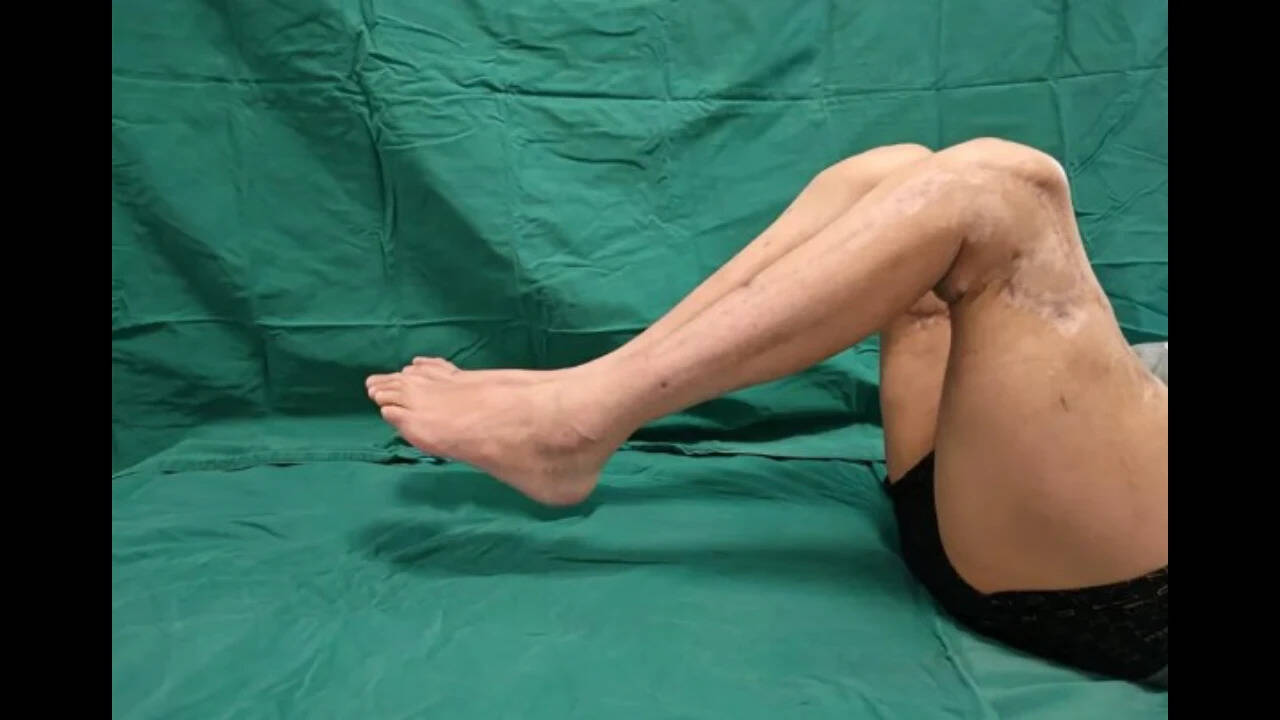
In the sterile confines of a specialized surgical suite in Suzhou, a fifty-one-year-old factory worker named Jiang became the subject of a medical milestone. After industrial machinery severed both his legs at the thigh in December 2024, a team at Suzhou Ruihua Orthopaedic Hospital spent eight grueling hours executing what is now verified as the first successful double thigh replantation. Today, twenty months after the accident, Jiang walks indoors with a frame, a testament to the raw persistence of both patient and surgeon. Yet, the story moves beyond the headline of a successful operation. It exposes the agonizing, high-stakes trade-offs of modern reconstructive medicine.
Reattaching a limb is not a matter of simply bolting bone to bone. It is a biological gamble. The medical team had to navigate the immediate trauma of bilateral amputation, which carries risks far exceeding those of a single limb injury. When a patient loses both thighs, the physiological shock is profound. Blood loss, systemic inflammation, and the sheer metabolic demand of repairing two massive, high-energy wounds require a level of surgical coordination that pushes the limits of human endurance. In other news, take a look at: The Sound of a Returning Pulse in Manitoba Hospitals.
The surgeons faced a complex jigsaw puzzle of nerves, vascular channels, and muscle tissue. Every minute the limbs remained detached, the clock ticked against cell survival. The initial eight-hour surgery was merely the first move in a long, punishing sequence of interventions. The patient suffered from localized skin necrosis, a common nightmare in high-level replantations where blood supply is precarious. He required multiple secondary procedures, including flap reconstruction and advanced internal fixation of his femurs, to overcome nonunion—the failure of the bones to mend correctly.
Consider the reality of a femoral nonunion. In a hypothetical scenario of a standard injury, a patient might face a single corrective procedure. For Jiang, this complication meant enduring months of stabilization, external fixators, and persistent uncertainty. The surgical team had to manage the biological environment of the thigh, which contains some of the largest, most vascularized muscle groups in the human body. When these are traumatized, the body often responds with a cascade of swelling and tissue death that can undermine even the most pristine suturing of a microscopic vessel. Everyday Health has also covered this fascinating topic in extensive detail.
The triumph here is not found in the initial surgery. It is found in the twenty months of grinding, incremental rehabilitation that followed. Most medical reports focus on the "successful" graft, but the clinical reality is often defined by the months spent relearning how to fire a muscle group or detecting the return of sensation—which, in this case, slowly crept down to his lower legs.
Some might argue that such a heroic effort for a fifty-one-year-old is medically irrational when high-quality prosthetics exist. Why endure the agony of flap surgeries and bone grafts? The answer lies in the psychological and functional chasm between a natural limb and a mechanical one. A prosthetic, however advanced, cannot replicate the proprioception of a biological leg. It cannot provide the same neural feedback loop that allows for a natural gait. For a man accustomed to the physical demands of factory work, the preservation of his own anatomy represents a return to a life that a prosthetic could only approximate.
This case also forces a reckoning with how trauma centers approach resource allocation. The sheer number of professionals—over twenty individuals—required for this single patient underscores the immense cost and intensity of such procedures. It is a luxury of high-tier orthopedic centers, a concentration of talent and equipment that remains inaccessible to the vast majority of the global population. The expertise required to perform vascular anastomosis and complex nerve repair at this scale is localized, usually in urban centers where industrial accidents are frequent enough to maintain a high level of surgical readiness.
The future of this discipline remains uncertain. As microsurgical techniques evolve, we may see more surgeons attempting these massive, multi-limb reattachments. However, the limitation will never be the surgical technique itself. It will be the biological limits of the patient. The body can only withstand so much reconstruction. The healing of a bone, the integration of a nerve, and the resilience of skin are biological constants that no amount of surgical skill can override.
Jiang is currently walking with a walker. He has not yet returned to an independent, unassisted gait. This is the truth of the recovery arc: it is slow, often incomplete, and subject to the vagaries of biology. There is no instant repair. There is only the long, difficult climb back toward mobility. The success of this case suggests that when we push against the boundaries of what is possible, we often find that the limit is not the machine, but the man. Whether this approach becomes a standard of care or remains a rare, isolated feat depends on whether the long-term quality of life for the patient justifies the extreme intensity of the intervention. For now, the patient stands, and for modern orthopedics, that is enough to justify the gamble.