Global poverty is rising. For the first time since the aftermath of the 2008 financial crisis, the steady, hard-fought march toward shrinking extreme poverty has reversed. The United Nations and international financial institutions have confirmed what aid workers on the ground have quietly known for years: decades of developmental progress are unraveling.
The numbers tell a stark story, but numbers alone obscure the mechanics of failure. When global poverty ticks upward, it is rarely the result of a single catastrophic shock. It is the cumulative failure of economic systems, structural debt burdens, trade imbalances, and the erosion of local safety nets under the weight of compounding global crises. We are witnessing the exhaustion of the post-Cold War globalization model, which promised that aggregate economic growth would naturally trickle down to the most vulnerable. It did not. Instead, wealth concentrated at the top while the floor dropped out from under developing economies.
To understand why global poverty is rising now, we must look beyond the immediate headlines of inflation and geopolitical conflict. We must examine the structural architecture that leaves developing nations uniquely vulnerable to external shocks, turning temporary downturns into permanent humanitarian disasters.
The Anatomy of a Regression
For a quarter-century, the narrative of international development was one of cautious optimism. Driven primarily by rapid industrialization in East Asia and targeted poverty reduction programs in Latin America and Sub-Saharan Africa, the share of the world’s population living on less than $2.15 a day plummeted. Millions crossed the threshold of extreme poverty, entering the lower rungs of the global consumer class.
That momentum stalled, and then violently reversed. The convergence of the pandemic, aggressive monetary tightening in developed economies, and supply chain fractures exposed the fragility of this progress. When central banks in Washington and Frankfurt raised interest rates to combat domestic inflation, capital fled emerging markets at an unprecedented rate. Developing nations, many of which had borrowed heavily during the low-interest-rate era of the 2010s, found themselves trapped in a liquidity squeeze.
Currencies collapsed. Import costs for essential goods like food and fuel skyrocketed. Governments that should have been expanding social protection programs to support their most vulnerable citizens were instead forced into brutal fiscal austerity measures just to service foreign debt obligations. Schools closed. Health clinics ran out of basic pharmaceuticals. Subsidies for agricultural inputs were slashed, driving smallholder farmers into bankruptcy.
This is the hidden mechanism behind the rising poverty statistics. It is not merely that people lost their jobs; it is that the state machinery designed to catch them when they fell had been systematically dismantled or starved of resources.
The Debt Trap and Structural Impasse
At the heart of the current crisis lies a sovereign debt architecture that is fundamentally broken. Low-income countries are currently spending a record share of their public revenues on debt service rather than health, education, or infrastructure.
Consider the plight of nations across Sub-Saharan Africa and parts of South Asia. When a country spends more on paying foreign bondholders than it does on keeping children nourished, poverty is no longer an accidental byproduct of the economy; it is a structural inevitability. The current international debt relief architecture—dominated by ad-hoc restructuring talks, protracted negotiations with private creditors, and rigid International Monetary Fund conditionalities—is too slow and too narrow.
By the time a sovereign default is officially recognized and restructured, the social fabric of the country has already frayed beyond repair. A generation of children out of school, malnourished during critical developmental windows, cannot simply be recovered when macroeconomic indicators stabilize. The human capital is lost, locking families into multi-generational poverty.
The Myth of Aggregate Recovery
Policymakers in wealthy capitals often point to aggregate global gross domestic product growth as proof that the global economy is recovering. This is a dangerous illusion. GDP measures the total monetary value of goods and services, but it says nothing about distribution.
An economy can register positive growth while the median income of its working class stagnates or drops. In many developing nations, post-pandemic economic bounces have been concentrated in capital-intensive sectors—such as resource extraction, high-tech enclaves, or financial services—that employ very few people and generate minimal localized spillovers. Meanwhile, the informal economy, which accounts for the vast majority of employment in the developing world, remains battered by high operating costs and shrinking consumer demand.
When a street vendor in a sprawling urban slum sees their purchasing power halved by food inflation, an uptick in national GDP is cold comfort. The disconnect between macro-level indicators and micro-level survival has never been wider.
Climate Shocks on Fragile Ground
No analysis of rising global poverty is complete without addressing the role of environmental degradation and climate change. The poorest populations on earth are overwhelmingly concentrated in agrarian and coastal regions that are least equipped to absorb extreme weather events.
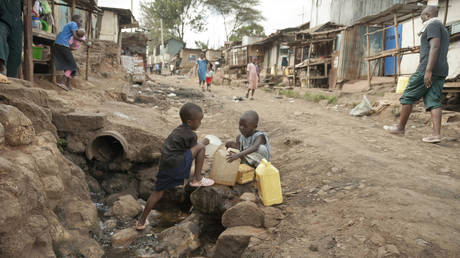
A prolonged drought in the Horn of Africa, an unseasonal flood in South Asia, or erratic rainfall patterns across Central America do not just destroy crops; they destroy livelihoods permanently. When smallholder farmers lose everything, they migrate to urban slums, swelling the ranks of the urban poor where formal jobs are scarce and living conditions are unsanitary.
Crucially, climate adaptation finance has consistently fallen short of its promises. Wealthy industrialized nations, historically responsible for the lion's share of global carbon emissions, have repeatedly failed to deliver the pledged billions in adaptation and mitigation funds to the developing world. The burden of managing a crisis they did not create falls squarely on the shoulders of governments that cannot even balance their basic budgets.
Rethinking the Path Forward
If we are to reverse this trend, standard developmental playbooks will no longer suffice. Pumping more money into traditional foreign aid channels while ignoring the structural rules of global trade and finance is like bailing out a sinking ship with a teaspoon.
First, comprehensive debt restructuring must become the baseline, not the exception. Without sweeping debt cancellation or meaningful write-downs for severely distressed nations, any conversation about poverty reduction is moot. Governments must have fiscal space to invest in human capital.
Second, international trade rules must be reformed to allow developing nations to build domestic manufacturing and agricultural sectors rather than remaining trapped as exporters of raw commodities subject to volatile global price swings.
Third, social protection systems must be institutionalized rather than treated as emergency band-aids. Universal basic income pilots, digital cash transfer networks, and resilient public health infrastructure are not luxuries for wealthy societies; they are the fundamental shock absorbers required for any stable economy in the twenty-first century.
The rise in global poverty is a choice, driven by policy failures, political neglect, and an unwillingness to reform a global economic order that privileges capital over human survival. Until those realities are confronted head-on, the numbers will continue to climb.