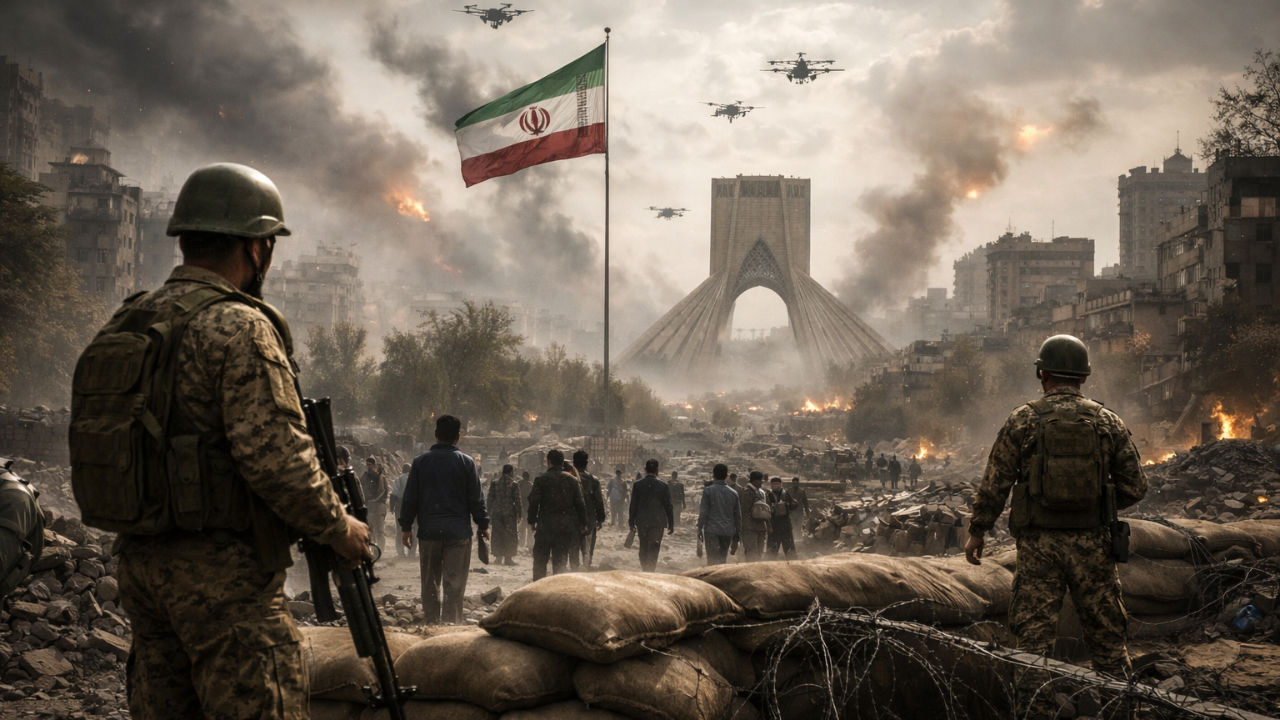
Farzad sits on a low wooden bench in a teahouse near Tehran’s Grand Bazaar, his fingers tracing the rim of a small glass of black tea. The steam rises into the afternoon light, disappearing before it can reach the ceiling. For Farzad, and for millions of others living within the borders of the Islamic Republic, life has become a series of these small, quiet disappearances. Hope appears, then vanishes. Stability arrives, then evaporates.
The news on the television mounted in the corner is muted, but the ticker at the bottom tells the story the world is watching: a ceasefire, a pause, a momentary halt in the long-simmering friction between Tehran and Washington. To a diplomat in a climate-controlled room in Geneva, this is a "strategic de-escalation." To Farzad, it is simply a chance to breathe without his chest tightening.
But it is an uneasy breath.
The silence that follows a ceasefire isn’t the silence of peace. It is the silence of a house during a hurricane's eye, where the wind has stopped but the sky remains a bruised, unnatural purple. Iran is currently standing in that eye. The immediate threat of missiles lighting up the night sky has receded, replaced by a much older, more grinding anxiety. How long does a pause last when neither side has truly moved their hand away from the hilt of the sword?
The Architecture of a Frozen Conflict
Geopolitics is often discussed in terms of "spheres of influence" and "deterrence capabilities," but the reality is far more visceral. When a ceasefire is signed, the maps don't change. The underlying grievances don't dissolve. Instead, the conflict becomes architectural. It hardens into the walls of the city.
Consider the Iranian economy, a structure that has been under siege for decades. The ceasefire hasn't lifted the sanctions that weigh on the rial like lead. It hasn't reopened the valves of international banking. What it has done is create a psychological plateau. For the Iranian leadership, this pause is a period of consolidation. They are holding their ground, ensuring that the domestic front remains stable while the external pressure is temporarily dialled back.
Hypothetically, imagine a merchant named Amin who imports electronic components. For Amin, the ceasefire means he might not lose 20% of his capital to a sudden currency crash tonight. He can plan for Tuesday. He might even plan for next month. But he won't invest in a new warehouse. He won't hire five more employees. He knows that a single tweet or a stray drone in a distant desert can shatter this fragile glass floor.
The ceasefire is a tactical choice, not a moral one. Iran has realized that a direct, high-intensity confrontation with the West at this specific juncture serves no purpose other than total exhaustion. By holding their ground, they are gambling that time is a more effective weapon than ballistics. They are waiting for the political winds in Washington to shift, for the coalition of their rivals to fray, or for their own internal structures to adapt to a "resistance economy" that no longer needs the global North to survive.
The Invisible Stakes of the Status Quo
What is actually at stake during this "uncertain pause"? It isn't just the nuclear program or the influence of regional proxies. It is the social contract between the Iranian state and its people.
The Iranian government is walking a tightrope thin as a razor. On one side is the need to maintain a revolutionary identity—an identity built on defiance and the rejection of Western hegemony. On the other side is a young, hyper-educated population that is tired of being the vanguard of a movement they didn't choose. They want high-speed internet, they want to travel, and they want a currency that doesn't lose its value while they sleep.
Every day the ceasefire holds, the pressure shifts from the borders to the streets. When there is an external enemy to point to, a government can demand sacrifice. In the quiet of a ceasefire, the people begin to look inward. They ask why the bread is still expensive. They ask why the air in Tehran is still thick with smog. They ask what the "pause" is actually buying them.
Statistics tell a part of this story. Inflation in Iran has hovered in the 40% range for years. The youth unemployment rate remains a ghost that haunts every university graduation. These aren't just numbers; they are the ingredients of a slow-burning fire. The state’s strategy of "holding ground" is an attempt to manage this heat. They are using the diplomatic lull to shore up trade routes with Russia and China, creating a "Fortress Iran" that can withstand the next inevitable wave of pressure.
The Mirror of History
We have been here before. History is littered with "pauses" that were mistaken for "resolutions."
In the late 1980s, after eight years of brutal trench warfare with Iraq, Iran accepted a UN-brokered ceasefire. Ayatollah Khomeini famously described it as "drinking from a poisoned chalice." That pause didn't lead to a grand opening of the country. Instead, it led to a decade of internal restructuring and a deepening of the security apparatus.
The current situation feels different because the world is more interconnected, yet more fragmented. Iran is no longer an isolated revolutionary state; it is a regional power with a footprint that stretches from the Mediterranean to the Gulf of Aden. Their "ground" is no longer just the plateau between the Zagros Mountains and the sea. It is a network of alliances and influence that they are unwilling to trade for a seat at a table they no longer trust.
The West often views Iran as a problem to be solved. Iran views itself as a civilization to be restored. This fundamental disconnect is why every ceasefire feels like a long-form rehearsal for the next act of the drama.
The Weight of the Wait
In the West, we measure time in news cycles. In the Middle East, time is measured in generations.
There is a specific kind of exhaustion that comes from living in a state of permanent "almost." We are almost at war. We are almost at peace. We are almost a normal country. This "almost" is a weight that rests on the shoulders of every Iranian student, every grandmother in Isfahan, and every tech worker in Shiraz.
The ceasefire provides a respite from the "almost at war," but it offers no path to "normal." It is a holding pattern in a storm.
The Iranian leadership knows that their strength lies in their ability to endure. They are masters of the long game, betting that the West’s attention span is too short to maintain a siege forever. They hold their ground not because they are comfortable, but because they believe that if they stand still long enough, the world will eventually have to walk around them.
But ground is hard. Ground is cold. And holding it requires a constant, draining expenditure of energy.
The Final Chord
Back in the teahouse, Farzad finishes his tea. He leaves a few coins on the table and steps out into the noisy, crowded street. The air is filled with the smell of diesel and grilled meat. Above him, a giant mural of a martyr looks down with somber eyes, a relic of a conflict that never truly ended.
He walks past a shop selling iPhones that shouldn't be there, smuggled through borders that are supposed to be closed. He passes a group of young women with their headscarves pushed back just far enough to be a statement, but not far enough to be a crime.
Everyone is holding their ground.
The ceasefire isn't a victory, and it isn't a defeat. It is a collective holding of breath. It is the moment in the theater after the lights have dimmed but before the curtain rises, where the only sound is the heartbeat of the audience, thumping in the dark, waiting to see if the next scene is a comedy or a tragedy.
The pause continues. The world watches the headlines, but the real story is written in the silence between them. It is written in the way Farzad adjusts his jacket against the wind, wonders if he should fix his car this month or wait, and then, with a sigh, starts walking home.
He doesn't know what tomorrow brings. No one does. And in the heart of the pause, that is the only truth that matters.


