Silence.
That is the first thing you notice when you stand at the edge of an unmarked cemetery in the Australian bush, where the red dust settles into the creases of your boots and the eucalyptus trees drop dry bark onto soil that looks entirely undisturbed. You look down at the grass, the scrub, and the scattered stones, and your eyes tell you there is nothing here at all.
Your eyes are lying.
Six feet beneath the surface of that quiet earth, history is waiting to be named. For decades, families have walked across paddocks like this, holding faded photographs and handwritten letters, desperate to know where their ancestors were laid to rest after frontier fevers, mining accidents, or quiet rural lives ended without a headstone to mark the spot. Without a stone, a grave disappears within a generation. Wildfires burn away wooden crosses. Floods shift creek beds. Grazing cattle trample low mounds flat until the earth keeps its secrets completely.
To find what the soil has swallowed, most people would hire a team of archaeologists with university grants and fifty-thousand-dollar commercial equipment. Or they would bring in heavy machinery and risk destroying the very thing they came to protect.
Instead, they call a young man who learned how to listen to the dirt because he wanted to help his grandfather find three dead bulls.
The Problem With Buried Memory
To understand why this matters, you first have to feel the quiet panic of erasure. Imagine standing in a country graveyard—let us picture a hypothetical woman named Clara, though there are thousands of real families just like her across rural Australia—holding a death certificate from 1894. The paper states her great-great-grandmother was buried in the local cemetery, section four, row twelve. Clara drives six hours to pay her respects, only to find that section four is now an empty stretch of waist-high weeds bordered by a rusted wire fence. No markers. No map. Just wind moving through dry grass.
Where does she lay her flowers? Where does she stand to say goodbye?
Across Australia, tens of thousands of historical burials sit unmarked in regional cemeteries, abandoned churchyards, and forgotten homestead plots. Record books were lost in courthouse fires. Cheap timber markers rotted away in the sun and rain. Over time, local councils or property owners lost track of where the rows ended and the empty ground began. This creates an invisible crisis that goes far beyond genealogy. When a town needs to expand a cemetery, build a road, or dig a trench for water pipes, nobody knows where the safe ground actually is. Disturbing an unmarked grave is not just a legal and ethical nightmare; it is a second erasure of a human life.
For a long time, solving that mystery belonged exclusively to specialists. Commercial ground-penetrating radar units cost as much as a luxury car, require specialized software licenses, and demand years of training just to read the jagged, static-filled lines scrolling across a screen. For a small rural historical society running on bake sales and volunteer hours, hiring a commercial survey team was out of the question. The dead stayed lost simply because nobody could afford the technology to find them.
Three Bulls and a Soldering Iron
Enter David Rafferty, a teenager growing up in regional New South Wales with a knack for electronics and a problem on his family’s property.
Years earlier, three prized bulls had died on his grandfather’s farm and been buried somewhere in a sprawling paddock. As time passed, the exact location faded from memory, leaving behind a practical headache for managing the land. Most teenagers would have shrugged and gone back to their phones. Rafferty went to his workbench.
If you have never built a radar system from scratch in a farm shed, it is hard to appreciate the sheer stubbornness required to make physics cooperate on a budget. Commercial ground-penetrating radar works by firing high-frequency radio pulses into the earth and measuring the precise nanoseconds it takes for those signals to bounce back when they hit a change in density—a rock, a pipe, a cavity, or disturbed soil where a pit was once dug and refilled. Think of it like shouting into a dark canyon and judging the shape of the walls entirely by the timing and tone of the echo. Except here, the canyon is solid clay, and the echo travels at the speed of light.
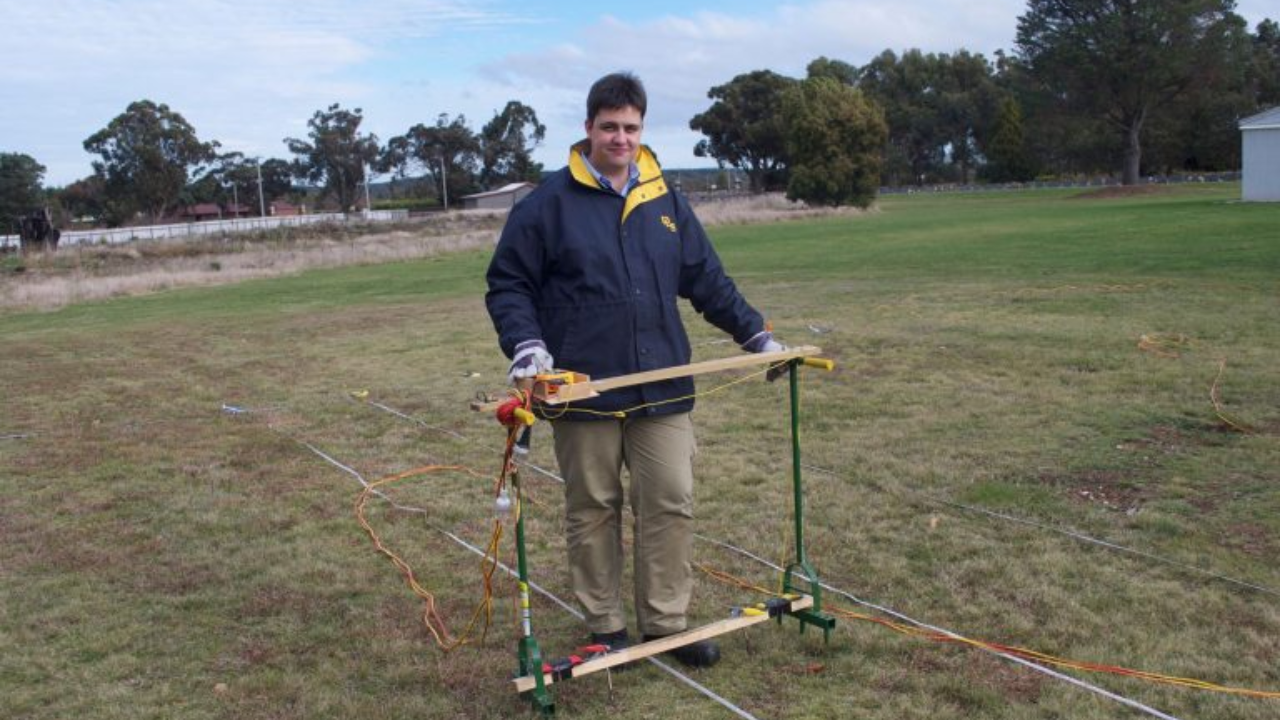
Rafferty did not have a university lab. He had scrap components, circuit boards, antennas he configured himself, and an obsessive willingness to fail repeatedly until the signal cleared up. He wheeled his contraption out across his grandfather’s paddock, watching the reflected waves translate onto a screen. When the radio waves passed over undisturbed earth, the pattern stayed flat and predictable. When they crossed the spot where the soil had been dug up years before, the underground layers broke into a distinct, curved signature—a hyperbolic arch on the display that told him the ground had been opened and closed again.
He found the bulls.
That could have been the end of a clever teenage science project. A good story at family dinners, a neat line on a resume, and nothing more. Instead, word got out in the local community about the kid with the homemade machine who could see through dirt without lifting a shovel.
What the Soil Remembers
Once you realize you can read the memory of the earth, it is very hard to walk away from people who are desperate for answers.
Local historians and cemetery caretakers began reaching out to Rafferty. Could his homemade radar find unmarked graves in old country cemeteries? Could it tell a grieving family where an infant buried a century ago was actually resting?
Rafferty took his machine—wheeled across uneven grass like a modified lawnmower, humming quietly as it sent pulses downward—into his first cemeteries. What he discovered was that the earth never truly forgets being opened. Even after a hundred and fifty years, when a coffin has collapsed and timber has turned to dust, the soil inside a grave shaft has a different compaction, moisture retention, and mineral mix than the untouched earth surrounding it. To a shovel, it all looks like dirt. To calibrated radio waves, a century-old grave shaft stands out like a doorway cut into a brick wall.
I have watched people stand beside a newly located grave after decades of searching, and the shift in the air is unmistakable. It is not morbid. It is relief. Suddenly, a name on a yellowed ledger has coordinates. A story that floated unanchored in family lore has a physical address on this earth.
Rafferty began refining his rig, teaching himself the subtle differences between a tree root, a burrowing animal tunnel, a buried fence post, and a human burial. He had to learn how to read false positives—the frustrating moments when a promising underground anomaly turns out to be a buried water pipe or a pocket of heavy ironstone clay. Anyone who tells you subsurface scanning is as simple as pointing a magic wand at the ground has never spent six hours under an Australian sun trying to separate genuine archaeological signals from geological noise. It takes patience. It takes squinting at waveforms until your eyes ache, cross-referencing old parish maps with compass bearings, and walking grid after grid in straight, methodical lines.
More Than Six Hundred Names Restored
By his early twenties, the teenager who started out looking for livestock had become known across Australia as the "Grave Hunter."
Working with local councils, historical societies, churches, and individual families, Rafferty has now located more than 600 lost and unmarked graves across the country. Each number in that tally represents a grid walked meter by meter, a waveform analyzed, and a wooden peg driven gently into the grass to mark what had been forgotten.
Consider what happens when a small regional town discovers forty unmarked burials sitting directly in the path of a planned cemetery expansion. Without a radar survey, backhoes roll in on a Monday morning, and history is shattered before anyone realizes a mistake has been made. With Rafferty’s scans, the town redraws its plans, erects a memorial plaque listing the names from the old register, and preserves the dignity of its founders.
His work has stretched from overgrown pioneer cemeteries to lonely pastoral stations where early settlers buried loved ones miles from the nearest town. In several cases, descendants who had spent their entire adult lives wondering where a grandparent or great-aunt lay buried finally stood beside a small marker placed directly over the spot confirmed by radio waves.
There is a strange, quiet poetry in the tools he uses. Radar was born out of wartime necessity, engineered to spot incoming aircraft and hidden submarines across hostile skies and oceans. Rafferty took that same fundamental physics, stripped away the corporate price tag, and aimed it straight down into the soil to perform an act of pure human kindness.
Why One Kid With a Circuit Board Matters
You do not need to live in rural Australia or have a missing ancestor to feel the weight of what David Rafferty built.
We live in an era where technology often feels like something designed to pull us away from reality—algorithms engineered to hijack our attention, gadgets built to be replaced every eighteen months, software that creates noise instead of clarity. It is easy to become cynical about what engineering is actually for.
Then you look at a young man pushing a homemade radar rig through tall dry grass in the middle of nowhere, using physics and patience to give forgotten people back their place in the world.
He did not wait for a government grant. He did not wait for permission from an institution or ask a venture capital firm to fund a five-year roadmap. He saw a problem on his grandfather’s farm, taught himself how radio waves behave underground, and kept going until a tool built for three dead bulls became a lifeline for hundreds of families searching for their past.
Next time you walk past an old country churchyard or a quiet patch of overgrown grass behind a stone wall, stop for a second and look down. The surface looks empty, smooth, and silent. Beneath your boots, beneath the roots and the red dust, the earth is holding onto every story ever entrusted to it—waiting for someone patient enough to listen.