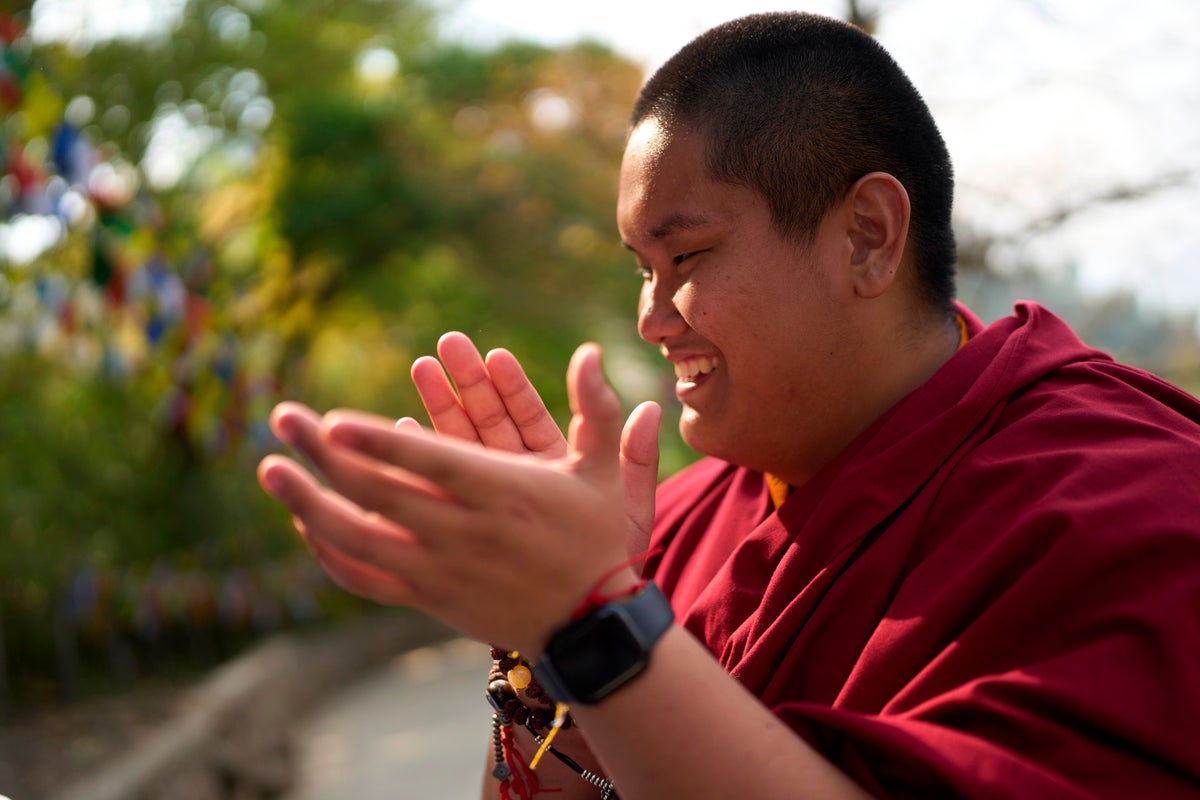
A teenage boy from the American Midwest trades his football helmet and PlayStation controller for the maroon robes of a Tibetan Buddhist lama in the remote Himalayas. This is not a pitch for an indie movie. It is the real-life trajectory of an ordinary American teenager choosing an extraordinary path. While peers back home obsess over college applications, social media metrics, and high school sports, this young man opted for rigorous monastic isolation, hours of silent meditation, and the study of ancient texts. The transition represents a radical rejection of modern Western consumerism in pursuit of a completely different kind of mastery.
Moving from a comfortable life in Minnesota to a spartan monastery in northern India or Nepal requires more than just a passing interest in meditation. It demands a total deconstruction of identity. To understand how a teenager makes this leap, one must look beyond the romanticized image of mountain peaks and incense. The reality of monastic life is grueling, disciplined, and utterly detached from the conveniences of the modern West.
The Friction of Two Universes
The average teenager spends hours a day interacting with digital screens. High school culture centers on social validation, athletic achievement, and preparing for a hyper-competitive job market. When a young person walks away from that environment, they are not just changing their geographic location. They are opting out of the foundational myths of Western society.
Monastic life replacing American youth culture means exchanging a world of instant gratification for one of infinite patience. Consider the stark differences in daily routines.
- The Clock: Instead of school bells and practice schedules, the day is governed by pre-dawn gongs and long sessions of chanting.
- The Comforts: Central heating, fast food, and private bedrooms give way to unheated stone quarters, communal vegetarian meals, and intense physical chores.
- The Connection: High-speed internet is replaced by isolation, forcing an inward focus rather than an outward broadcast of one's life.
This choice is often met with deep skepticism by family and peers. To the Western mind, success is measured by accumulation, status, and financial security. Giving all of that up before even entering adulthood looks, to some, like a waste of potential or a symptom of deep-seated alienation.
Yet, for the individual who makes this choice, the move is often seen as a logical escape from a system that feels fundamentally hollow. It is an active pursuit of psychological clarity that the standard American trajectory rarely offers.
The Making of a Western Lama
The process of becoming recognized or trained as a lama—a spiritual teacher in Tibetan Buddhism—is not an honorary title handed out to enthusiastic foreigners. It involves years of intense, sometimes mind-numbing study.
Monastic education mirrors the academic rigor of an elite university, but with a focus on internal mechanics rather than external data. Students must memorize hundreds of pages of philosophical texts. They participate in formal, highly stylized theological debates where every logical fallacy is publicly picked apart by peers and seniors.
For an American teenager, the language barrier alone is a massive hurdle. Tibetan is a complex, nuanced language with entirely different structures for honorific speech. To study the texts, one must master classical Tibetan, a dead language akin to Latin in the Western tradition.
The Psychology of Discomfort
Western culture is built to maximize comfort and minimize friction. If you are cold, you turn up the heat. If you are bored, you open an app.
Monasteries operate on the opposite principle. Friction is used as a tool for self-discovery. Sitting cross-legged on a hard cushion for six hours a day causes genuine physical pain. The mind rebels against the silence, generating waves of boredom, anxiety, and regret.
Without the usual distractions of music, video games, or casual conversation, a person is forced to confront their own internal monologue. This is where most Westerners fail. The romantic illusion of the peaceful monk evaporates within the first few weeks of freezing mornings and aching joints.
The System of Recognition
In some cases, a young Westerner is identified as a tulku, the reincarnation of a deceased Buddhist master. In other instances, they simply show an extraordinary aptitude and dedication that elevates them through the ranks.
When a Western teenager is placed into this system, they face a double burden. They must learn the culture of the monastery while simultaneously unlearning the conditioning of their upbringing. They are viewed with curiosity by the local monastic community and often with intense scrutiny by Western visitors who look for any sign of disillusionment or cracked resolve.
The Illusion of the Exotic Escape
It is easy to paint this story with a stroke of orientalism, viewing the Himalayas as a mystical refuge where all modern anxieties disappear. This perspective is both lazy and inaccurate.
The Himalayan region faces severe geopolitical pressures, environmental degradation, and the encroachment of the very globalized culture the teenager left behind. Monasteries today are not completely cut off from the world. Many have solar panels, basic internet connections for administrative purposes, and young monks who secretly covet smartphones.
The teenager from Minnesota does not find a pristine, timeless paradise. They find a living, breathing, often struggling institution trying to preserve its heritage in a changing world.
The true sacrifice is not the loss of material goods, but the loss of anonymity and the freedom to change one's mind without consequence. Once a young person is elevated to the status of a lama, they become a symbol for a whole community. Their actions carry weight. The pressure to conform to the expectations of thousands of devotees can be just as heavy as the pressure to succeed in a Western high school, if not heavier.
The Brain on Meditation
Neurological research has shown that the intense mental training undergone by long-term monastic practitioners fundamentally alters brain architecture. Functional MRI scans of advanced meditators show significant changes in areas associated with stress regulation, empathy, and attention span.
While an American teenager back home might be training their brain for rapid task-switching and dopamine-seeking behavior through social media loops, the monastic teenager is training for sustained focus and emotional resilience.
This is not a mystical transformation; it is a neurological adaptation to a specific environment. The brain adapts to the demands placed upon it. Hours of daily meditation strengthen the prefrontal cortex and calm the amygdala. The result is a level of emotional stability that is exceptionally rare in adolescence.
The Counterargument
Some psychologists and cultural critics argue that entering a monastery at a young age is a form of premature closure. Adolescence is typically a time for exploration, trial and error, and the gradual forging of an identity through diverse experiences.
By committing to a strict religious hierarchy and a specific worldview before fully experiencing adult life in the secular world, a teenager might be limiting their development. What happens if, at age twenty-five, the young lama realizes they want a family, a traditional career, or simply the freedom to walk down a city street unnoticed?
Returning to secular Western life after years in a monastery is notoriously difficult. Ex-monks often struggle with basic tasks like managing money, navigating romantic relationships, and finding employment in a market that does not value expertise in ancient Tibetan philosophy. The safety net is gone, and the culture shock is reversed, often proving more traumatic than the initial move to Asia.
Beyond the Robes
The story of the Minnesota teenager is ultimately a mirror for Western society. It forces an uncomfortable question: What is lacking in our culture that would drive a young person to seek meaning in a medieval monastic system thousands of miles away?
The answer lies in the systemic fragmentation of modern life. We offer youth an abundance of choices but very little direction. We provide endless entertainment but a scarcity of genuine purpose. The monastery offers the exact opposite: zero choices, absolute direction, no entertainment, and an uncompromising purpose.
This teenager did not just drop out of football and gaming. He dropped out of a cultural narrative that he found wanting. Whether his choice is a permanent destination or a profound chapter in a larger journey remains to be seen. The true test of his practice will not occur on a cushion in the Himalayas, but in how he handles the inevitable collisions between the ancient world he chose and the modern world he left behind.