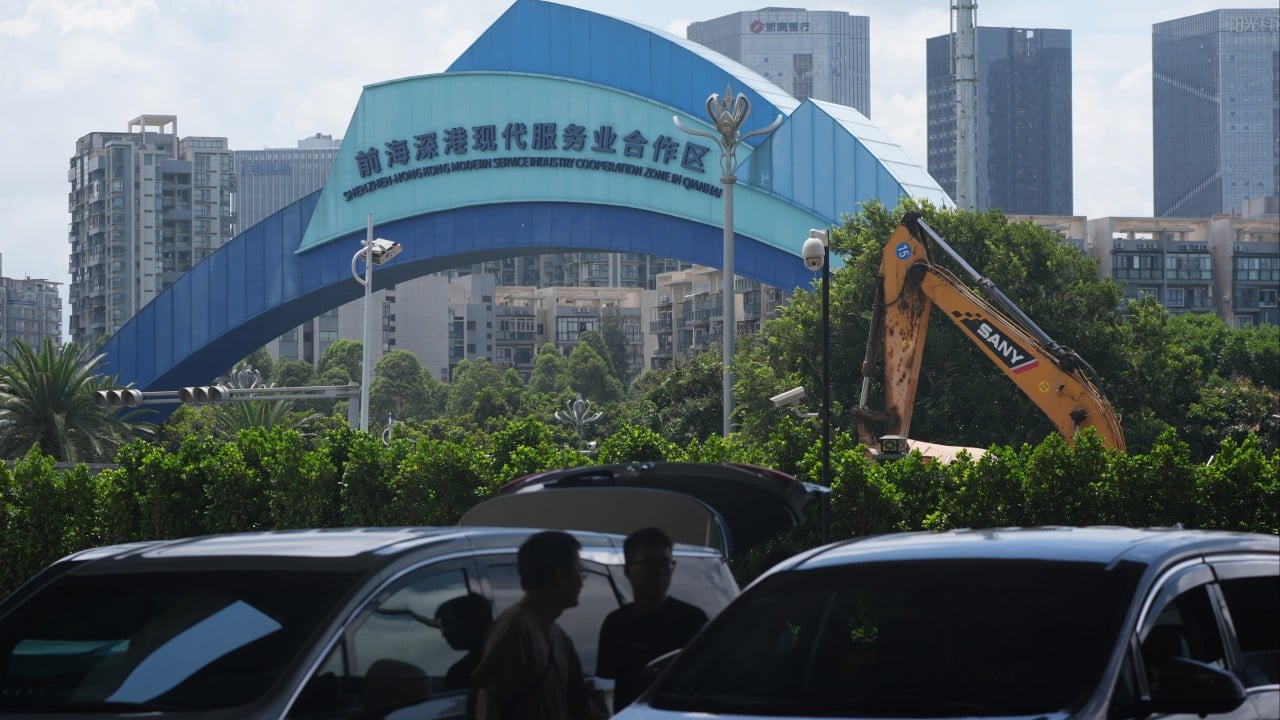
Hong Kong is currently trapped in a cycle of polite policy recommendations while the ground beneath its feet shifts. The persistent friction at the Shenzhen border is no longer just a daily inconvenience for commuters; it is a structural tax on the Northern Metropolis and the wider Greater Bay Area (GBA) project. To unlock the economic power of this region, the city must move past the "wait and see" approach. Real integration requires a radical shift in how we handle data, labor, and hardware across a boundary that remains stubbornly rigid despite decades of integration talk.
The High Cost of the Soft Border
For years, the narrative focused on physical infrastructure. We built the High-Speed Rail and the Hong Kong-Zhuhai-Macao Bridge. These are impressive feats of engineering, yet they remain underutilized because the administrative hurdles haven't shrunk to match the shortened travel times. A technician in Shenzhen can see the skyscrapers of the Northern Metropolis from their office window, but getting their specialized equipment across the line for a three-hour repair job involves a mountain of paperwork that often takes days to clear.
This isn't just about moving people. It is about the movement of capital and information. When we talk about "removing barriers," we are really talking about the cost of doing business. Every minute a cargo truck sits at a checkpoint is a line item on a balance sheet. Every time a research team has to split its data because of different privacy regulations, the pace of innovation slows. We are effectively running a high-speed engine with a clogged fuel line.
Why the Current Approach is Stagnating
The primary reason progress feels glacial is the reliance on top-down directives that lack granular execution. Governments announce "cooperation zones" with fanfare, but the mid-level bureaucracy remains tethered to legacy systems. These systems were designed for a time when Hong Kong was a gateway and Shenzhen was a factory floor. That dynamic is dead. Today, Shenzhen is a global tech powerhouse, and Hong Kong is struggling to redefine its role as a high-tech services hub.
We see a mismatch in urgency. Shenzhen moves at a pace dictated by the private sector's relentless drive for efficiency. Hong Kong, by contrast, often moves at the pace of a legislative committee. This disconnect creates a "border fatigue" where businesses simply give up on cross-boundary expansion because the regulatory overhead eats the profit margin.
The Data Deadlock
The most significant overlooked factor is the data barrier. In a modern economy, data is the most valuable commodity. Currently, Hong Kong and the mainland operate under two entirely different legal frameworks for data protection and transfer. While this protects the "One Country, Two Systems" principle, it creates a digital wall.
A biotech firm in the Lok Ma Chau Loop cannot easily share genomic data with a laboratory three kilometers away in Futian without navigating a maze of security assessments. This isn't just a technical hurdle; it’s a competitive disadvantage. While Silicon Valley or the Tokyo-Yokohama corridor benefits from a unified data environment, the GBA is fragmented. Without a "Data Green Lane" that allows pre-verified institutions to move information freely, the Northern Metropolis will remain a collection of buildings rather than a living ecosystem.
The Hardware Bottleneck and the Equipment Tax
Consider the "Small-Batch" problem. For a hardware startup in Hong Kong, the proximity to the Shenzhen supply chain should be a secret weapon. In reality, sending prototypes back and forth for testing is a logistical nightmare.
- Customs declarations for single components are often as complex as for bulk shipments.
- Temporary admission rules for expensive diagnostic tools are restrictive.
- Certification standards differ, meaning a device approved for use in a Hong Kong lab may need a separate, lengthy verification process to cross the border for a week of testing.
This creates an environment where startups either move entirely to Shenzhen to save time or stay in Hong Kong and pay a premium for slower development. This "equipment tax" is invisible in official statistics but felt by every engineer in the field.
The Talent Paradox
We hear constant calls for "talent flow," yet the reality of living in one city and working in the other remains grueling. It is not just about the commute. It is about the friction of daily life—taxes, healthcare, and education.
A Hong Kong resident working in Shenzhen faces a different tax regime that, despite recent subsidies, remains a complex calculation. More importantly, the lack of professional credential recognition is a massive anchor. A qualified surveyor or accountant in Hong Kong often finds their years of experience discounted across the border, and vice-versa. If we cannot trust each other's professional certifications, we cannot claim to be an integrated economy.
Breaking the Cycle of Incrementalism
To fix this, the proactive stance must involve "Mutual Recognition" rather than "Harmonization." Trying to make the laws identical is a fool's errand that would take decades and compromise the legal autonomy that makes Hong Kong valuable. Instead, the focus should be on a "Recognized by One, Accepted by Both" model.
If a piece of medical equipment is certified in Hong Kong, it should be cleared for use in designated GBA zones immediately. If a professional is licensed in Shenzhen, they should be able to consult on projects in the Northern Metropolis without sitting for a fresh round of exams. This requires political courage and a willingness to accept that the other side's standards are "good enough" for the sake of speed.
The Specter of Regulatory Arbitrage
There is a risk that "removing barriers" could lead to regulatory arbitrage, where companies flock to whichever side has the looser rules. However, this fear is often used as an excuse for inaction. The reality is that the GBA is competing against the world, not against itself. If a company moves from Central to Qianhai, the money stays in the region. If they move from the GBA to Singapore or Ho Chi Minh City because our internal borders are too thick, we all lose.
The obsession with maintaining perfect regulatory silos is becoming a liability. We need to stop viewing the border as a security fence and start viewing it as a filter. A filter lets the good things through quickly while catching the bad. Currently, our filter is so fine that it's acting more like a dam.
Implementing the Tech-First Border
The technology exists to make the physical border almost invisible for pre-cleared individuals and goods. Biometric gates and blockchain-based customs tracking can reduce wait times to seconds. The delay is not technological; it is the lack of a unified digital backbone.
We need a single digital identity for GBA residents that integrates health codes, travel documents, and professional credentials. This isn't about surveillance; it’s about utility. If a person can unlock their phone, pay for a coffee, and clear customs with the same facial scan or token, the psychological barrier of the border begins to dissolve.
The Northern Metropolis as a Sandbox
The proposed Northern Metropolis should not be another housing project. It must be a regulatory sandbox where these barriers are dismantled first. This area should serve as a testbed for:
- Direct Data Peering: High-speed, secure data links between research institutions with sovereign-level encryption.
- Universal Professional Licensing: Automatic recognition of architectural, engineering, and legal credentials within the zone.
- Duty-Free Logistics: A "closed-loop" system where equipment can move between designated tech parks without formal import/export filings.
If we cannot make it work in a purpose-built zone, we will never make it work for the region at large.
The Illusion of Proactivity
Current efforts are often reactive. We wait for a bottleneck to become a crisis before forming a task force. A truly proactive approach requires Hong Kong to stop asking for permission and start presenting finished, workable frameworks for integration.
The city needs to leverage its common law system not as a shield to hide behind, but as a platform to build trust. By creating clear, transparent rules for cross-border arbitration and intellectual property protection, Hong Kong can become the legal "operating system" for the GBA’s global expansion.
The Zero-Sum Trap
The greatest barrier is the lingering mindset that if Shenzhen wins, Hong Kong loses. This zero-sum thinking is a relic of the 1990s. In the current global climate, survival depends on scale. A fragmented GBA is a series of mid-sized players. An integrated GBA is the world’s most powerful innovation engine.
The time for studying the problem has passed. The blueprints for the bridges are old; we need the blueprints for the bureaucracy. If a researcher cannot move their sample from a lab in Sha Tin to a factory in Bao'an in under two hours, the "proactive" mission has failed. Efficiency is the only metric that matters now.
Stop treating the border like a fragile artifact and start treating it like a piece of outdated software. It needs an update, not a polish. The economic gravity of the mainland is a fact of life; Hong Kong’s job is to ensure the connection is a superhighway, not a bottleneck.
Ensure the next policy address isn't a list of aspirations, but a timeline of de-regulations.