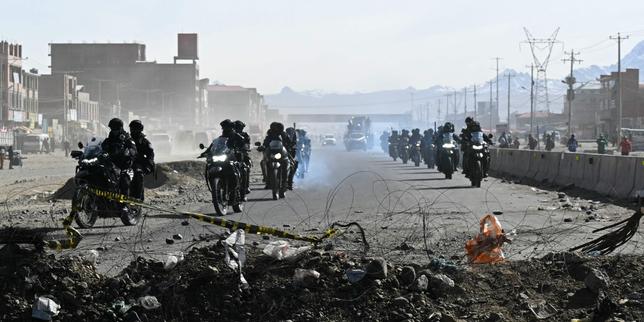
The international media loves a predictable script. When images of burning tires and boulder-strewn highways in Bolivia hit the wires, mainstream outlets rush to repeat the same shallow narrative: political instability is paralyzing an economy. They point to the bitter rivalry between President Luis Arce and former President Evo Morales. They blame the blockades for choking the nation supply lines. They treat the newly decreed state of exception as a sudden, dramatic twist in a democratic breakdown.
They are looking at the symptoms and calling it the disease.
The current paralysis in Bolivia is not a temporary crisis born of political theatre or road blockades. The blockades are merely the visible death spasms of an economic model that has been fundamentally insolvent for a decade. Mainstream commentators treat the disruption as an exogenous shock to a functioning system. The reality is far more grim: the system itself has run out of gas, literally and financially, and the roadblocks are being used as a convenient scapegoat by an administration desperate to hide its own bankruptcy.
The Myth of the Paralyzing Blockade
Every major wire service frames the current crisis as a logistical bottleneck caused by rural protesters. The narrative suggests that if the military clears the highways, normalcy will return.
This is a mathematical impossibility.
Bolivia is facing a severe macroeconomic reckoning, driven by the depletion of its foreign currency reserves and the collapse of its natural gas production. For nearly two decades, the country relied on the "Bolivian Economic Model," which used state-directed gas exports to fund massive domestic subsidies, particularly for fuel.
[Natural Gas Exports Collapse] ➔ [Foreign Currency Reserves Dry Up] ➔ [Fuel Import Crises]
                                                                            ⬇
[The True Source of Paralysis] 💡 (Not the road blockades)
Look at the hard data from the Central Bank of Bolivia. Foreign reserves have plummeted from a peak of nearly $15 billion in 2014 to negligible levels today. Without US dollars, the government cannot import the very fuel it promises to subsidize for its population.
When you see lines of trucks stretching for miles outside gas stations in La Paz or Santa Cruz, you are told it is because a protest group blocked a highway in Cochabamba. It is a lie. The trucks are empty because the state-owned oil company, YPFB, lacks the hard currency to pay international suppliers for diesel and gasoline. The blockades did not create the shortage; the shortage created the desperation that fuels the blockades. Clearing the roads does not conjure dollars out of thin air.
The State of Exception is an Admission of Financial Insolvency
Decreeing a state of exception is traditionally viewed as an assertion of executive strength. Commentators paint Luis Arce as a leader taking a hard line to restore order.
In reality, it is an act of absolute financial desperation.
When an economy runs out of hard currency, a government has two choices: let the currency devalue rapidly, causing hyperinflation, or ration resources through force. Arce has chosen the latter. By militarizing key regions under the guise of national security, the state gains the legal authority to control supply chains, ration fuel distribution, and suppress economic dissent without fixing the underlying monetary disaster.
I have watched resource-dependent economies play this exact hand across the globe. When the state can no longer afford to grease the wheels of domestic commerce with subsidies, it replaces subsidies with soldiers. The state of exception is not meant to save the economy; it is meant to protect the government from the immediate political consequences of an economy that has already stopped working.
Dismantling the People Also Ask Fallacies
Are the blockades destroying Bolivia's economy?
No. The blockades are accelerating the timeline, but they are not the root cause of the destruction. The economic engine was destroyed by a total failure to invest in hydrocarbon exploration over a fifteen-year period. Bolivia transitioned from a net exporter of energy to a net importer. You cannot blockade an economy into a fuel crisis if the country has the money to buy fuel.
Will resolving the Arce-Morales feud fix the crisis?
This is the most naive take in contemporary geopolitical analysis. The political split between the current president and his former mentor is loud, dramatic, and excellent for television ratings. But a reconciliation tomorrow changes nothing about the balance sheets. Whoever sits in the presidential palace faces the exact same reality: the Central Bank vaults are empty, the gas wells are drying up, and the international capital markets will not lend money to a state that artificially pegs its currency while running a massive fiscal deficit.
The Sovereign Default Illusion
The conventional advice from international financial institutions is always the same: implement austerity, float the currency, and seek an IMF bailout.
But this conventional wisdom ignores the unique fragility of Bolivia's social fabric. The moment the government removes fuel subsidies to balance the ledger, the real inflation rate will skyrocket overnight. The current parallel exchange rate for the Bolivian Boliviano is already trading at a massive premium compared to the official rate. A sudden float would wipe out the purchasing power of the middle and lower classes instantly.
The administration knows this. They are trapped in a corner of their own making. They cannot afford to maintain the subsidies, and they cannot survive the political fallout of removing them. Therefore, the strategy is to prolong the stagnation, blame the opposition blockades for every missing liter of diesel, and use authoritarian measures to manage the decline.
Expect the images of unrest to continue. But understand what you are actually looking at. It is not a nation paralyzed by a political protest. It is a nation paralyzed by the math of a empty treasury. The fire on the highway is just smoke; the engine room burned down years ago.