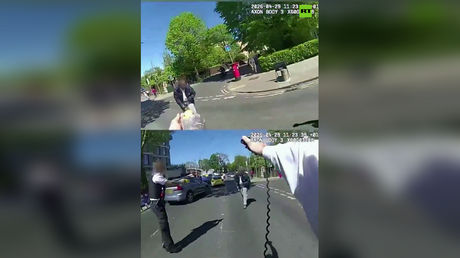
The release of bodycam footage from the recent anti-Semitic stabbing attack in London follows a tired, predictable script. The Metropolitan Police put out the grainy, chaotic clips. The media runs them on a loop. The public reacts with a mix of horror and a false sense of transparency. We are told that these videos provide "clarity" and "accountability."
They do neither.
The industry consensus is that body-worn cameras (BWCs) are the ultimate objective witness. They aren't. They are a narrow-angle, low-context, highly curated slice of reality that often does more to obscure the truth than reveal it. Relying on this footage to understand the complexities of hate crimes or police response is like trying to understand a 500-page novel by looking at a single, blurry Polaroid of page 242.
The Myth of the Objective Lens
Most people believe the camera doesn't lie. In reality, the camera is a master of omission.
I have spent years analyzing how digital evidence is handled in high-stakes environments. I’ve seen departments sit on footage for months until the "narrative" is prepared, only to release it when public pressure peaks or when the footage conveniently supports the official report. The London footage is no different. It captures the climax of the violence—the raw adrenaline and the blood—but it surgically removes the lead-up. It ignores the systemic failures, the missed warning signs, and the environmental factors that allowed an anti-Semitic attack to occur in broad daylight.
Standard bodycams have a limited field of view, usually between 95 and 130 degrees. Human peripheral vision is closer to 190 degrees. More importantly, the camera is mounted on the chest or shoulder. It doesn't see what the officer's eyes see. It doesn't feel the tension in the air or hear the muffled threats that occur off-mic.
When you watch that footage, you aren't seeing the event. You are seeing a 2D reconstruction designed to make you feel like you were there, without giving you any of the sensory data required to actually judge the situation.
Transparency as a PR Weapon
Let's dismantle the "transparency" argument. In the wake of this attack, the release of the footage served a specific political purpose: to demonstrate that the police were "on the job."
This is transparency as theater.
If the police were truly transparent, they wouldn't just release the highlights of a successful arrest or a tragic confrontation. They would release the data on how many times the suspect was flagged previously. They would release the internal communications regarding patrol shifts in Jewish neighborhoods. Instead, we get a "snuff film" sanitized by the state.
Publicly funded voyeurism is not oversight. By focusing on the visceral nature of the stabbing, the conversation shifts from "Why is anti-Semitism rising in London?" to "Did the officer use the right grip on his Taser?" It’s a classic bait-and-switch that protects the institution by sacrificing the nuances of the incident to the gods of viral content.
The Cognitive Trap of First-Person Perspectives
There is a psychological phenomenon known as the "camera perspective effect." Studies have shown that when people view footage from a body-worn camera—essentially a first-person shooter perspective—they are statistically more likely to empathize with the person wearing the camera.
- Scenario: Imagine two videos of the same arrest. One is from a CCTV camera across the street (third-person). The other is from the officer's chest (first-person).
- Result: Viewers of the first-person footage consistently rate the suspect as more aggressive and the officer's actions as more justified, even when the underlying facts are identical.
By releasing bodycam footage, the Met Police aren't just "informing" the public; they are subconsciously priming the public to adopt the police's perspective. It’s an incredibly effective tool for manufacture of consent. It turns a horrific act of violence into a tactical exercise where the viewer is "part of the team."
Why the Anti-Semitic Context Gets Lost in the Pixels
The most dangerous part of this digital obsession is that it flattens the motive. Anti-Semitism is a deep-seated, ideological poison. It exists in the history of the neighborhood, the rhetoric of local extremists, and the failures of social integration.
None of that is visible on a bodycam.
When we focus on the video, we treat the stabbing as an isolated physical event—a "glitch" in the matrix that was corrected by a brave officer. We ignore the fact that the attacker didn't emerge from a vacuum. The camera can’t capture the radicalization process. It can’t capture the fear felt by the Jewish community in the weeks leading up to the attack. It only captures the moment the knife meets the skin.
By prioritizing video evidence, we are effectively saying that if it isn't on tape, it didn't happen—and if it is on tape, nothing else matters.
The High Cost of the "Video First" Culture
We are spending millions on hardware and data storage for these devices. The "lazy consensus" says this money is an investment in justice. It's actually an investment in liability management.
- Data Bloat: Police departments are drowning in petabytes of useless footage, making it harder for actual investigators to find the needles in the haystack.
- Officer Hesitation: There is emerging evidence that the "Goldfish Effect"—the feeling of being constantly watched—can lead to "de-policing," where officers avoid necessary interventions for fear of how a 10-second clip will look on Twitter without context.
- Victim Re-traumatization: For the victim of an anti-Semitic attack, seeing their most vulnerable moment broadcast to millions is not "justice." It’s a second assault, sanctioned by the state in the name of the public's right to know.
Stop Asking for More Footage
If you want to solve the problem of rising hate crimes in the UK, stop asking for more bodycam videos.
Start asking for the raw data on radicalization. Ask for the transcripts of the court cases that were dropped due to "lack of evidence" despite clear witness testimony. Ask why the police presence in high-risk areas is reactive rather than proactive.
The bodycam is a pacifier. It’s a shiny object thrown at a frustrated public to make them feel like they have a seat at the table. In reality, you’re just watching a movie where the ending has already been decided by the editors in the police media wing.
True accountability is boring. It involves spreadsheets, policy audits, and long-term community engagement. It’s not "engaging." It doesn't get clicks. But it’s the only thing that actually works.
The next time a "shocking" video of an attack is released, turn it off. The truth isn't in the footage. It's in everything the camera was pointed away from.