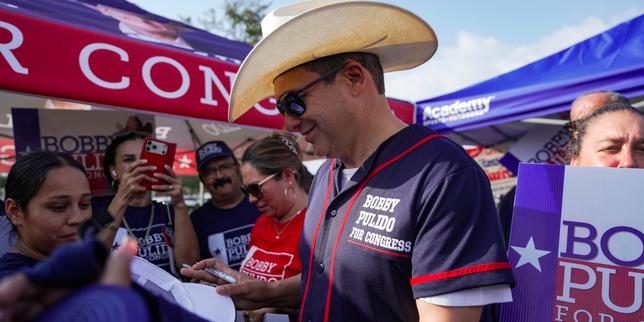
Political pundits love a simple fairy tale. A Tejano music icon steps off the stage, grabs a microphone at a campaign rally, and coasts to victory in the 2026 United States midterm elections on name recognition alone. That narrative, pushed heavily by international outlets like Le Monde in their coverage framing Bobby Pulido's triumph as an "improbable victory" for a Tex-Mex star, misses the entire structural reality of South Texas politics.
Calling Pulido’s win improbable reveals a fundamental blind spot among coastal and European commentators. They look at a Latin Grammy winner from Edinburg, Texas, and see a celebrity novelty act. Voters in the Rio Grande Valley saw something entirely different. They saw a native son who understood their economic anxieties, spoke their literal and cultural language without consulting a focus group, and bypassed the exhausted playbook of national political consultants.
To understand why Pulido succeeded where traditional candidates stalled, you have to strip away the glitter of his music career and look at the cold mechanics of regional political alignment.
The Myth of the Celebrity Shortcut
The lazy consensus in political journalism treats celebrity candidacies as pure vanity projects that rely on low-information voters recognizing a famous face on a ballot. While name recognition solves the initial awareness hurdle, history shows it rarely closes the deal in competitive congressional or state-level races.
Consider the graveyard of high-profile entertainers who assumed fame translates automatically into votes. From musicians to actors who entered races with massive media footprints, the pattern is consistent: celebrity gets you on the evening news in week one, but by week ten, voters demand to know what you will do about property taxes, border infrastructure, and healthcare costs. If the substance is missing, the novelty curdles into resentment.
Pulido avoided that trap because his public persona was never built on distant Hollywood glamour. For three decades, Tejano music has functioned as a hyper-local, blue-collar industry. Unlike pop stars insulated by private jets and publicists, Tejano artists build careers by playing county fairs, dance halls, and community festivals across South Texas. Pulido spent years shaking hands with the exact working-class families who make up the decisive voting bloc in the region. He did not need to introduce himself to the electorate because he had been part of their weekend lives for thirty years.
Why International Media Missed the Real Story
When foreign outlets frame a South Texas election around the novelty of a "Tex-Mex star," they flatten a complex demographic shift into a colorful human-interest piece. According to political analysts who track the Rio Grande Valley, the region has undergone a dramatic ideological realignment over the past decade.
For generations, South Texas was treated as a guaranteed stronghold where national party operatives could parachute in during October, run a few Spanish-language radio ads, and expect automatic turnout. That era ended when voters in border communities began prioritizing economic mobility, energy sector jobs, and border security over traditional party loyalty.
Pulido’s campaign capitalized on this friction. Rather than running as a creature of the national party apparatus, he positioned himself as an independent-minded regional advocate. Political strategists in Texas have noted that voters in districts like Texas’s 15th—and surrounding South Texas jurisdictions—increasingly punish candidates who sound like they are reading talking points written in Washington, D.C. Pulido’s background gave him built-in credibility as someone rooted in the Valley rather than beholden to outside donors.
Cultural Fluency Versus Pandering
National political campaigns spend millions trying to manufacture authenticity. I have watched consultants burn through massive budgets on poorly translated campaign mailers and awkward photo ops at local taco stands, convinced that surface-level cultural nods will secure Hispanic votes. It almost always backfires because voters can spot calculated pandering immediately.
Pulido possessed what money cannot buy: genuine cultural fluency. In South Texas, identity is not a monolithic demographic box. It is a specific blend of Tejano heritage, multigenerational American roots, Catholic social values, and fierce economic pragmatism.
- Language as trust: Switching effortlessly between English and Spanish in a unscripted town hall signals shared lived experience, not a rehearsed outreach strategy.
- Economic realism: Voters in border counties deal daily with the realities of cross-border trade, agricultural water rights, and law enforcement strain. A candidate who grew up navigating those realities speaks with natural authority.
- Institutional skepticism: After years of feeling ignored between election cycles, South Texas residents respond to candidates who treat the region as home rather than a battleground metric.
The Structural Vulnerability of Career Politicians
If Pulido’s victory looks shocking from the outside, it is only because observers overestimate the strength of traditional career politicians in 2026. Voters across the ideological spectrum have grown deeply cynical toward polished lifelong operatives who move seamlessly from legislative staff jobs to lobbying firms and back onto the ballot.
In a head-to-head matchup, a career politician brings a paper trail of compromises, donor obligations, and scripted evasions. An outsider with deep community roots brings a clean slate and an ability to communicate like a normal human being.
However, there is a distinct catch to the outsider advantage that supporters often overlook. Winning an election on regional authenticity and anti-establishment frustration is vastly easier than governing once the celebratory music stops.
The Governance Trap Ahead
The very qualities that make a cultural figure attractive on the campaign trail—independence from party bosses, blunt rhetoric, and a lack of legislative baggage—become liabilities inside a rigid legislative body. Without seniority or deep institutional alliances, a newcomer faces an uphill battle securing committee assignments, directing federal infrastructure dollars back to South Texas, or advancing complex water and trade legislation.
Voters who backed Pulido because he was not a typical politician will quickly judge him by traditional metrics: job growth, border stability, and cost of living. If he fails to translate cultural resonance into tangible legislative results, the same electorate that embraced him as an authentic champion will treat him as just another politician who overpromised.
Rethinking Political Viability in 2026
The broader lesson from South Texas has nothing to do with music charts and everything to do with how modern campaigns fail. Political operatives remain obsessed with demographic targeting—slicing the electorate into racial, age, and income brackets and feeding each group algorithmic messaging.
Pulido’s race demonstrated that geographic and cultural belonging overrides demographic modeling. Voters do not experience their lives as data points in a party strategist's spreadsheet. They experience their lives through their neighborhoods, their local economies, and the people who actually show up when cameras are not rolling.
Political analysts who dismissed Pulido at the start of the cycle made a classic error: they confused a lack of traditional political credentials with a lack of political capital. In communities where trust in institutions has collapsed, thirty years of genuine cultural connection is the strongest currency on the ballot.
Stop asking how a Tex-Mex singer managed to win a major American election. Start asking why professional politicians have become so disconnected from the people they claim to represent that an outsider had to step onto the stage to do their job for them.


