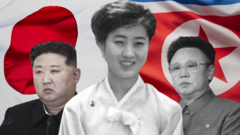
The stability of the North Korean regime relies on a single domestic monopoly: the exclusive right to political power via the Baekdu bloodline. This state-manufactured lineage constructs a divine mandate around the descendants of Kim Il Sung, framing them as the ultimate arbiters of anti-Japanese resistance and pure Korean sovereignty. Yet, the biological reality of the current supreme leader, Kim Jong Un, introduces a critical structural defect into this narrative. His biological mother, Ko Yong Hui, possesses a genealogy that contradicts every foundational pillar of the state's founding mythology.
To preserve institutional stability, the regime must execute a total domestic erasure of Ko’s identity. Within North Korea, she has no public name, no verifiable history, and no face. She exists exclusively as an abstracted construct—"The Mother of Great Songun Korea"—because revealing her concrete biography would expose the ruling executive to a profound systemic vulnerability. This dynamic is not a matter of familial preference; it is a calculated risk-mitigation strategy designed to prevent the collapse of the state's ideological infrastructure. Recently making waves in related news: Inside the French Mortuary Crisis Everyone is Ignoring.
The Tripartite Songbun Constraint
The primary mechanism governing social stratification, resource allocation, and political trustworthiness in North Korea is the songbun system. Established in the late 1950s, this matrix classifies citizens into three primary strata based on the actions of their paternal ancestors during the Japanese colonial period and the Korean War: the loyal core class, the wavering class, and the hostile class.
Ko Yong Hui’s genealogy places her at the absolute absolute nadir of this structural hierarchy due to three distinct variables. Further insights regarding the matter are explored by NPR.
[Ko Yong Hui Genealogy]
       │
       ├── Variable 1: Zainichi Status (Geographic Detachment)
       ├── Variable 2: Imperial Military Collaboration (Maternal Grandfather)
       └── Variable 3: Post-War Smuggling (Criminal Record)
- Geographic Detachment (Zainichi Status): Ko was born in 1952 in the Tsuruhashi district of Osaka, Japan, making her a Zainichi Korean (an ethnic Korean resident in Japan). Under the songbun architecture, returnees from the mass repatriation program initiated in 1959 were structurally classified within the hostile or lower-wavering echelons. The regime systematically viewed these individuals with acute suspicion, treating them as potential vectors for capitalist contagion, espionage, and foreign subversion.
- Imperial Military Collaboration: Her father, Ko Gyon Tek, was employed at a sewing and munitions factory overseen by the Imperial Japanese Ministry of War during World War II. For a state that derives its foundational legitimacy from a fierce, perpetual anti-Japanese guerrilla narrative, having a maternal grandfather who actively produced uniforms or matériel for the occupying imperial forces is an irreconcilable ideological contradiction.
- Post-War Criminal Record: Following the partition of the peninsula, Ko Gyon Tek engaged in maritime smuggling operations between Japan and South Korea. His subsequent arrest by South Korean authorities and threat of deportation from Japan precipitated the family's flight to North Korea in 1962. A lineage featuring an illegal emigrant, a collaborator, and a transnational smuggler represents the lowest imaginable quality index within the songbun system.
The core systemic risk is an asymmetry of accountability. If a standard North Korean citizen possessed a fraction of Ko's negative songbun, their entire extended family would face immediate generational relegation to manual labor sectors or political prison camps like Yodok. The regime cannot reconcile the execution of absolute domestic terror based on ancestral history with the reality that the supreme leader is himself the product of a compromised lineage.
The Asymmetry of the Baekdu Narrative
The preservation of absolute power in Pyongyang requires the maintenance of a highly specific ideological equilibrium. The regime justifies its hereditary succession by weaponizing a closed logical loop: leadership belongs exclusively to the Baekdu bloodline because that bloodline is uniquely pure and revolutionary; the bloodline is pure and revolutionary because it remains untouched by foreign or treasonous contamination.
       ┌─────────────────────────────────────────────────────────┐
       ▼                                                         │
[Baekdu Bloodline Legitimacy] ──► [Absolute Pure/Revolutionary] ─┘
       │
       ▼ (Contaminated by)
[Ko Yong Hui Biography] ──► [Systemic Myth Instability]
Exposing Ko Yong Hui’s real identity forces an irrecoverable collapse of this loop. The state relies on the historical narrative of Kim Jong Suk—the first wife of Kim Il Sung and maternal matriarch of the regime—who is mythologized as a rifle-bearing guerrilla fighter who battled Japanese forces in the wilderness. Ko Yong Hui, by contrast, arrived in North Korea at age ten via a Japanese transport ship, grew up in the relative luxury of a repatried community, and achieved prominence as a dancer in the Mansudae Art Troupe before catching the eye of Kim Jong Il in 1972.
The structural contrast creates a critical bottleneck for state propagandists:
- The Anti-Japanese Paradox: The state cannot claim absolute moral authority based on the eradication of Japanese influence while its leader is the grandson of an Imperial Japanese military factory worker.
- The Origin Myth Contamination: The holy status of Mount Baekdu cannot absorb a lineage traced back to the urban enclaves of Osaka without destabilizing the metaphysical foundation of the state's pseudo-religious authority.
- The Consort Problem: Ko was never the official, publicly acknowledged wife of Kim Jong Il; she was one of multiple consorts in a highly fractured domestic ecosystem. Elevating her to the status of a state matriarch invites internal scrutiny from the elite regarding the legitimacy of Kim Jong Un over his older half-brother, the late Kim Jong Nam, whose mother also possessed a complicated background.
Strategic Information Containment and Institutional Risk
To mitigate this legitimacy deficit, the state operates a policy of total informational containment. This strategy has evolved through distinct operational phases, demonstrating the regime's acute awareness of the threat.
In 2002, as Kim Jong Il began weighing succession scenarios, the Korean People's Army launched a highly insulated internal cult of personality dedicated to Ko, utilizing internal propaganda documents and a film titled The Great Mother of Military-First Korea. This media praised her as a loyal subject but omitted her name, birth year, and geographical origin entirely. Following Kim Jong Il's stroke in 2008 and the subsequent acceleration of Kim Jong Un's succession timeline, these internal campaigns were abruptly halted.
The rationale behind the sudden cessation reveals the underlying risk function. While the inner circle of the Workers' Party and senior military cadres could be exposed to a sanitised, nameless version of the mother to validate her proximity to power, any wider dissemination risked leaking the truth to the general populace. By 2015, security organs actively recalled and destroyed remaining copies of the internal documentary. The threat matrix had shifted: with the rapid proliferation of illicit Chinese cellular networks and cross-border smuggling of flash drives along the Yalu and Tumen rivers, the probability of a citizen connecting the "Great Mother" to her Osaka roots approached an unacceptable threshold.
The domestic cost of an information failure here is severe. If the general population recognizes that the supreme leader’s maternal family was composed of individuals who would normally be exiled to remote mining provinces, the moral authority undericg the state's entire penal and social hierarchy dissolves. The state maintains obedience by enforcing the absolute reality of its myths; if the foundational myth is exposed as a fabrication designed to hide a Zainichi smuggler’s lineage, the psychological compliance mechanism of the populace is profoundly compromised.
The Transition to Direct Descendant Matrilineal Validation
The inability to leverage his mother for ideological consolidation has forced Kim Jong Un to pivot to an alternative structural strategy for long-term dynastic continuity. This explains the highly irregular, visible elevation of his daughter, Kim Ju Ae.
Because Kim Jong Un cannot anchor his past to a legitimate, publicly state-sanctioned mother, he is hyper-compensating by anchoring his future directly to a visible, uncontaminated descendant. The prominent inclusion of his daughter in strategic state events—such as intercontinental ballistic missile tests and military parades—serves an explicit analytical function: it bypasses the historical vulnerability of his own maternal lineage by establishing an unambiguous, visible trajectory for the next generation of the Baekdu line.
This forward-looking validation mechanism attempts to construct a direct line of sight from Kim Il Sung through Kim Jong Il and Kim Jong Un down to the fourth generation, deliberately shifting the gaze of the elite and the populace away from the unresolvable biographical vacuum of the past. The strategic imperative is clear: when the history behind you is a structural liability, you must force the system to look exclusively at what lies ahead.