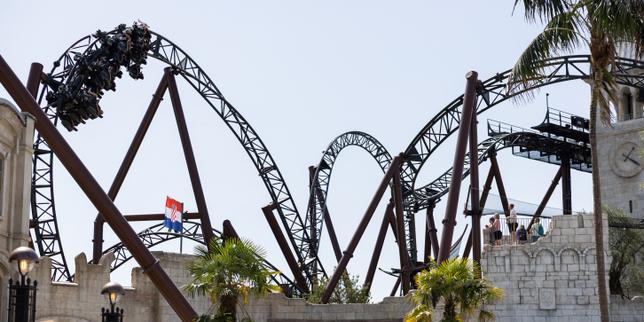
The scent of grease, sugar, and ozone doesn't just hang in the air at Europa-Park. It seeps into your skin. It is the smell of a century-old obsession.
Franz Mack didn’t start with a dream of roller coasters. He started with wood and iron. In the 1920s, the Mack family was already synonymous with the engineering of movement, building stagecoaches and circus wagons in a small workshop in Waldkirch. They were the people who made the world move. But it was in 1975, in the sleepy village of Rust, that the dynasty decided to stop just building the rides and start owning the ground they stood on.
They were told it would fail. Experts looked at the swampy Rhine valley and saw a graveyard for capital. The Macks saw a laboratory.
The Weight of the Crown
Roland Mack often speaks with the measured precision of a man who knows exactly how many bolts hold a Silver Star train together. But look closer at the way the family operates, and you see something more primal than engineering. This is a monarchy of the midway.
In most corporate structures, a CEO answers to a board of directors who answer to shareholders who only care about the next fiscal quarter. The Macks answer to their ancestors and their descendants. This vertical pressure changes how you think. You don't build a ride to recoup costs in three years; you build a landmark that your grandson will maintain in forty.
Every morning, the family—Roland, Jürgen, Michael, and Thomas—walks the park. They aren’t looking for spreadsheets. They are looking for the way a child’s eyes light up at the entrance of the "Arthur" ride, or the slight delay in a server’s smile at one of the park's six themed hotels. This is the "Mack way." It is an exhausting, relentless pursuit of a perfection that doesn't actually exist, but the chasing of it is what has made them the second most popular theme park in Europe, trailing only the deep-pocketed American giant in Marne-la-Vallée.
The Border as a Canvas
Rust is a village that should be quiet. Instead, it is the heartbeat of a cross-border empire. The proximity to the French border isn't just a geographic convenience; it’s the park's soul.
Think about the Rhine. For centuries, it was a barrier, a line of defense, a scar between two nations that couldn't stop fighting. The Mack family treated that river like a bridge. They didn't just market to the French; they integrated French culture into the very fabric of the park. When you walk through the "Quartier Français," you aren't seeing a caricature. You are seeing a love letter.
This cross-border synergy is why the family is currently pushing for a cable car project that would link Germany and France. It isn't just about moving people from point A to point B. It’s a statement of European unity that politicians talk about but the Macks actually build. They are effectively erasing the border with a steel cable and a gondola.
However, building a dream across international lines isn't as easy as laying track. It involves navigating two different bureaucracies, two different sets of environmental laws, and the local anxieties of residents who worry their quiet sky will be sliced by tourists in transit. The Macks don't just fight these battles with lawyers. They fight them with the sheer momentum of their history.
The Rulantica Gamble
For decades, Europa-Park was a seasonal beast. You opened in the spring, you raked in the summer sun, you did a spooky October, and you shut down while the frost bit the tracks. But the modern world doesn't like waiting.
Rulantica, their massive indoor water world, was the family’s $200 million bet against the weather. It was a pivot from being a theme park to being a "resort destination." If you build a massive, Nordic-themed water cathedral, people will come even when the German winter is gray and biting.
The risk was staggering. If Rulantica had flopped, the dynasty would have been bruised, perhaps even fractured. Instead, it became the anchor. It proved that the "Made by Mack" brand could transcend the traditional roller coaster. It was a masterclass in diversification, executed with the kind of capital that only a family-owned business can stomach. They didn't need to ask permission from a bank to take the leap. They just looked at each other and jumped.
The Invisible Stakes of Innovation
We often talk about "innovation" as if it’s a clean, digital process. For the Macks, innovation is messy. It’s heavy. It’s Mack Next, their digital and creative arm, trying to figure out how to make Virtual Reality (VR) work on a moving coaster without making the riders vomit.
Consider the "Eatrenalin" experience. It’s a futuristic restaurant where the chairs move you through different sensory environments. It’s absurd. It’s expensive. It’s arguably unnecessary. But that is exactly why it is vital. The Macks understand that in the 21st century, you aren't competing against other parks. You are competing against the couch. You are competing against Netflix and the high-definition screens in everyone’s pockets.
To win, you have to offer something physical that cannot be replicated. You have to offer the stomach-flip of a 70-meter drop and the tactile sensation of a moving floor while you eat a five-course meal. You have to be more real than reality.
The Friction of Growth
Growth is never a straight line. As the Mack dynasty expands, they hit the limits of the land. Rust is full. The surrounding forests are protected. The French side of the border is open, but it comes with the weight of "expansionism."
Local critics exist. They aren't villains; they are people who remember when Rust was just a farming village where everyone knew their neighbor’s name. Now, their neighbor is a 13-story hotel shaped like a lighthouse. The Macks have to balance the hunger of their empire with the heart of their home. They have to convince the locals that the park isn't a parasite, but a heart that pumps blood—and money—into the entire region.
They do this by staying local. You will see the Macks at the local bakery. You will see them at the village festivities. They haven't retreated into a gated estate. They live in the middle of the machinery they built.
The Engine of Succession
The most dangerous moment for any dynasty isn't a market crash or a global pandemic. It is the handover.
We have seen it a thousand times: the founder builds the mountain, the son maintains it, and the grandson sells it to a private equity firm that strips it for parts. Roland Mack knows this. He is the bridge between the founding grit of Franz and the digital ambition of Michael and Thomas.
The transition is happening in real-time. Michael is pushing the park into film production and digital gaming. Thomas is obsessed with the culinary and hotel experience. They are dividing the kingdom to save it.
But there is a tension there. The older generation’s "gut feeling" vs. the younger generation’s "data-driven" approach. It’s a classic friction, but in Rust, it plays out over a canvas of millions of visitors and billions of euros. If they get it wrong, the second-largest park in Europe becomes a relic of the 20th century. If they get it right, they become the blueprint for how family businesses survive the digital age.
The Last Bolt
Think about a roller coaster for a moment. It is a series of controlled falls. You are held in place by a harness, but for a split second at the top of the lift hill, you feel the weightlessness. You feel the terror of the unknown.
The Mack family is currently at the top of that lift hill. Behind them is a century of success, of wagons and wood and the first loop-de-loops. In front of them is a landscape of changing climate, shifting demographics, and a world that is increasingly allergic to "physical" experiences.
They are leaning forward.
They aren't just selling rides. They are selling the idea that a family, through sheer force of will and a lot of steel, can carve a kingdom out of a swamp. They are selling the belief that the future belongs to those who aren't afraid to get their hands dirty with the grease of the machinery.
The sun sets over the peaks of the Blue Fire Megacoaster, casting long, jagged shadows across the Rhine. The park grows quiet for a few hours, the neon lights flickering as the last of the crowds trickle out. But in the offices, in the workshops, and in the kitchens, the lights stay on. The Macks are still awake. They are already planning for the day after tomorrow, because when you own the ground, you never really stop building.
The dynasty isn't a fixed thing. It’s a moving target. And as long as there is a Mack at the helm, the wheels will keep turning, the cables will keep pulling, and the dream of expansion will remain as relentless as gravity.