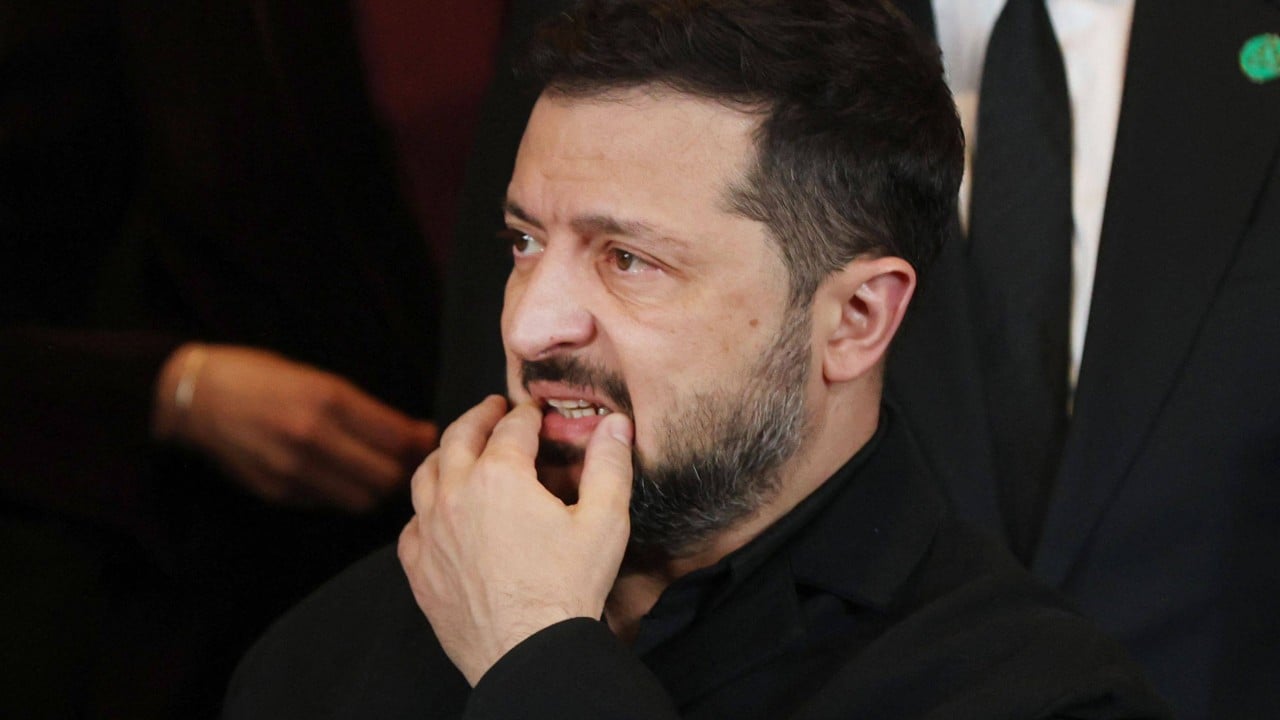
Every winter, the coverage around Ukraine’s electrical grid falls into the exact same trap. A high-profile warning drops—this time, Ukrainian President Volodymyr Zelensky cautioning that restrictions on SpaceX’s Starshield satellite network threaten Ukraine’s winter energy defenses—and the commentary class immediately frames the entire crisis as a simple tug-of-war over Silicon Valley permissions.
That framing is lazy. It mistakes a symptom for the disease. Discover more on a connected topic: this related article.
Treating commercial satellite access as the primary determinant of whether a national power grid survives kinetic bombardment ignores how air defense networks, low-Earth orbit (LEO) constellations, and modern electrical grids actually fail. When coverage reduces a multi-layered industrial and military problem to a single vendor policy debate, it obscures the structural vulnerabilities that matter far more when temperatures drop below freezing.
What the Conventional Narrative Gets Wrong
According to reports citing Zelensky’s warnings, limits placed on Starshield—the militarized, hardened sibling of SpaceX’s commercial Starlink service—risk degrading the real-time communications needed to coordinate air defenses protecting power plants and substations. The mainstream takeaway is straightforward: unrestricted satellite connectivity equals intact transformers; restricted connectivity equals blackouts. More journalism by MIT Technology Review explores comparable perspectives on the subject.
In defense engineering, single-point-of-failure thinking is fatal. Relying on any single private aerospace contractor to serve as the irreplaceable nervous system of sovereign critical infrastructure was always a precarious stopgap, not a sustainable doctrine.
To understand why, you have to separate what Starshield actually does from what commentators assume it does.
- Starlink is a commercial broadband constellation designed for high-throughput consumer and enterprise data. Its terminals are widely deployed across Ukrainian units for tactical communications, drone feeds, and command-and-control.
- Starshield is a government-focused architecture built on Starlink’s bus and launch cadence, incorporating stronger cryptographic encryption, hosted payloads, and tighter operational security tailored for defense agencies like the U.S. Department of Defense and the National Reconnaissance Office.
Neither system intercepts incoming ballistic missiles or one-way attack drones. They move data. When an air defense battery tracks an incoming cruise missile heading toward a 750-kilovolt substation, the terminal provides the backhaul link connecting radar sensors, command posts, and firing units.
Blaming operational restrictions on that link for winter grid vulnerability overlooks three harder truths:
- Jurisdictional and legal boundaries are inherent to U.S. defense hardware. Starshield operates under U.S. government contracts and International Traffic in Arms Regulations (ITAR). SpaceX does not unilaterally flip switches on sovereign military payloads without Pentagon oversight and legal authorization. Expecting a U.S. defense contractor to operate outside Washington’s export-control and rules-of-engagement frameworks misunderstands how American defense procurement works.
- Electronic warfare degrades LEO terminals regardless of policy. Russian electronic warfare (EW) units have spent years refining jamming and spoofing techniques against satellite uplinks and downlinks along the front lines and around high-value targets. Even with zero policy restrictions, contested electromagnetic spectrum remains an active barrier.
- Interceptor math is more decisive than bandwidth. If a mobile fire team or air defense battery lacks enough surface-to-air missiles, anti-aircraft ammunition, or interceptor drones to match the volume of a saturation strike, pristine satellite connectivity simply gives commanders a clearer view of an impact they cannot stop.
The Structural Reality of Grid Defense
I have watched major infrastructure operators burn millions on redundant communications gear while leaving their core physical assets exposed to basic single-point failures. In telecom and energy engineering alike, teams love buying shiny telemetry and command-and-control upgrades because software and terminals deploy in weeks. Hardening physical grid architecture takes years and massive capital.
Ukraine’s energy sector faces an asymmetric engineering problem that no satellite constellation can solve on its own.
The Autotransformer Bottleneck
Soviet-era high-voltage transmission grids rely heavily on massive autotransformers to step power down from 750 kV and 330 kV transmission lines to regional distribution networks. These units weigh hundreds of tons, contain tens of thousands of liters of insulating oil, and are custom-manufactured on lead times that often stretch beyond twelve months.
When a drone or missile strikes an unshielded transformer yard, the damage is physical and immediate. Whether the air defense network had restricted or unrestricted Starshield access five minutes prior changes nothing about the replacement timeline for specialized high-voltage winding equipment.
Centralized Generation vs. Distributed Resilience
A grid built around a handful of large thermal and hydroelectric power plants presents fixed, unmoving coordinates. Attackers do not need real-time satellite reconnaissance to find a concrete dam or a coal-fired power station built in the 1970s.
True winter grid resilience comes from decentralization: smaller gas-turbine generators, modular combined heat and power (CHP) units, and microgrids that can island themselves when high-voltage transmission lines drop. If your energy architecture requires zero strikes getting through an air defense umbrella to keep hospitals and heating pumps running, your grid design has already lost.
Dismantling the Real Questions Behind the Headlines
When readers search for news on Starshield restrictions and Ukraine’s winter defenses, they are usually trying to answer a few core questions. Most mainstream coverage answers them poorly because it treats complex military-industrial trade-offs as simple political soundbites.
Why would Starshield have geographic or operational restrictions in the first place?
Because sovereign governments do not hand blank checks over strategic dual-use technology to any partner, ally or otherwise. Under U.S. law, defense services and space-based reconnaissance or communications architectures are tightly bound by national security directives, escalation management policies, and contractual scopes defined by the Pentagon. Furthermore, geofencing and terminal authentication exist to prevent captured hardware from being reverse-engineered or used by adversary forces on the battlefield.
Can European or domestic alternatives replace Starshield for air defense networks?
Not overnight, and not on a one-to-one basis. Europe’s IRIS² constellation remains years away from full operational capability. Existing geostationary (GEO) satellites like Viasat or Eutelsat offer high capacity over fixed regions, while OneWeb provides LEO coverage, yet none currently match SpaceX’s combination of low latency, terminal portability, jamming resistance, and sheer satellite density.
However, framed properly, air defense networks inside Ukrainian territory do not always need LEO satellite backhaul. Fixed energy infrastructure sits inside sovereign territory where buried fiber-optic cables, hardened microwave relays, and encrypted VHF/UHF tactical mesh radios can operate without relying on orbital relays.
What actually determines whether the lights stay on this winter?
Three variables outweigh satellite policy every single time:
- Interceptor supply depth: Having enough IRIS-T, Patriot, NASAMS, Gepard, and interceptor-drone munitions to defeat massed salvos.
- Physical fortification: Concrete blast walls, gabion cages, and underground bunkers shielding critical substation components from shrapnel and blast overpressure.
- Spare part inventories: Pre-positioned reserves of transformers, circuit breakers, and switchgear stored outside targeted facilities so repair crews can restore power in days rather than months.
How Defense Planners Should Actually Approach Communications Resilience
If you want an air defense network that cannot be crippled by a single contractor's terms of service or a sudden change in orbital permissions, you stop treating LEO constellations as primary infrastructure for static sites.
- Reserve LEO terminals for mobile and expeditionary units. Mobile air defense teams hunting Shahed-type drones across rural corridors genuinely need low-latency satellite links because they move constantly across areas without reliable cellular or fiber coverage. Static defense rings around major power plants do not.
- Bury fiber-optic rings around critical substations. Fiber-optic lines buried below frost and blast depth are immune to RF jamming, invisible to electronic intelligence, and completely independent of foreign commercial constellations. Connecting stationary radar sites and command posts via redundant underground fiber eliminates orbital dependency for fixed-site defense.
- Deploy hybrid mesh backhaul. Layering line-of-sight tactical radios, cellular fallback with hardened backup power, and multi-orbit satellite terminals (combining LEO and GEO providers) ensures that no single point of failure—technical or political—can blind an air defense sector.
The Uncomfortable Trade-Off Nobody Wants to Admit
There is an obvious downside to decoupling air defense backhaul from Starshield: it is slower, heavier, and far less convenient.
Commercial and militarized LEO terminals became ubiquitous in Ukraine precisely because they bypassed decades of bureaucratic procurement and civil engineering. You set a flat-panel dish on a roof, plug it into a generator, and within minutes you have encrypted broadband that would otherwise take months of trenching fiber or erecting microwave towers to replicate.
Walking back that convenience means accepting higher upfront logistics burdens, heavier equipment footprints for signal units, and lower bandwidth ceilings on fallback radio networks. It requires spending money on unglamorous civil engineering—trenching cables, pouring concrete, and stockpiling transformers—rather than relying on a silver-bullet tech platform.
Yet convenience is not a strategy. History shows that whenever a military or utility builds its survival around proprietary infrastructure controlled by an external actor, friction over usage limits is inevitable. Zelensky’s warning highlights a real operational headache for Ukrainian commanders managing contested airspace under extreme pressure, just as U.S. defense officials face genuine legal and strategic constraints over how American space architectures are deployed.
Treating Starshield restrictions as the central threat to Ukraine’s winter grid gets the hierarchy completely backward. Satellite links are only one fragile thread in a much larger industrial contest—and until physical hardening, interceptor stockpiles, and decentralized generation carry the primary load, no orbital network will ever guarantee a warm winter.