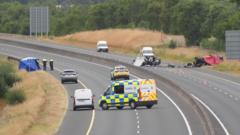
The Convenient Scapegoat
Every time a vehicle hurtles down the wrong carriageway and ends in a mangled wreck, the playbook is identical. The headlines scream about blue lights and sirens. Watchdog bodies issue stern reports about radio protocols and risk assessments. Activists dust off their talking points about aggressive policing, arguing that if officers simply stayed home, the danger would evaporate.
It is a comforting narrative. It turns a chaotic breakdown of human behavior into a bureaucratic checklist error.
Let us be brutally clear from the opening bell. Blaming the police for initiating a pursuit when a motorist chooses to drive the wrong way down a high-speed motorway is like blaming the thermometer for a fever. The pursuit does not create the danger. The fugitive already crossed that Rubicon the second they pointed their bumper into oncoming traffic.
When Ireland's Garda Síochána Ombudsman Commission steps in to dissect whether officers followed every procedural comma before a fatal wrong-way collision, they are asking a fundamentally useless question. They are examining whether the cops checked their mirrors while a freight train was already barreling down the tracks.
The lazy consensus is that backing off saves lives. The operational reality on the asphalt is far darker, far messier, and completely contrary to what the safety committees want to admit.
The Physics of Lawlessness
To understand why the policy of mandatory disengagement fails, you have to look past the press releases and study the psychology of people who flee.
I have spent years analyzing high-risk tactical interventions and traffic enforcement failures. When a driver makes the choice to travel against the flow of traffic on a multi-lane motorway, they are not having a momentary lapse in judgment. They are operating in an extreme state of antisocial panic, intoxication, or sheer malice.
The conventional argument from oversight bodies runs like this: If police disengage, the fleeing driver will calm down, slow to a sensible speed, and pull safely onto the hard shoulder.
This is a dangerous fantasy.
Imagine a scenario where a drunk or desperate driver tears northbound in the southbound lanes at one hundred and twenty kilometers per hour. A marked patrol car drops back two miles, turns off its lights, and coasts to a crawl. Does the wrong-way driver suddenly experience a wave of civic responsibility? Do they flip a U-turn across three lanes of high-speed traffic, roll down their window, and wait for a ticket?
Of course not.
Once a driver commits to the wrong side of a motorway, the presence of a police car behind them is entirely secondary to their own chaotic momentum. In fact, removing the police presence often removes the only containment mechanism left on the road. Without a rolling roadblock, warning flares, or active interdiction to clear or halt oncoming traffic downstream, the rogue vehicle becomes an unguided missile sailing through a dark room.
The Bureaucracy of Hesitation
Police bodies love rules because rules offer legal shelter. When an internal investigation asks whether an officer complied with Section 4B of the pursuit manual, they are shifting the burden of accountability away from the criminal who pressed the accelerator and onto the state employee trying to stop them.
This creates a culture of institutional paralysis.
Officers on the ground learn a toxic lesson: doing nothing keeps you out of the courtroom. Engaging aggressively means dealing with internal affairs, suspension threats, and media trials. So, safety policies drift toward passivity. We train cops to be witnesses rather than peacekeepers.
Let us dismantle the core premise of the anti-pursuit lobby. They argue that pursuits endanger innocent third parties. True. Every high-speed intervention carries residual risk. Driving a two-ton steel box at eighty miles per hour is inherently dangerous.
However, substituting a police pursuit with a passive monitoring strategy does not reduce risk. It transfers the risk directly onto completely random, unprepared motorists who have no warning that a lunatic is hurtling toward them out of the dark.
When officers are allowed to actively manage, box in, or terminate a threat early, the exposure window is measured in seconds. When departments rely on helicopters and distant tracking because ground units were ordered to fall back, the exposure window stretches into terrifying minutes. And on a motorway, minutes equal miles of carnage.
The Unspoken Cost of Standing Down
We need to talk about deterrence, a concept modern administrative agencies treat like a dirty word.
When word gets out that a police force has adopted a strict hands-off policy for wrong-way drivers or high-speed bailouts, the criminal underground adapts instantly. Word travels fast in car-theft rings and drug networks. If you can outrun the consequence simply by driving recklessly enough, reckless driving becomes your primary defensive strategy.
By tying the hands of patrol officers, oversight bodies inadvertently incentivize worse behavior. They send a clear, unintended signal: If you push the danger meter high enough, we will let you go.
That is not public safety. That is surrender wrapped in bureaucratic prose.
The solution requires throwing out the comfort blanket of absolute non-engagement policies and replacing them with a framework based on operational competence and tactical aggression.
- Empower Real-Time Interdiction: Give trained tactical units the authority to use controlled contact and precise immobilization techniques the moment a vehicle enters a wrong-way trajectory. Waiting for a disaster to unfold while maintaining a polite distance is not restraint; it is negligence.
- Redefine Accountability: Hold drivers one hundred percent liable for every meter of chaos they create. Stop entertaining defense arguments that blame police presence for provoking a suspect's flight.
- Invest in Infrastructure: Upgrade motorway warning systems with automated wrong-way detection loops that instantly flash overhead matrix boards, cutting down the reaction time for oncoming traffic long before a patrol car can catch up.
The Final Reckoning
The next time a tragic headline breaks about a motorway collision involving a fleeing vehicle, ignore the hand-wringing about police protocols. Look past the predictable calls for stricter oversight and restricted powers.
The problem is not that officers chased too hard. The problem is that we live in a system terrified of the friction required to keep order.
As long as we pretend that dangerous criminals will police themselves if we just turn off our sirens, the wreckage will keep piling up.
Stop managing the symptom. Confront the driver.


