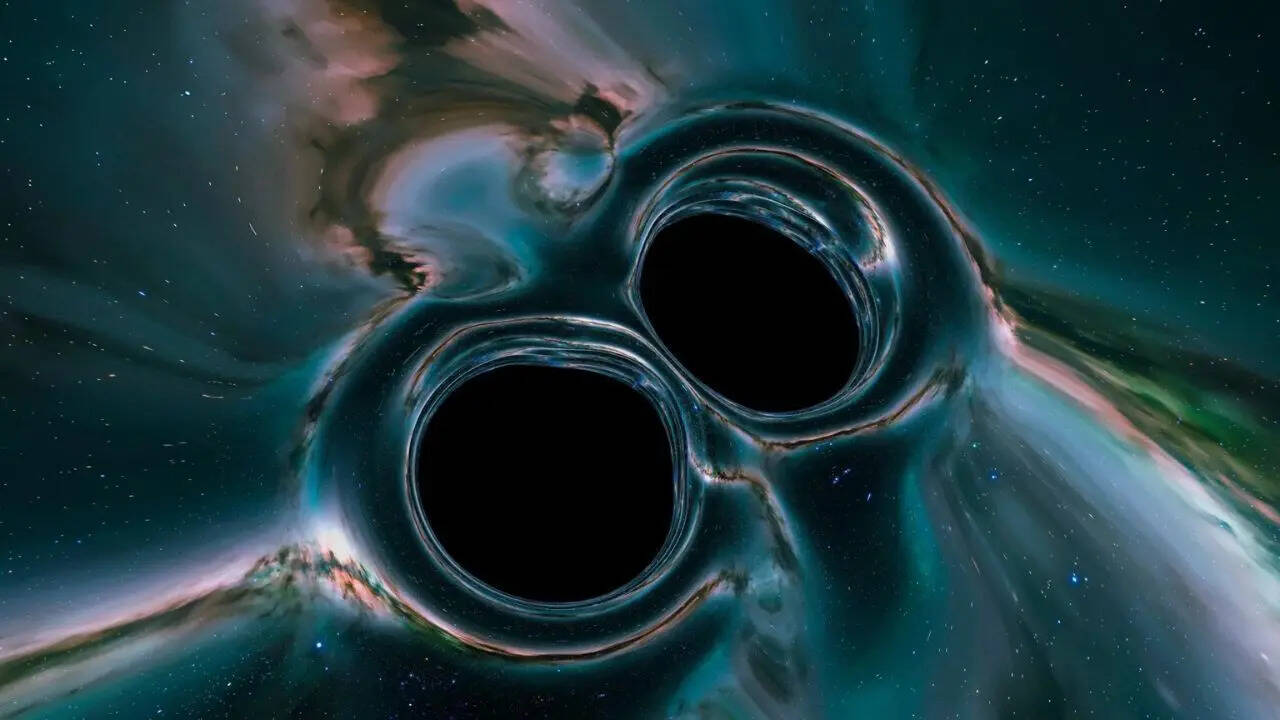
Black holes aren't just sitting there. For decades, we thought these gravity wells grew mostly by sucking in stray gas or swallowing an occasional star that wandered too close. It turns out that’s a small part of a much more violent story. Recent data from gravitational wave detectors like LIGO and Virgo suggests a "merger chain" is the real culprit behind the massive sizes we're seeing. If you want to understand how a black hole goes from a stellar-mass runt to a monster that anchors a whole galaxy, you have to look at the wreckage of cosmic collisions.
The violent math of the merger chain
Black holes come in different weight classes. You've got your standard stellar-mass ones, born from collapsing stars. Then you've got the supermassive giants at the centers of galaxies. There’s always been a weird gap in the middle. We call these Intermediate-Mass Black Holes (IMBHs). For a long time, they were the "missing link" of space. We couldn't find them, and we didn't know how they formed.
Now we know they’re the product of a brutal series of mergers. Think of it like a cosmic bracket tournament. Two black holes collide and form a bigger one. That new, heavier black hole then finds another partner and eats it, too. This keeps happening until the object is so massive it defies our old models of stellar evolution. You can't get that big just by eating gas. There isn't enough time in the history of the universe for a black hole to reach millions of solar masses by sipping on hydrogen. It has to eat its own kind.
Scientists at institutions like the University of Birmingham and Northwestern University have been tracking these "hierarchical mergers." The signal GW190521 changed everything. It was a bang that shouldn't have existed. One of the black holes in that merger was about 66 times the mass of our sun. According to stellar physics, stars shouldn't be able to leave behind a black hole in that specific mass range because of something called "pair-instability supernova." Basically, the star blows itself to smithereens and leaves nothing. Since that 66-solar-mass black hole existed, it wasn't born from a star. It was born from a previous merger. It's a second-generation monster.
Why the environment matters more than you think
Black holes don't just find each other in the empty void. Space is huge. If you put two black holes in the middle of nowhere, they’d likely never meet. They need a wingman. That wingman is usually a dense star cluster or the "active galactic nucleus" (AGN) disk.
In a dense star cluster, gravity does the heavy lifting. The heaviest objects sink to the center. It’s like a mosh pit where the biggest guys eventually bump into each other. Once they're close, they start a death spiral. They radiate energy away as gravitational waves, which are ripples in the fabric of space-time. As they lose energy, they get closer. Then—bang.
The AGN disk is even wilder. Imagine a giant, swirling pancake of gas and dust surrounding a supermassive black hole. Smaller black holes get caught in this disk like flies in honey. The gas creates drag, forcing these smaller black holes toward "migration traps." It’s a literal assembly line for monsters. They get shoved together by the gas, merge, and then wait for the next victim to slide down the line. It's efficient. It’s scary. And it explains why we see objects that shouldn't be possible.
The problem of the cosmic kick
Physics isn't always kind to these growing giants. When two black holes merge, they don't always do it symmetrically. If one is spinning faster or is much larger, the gravitational waves get blasted out more in one direction than the other. This creates a "recoil kick."
It’s basically a cosmic shotgun blast. The resulting black hole can be kicked out of its host cluster at speeds of thousands of kilometers per second. If the kick is too strong, the black hole gets yeeted into the empty intergalactic void. Once it's out there alone, the merger chain stops. It’s a dead end.
For a black hole to become a true cosmic monster, it has to stay in the game. It needs to be in an environment with enough gravity to hold onto it even after a massive kick. This is why the centers of galaxies are so important. They have the "escape velocity" required to keep these monsters local so they can keep feeding.
Why this matters for the future of astronomy
We used to look at the sky with just light. That's like trying to understand a concert by only looking at the shadows on the wall. Gravitational wave astronomy lets us hear the music. We're finally seeing the "dark" side of the universe that doesn't emit light.
Every time LIGO or the upcoming LISA mission (a space-based detector) picks up a chirp, we're witnessing a piece of this merger chain. We're seeing the growth spurts of the largest objects in existence. It’s messy and violent, but it’s the only way the math adds up.
If you're following this space, stop looking for "missing links." Start looking for the crowded places. The galactic centers and the globular clusters are where the action is. That's where the next generation of monsters is being built right now. You can track the latest detections through the LIGO Detection List to see the masses of these objects for yourself. Look for the ones in the "upper mass gap"—those are the ones that have already eaten a sibling or two.